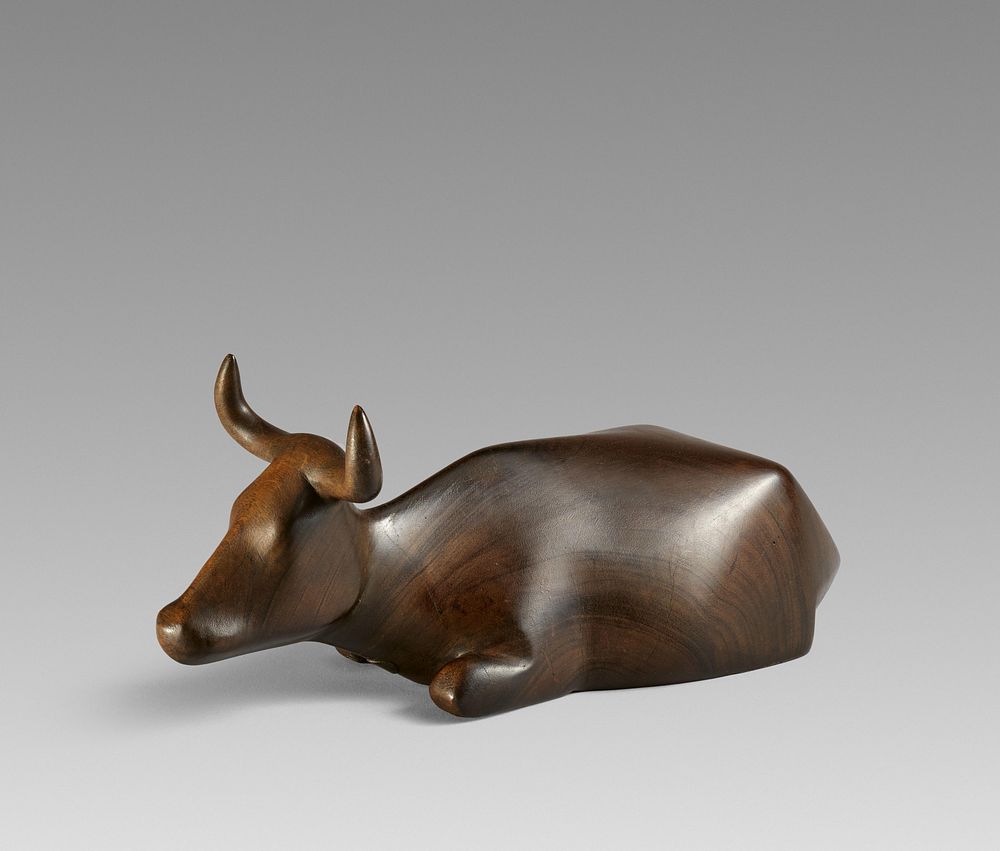
Bidspirit auction | Ewald Mataré: Liegende Kuh mit
Ewald Mataré: Liegende Kuh mit erhobenem Kopf - MATARÉ, EWALD 1887 Aachen - 1965 Büderich Title: Liegende Kuh mit erhobenem Kopf. Date: Ca. 1925. Technique: Amaranth wood. Measurement: 12 x 30 x 12cm. Notation: Artist's signet underneath. Provenance: - Julian Manheimer Collection, Zurich (presumably acquired directly from the artist) - Ruth Fischer Collection, San Francisco (from the previous owner by inheritance) - Private collection, California (from the previous owner by inheritance) Literature: - Schilling, Sabine Maja/Werd, Guido de: Ewald Mataré - Das plastische Werk, catalogue raisonné, vol. II, Cologne 2024, cat. rais. no. 34, no. ill. (here with incorrect provenance information provided by Sonja Mataré) - Cf. Schilling, Sabine Maja: Ewald Mataré - Das plastische Werk, catalogue raisonné, Cologne 1987, catalogue raisonné no. 29 (here listed as a bronze cast after a lost wooden original) - The sculpture had been considered lost for ages and had previously only been documented without an illustration - An absolute rediscovery in the artist's oeuvre - Carved from fine amaranth wood - With his sculptures from the 1920s, Mataré made a pioneering contribution to German art history - Wooden sculptures are very rarely offered on the international art market - they are almost exclusively in public collections From Mataré to VAN HAM The wooden sculpture ”Liegende Kuh mit erhobenem Kopf” (Reclining Cow with Raised Head) cannot be found in any of the exhibitions in which Mataré participated before the Second World War, neither in his exhibitions at the Secession in Berlin and the Novembergruppe in Berlin, nor in the solo exhibitions in Witten (1933) and Krefeld (1935), of which photographs of the rooms exist. The sculpture is also not recognisable in the sketches Hugo Kükelhaus made of the sculptures exhibited at the Nazi sales exhibition at Schönhausen Palace. The collector Julian Manheimer probably acquired the sculpture directly from Mataré. Manheimer was a well-known collector of old master prints, specialising in Dürer and Rembrandt. Prints from his collection still regularly appear at auctions today. Manheimer also owned a collection of expressionist prints. When he moved to Switzerland, he was able to take his art collection and this sculpture with him. Julian Manheimer was born on 10 October 1871 in Posen. In Berlin, he managed the Wittkowsky wood industry company, which was founded in 1903 and specialised in birch woodwork for the aircraft, suitcase and automobile industries. In the 1930s, he emigrated to Switzerland and died in Zurich in 1947. His only daughter, Ruth Fischer, a dancer, inherited his collection. In the 1930s, she emigrated from Balboa, Panama, to the United States, where she settled in San Francisco and applied for citizenship with her husband Siegfried Fischer in 1939. After their divorce, she resumed using her stage name Ruth Reinheimer. She worked in San Francisco in a jewellery shop owned by the mother of the current owner. After the two became friends, Ruth Fischer left her all her artworks, including Mataré's ‘Reclining Cow with Raised Head’, upon her death in 1987. Her son, now 95 years old, has owned the cow ever since and has turned to VAN HAM for its sale. A sculpture of great rarity ”Liegende Kuh mit erhobenem Kopf” is one of the few wooden sculptures from Mataré's early work that is still in private ownership. Mataré kept his wooden sculptures for a long time. They served as models for his bronze casts, most of them are in public ownership. The sculpture dates from the mid-1920s, a very productive phase in Mataré's work. Trained as a painter at the Berlin University of the Arts, Mataré discovered woodcut in the early 1920s, inspired by pieces of driftwood he found on the beach, into which he carved motifs with a pocket knife, initially under the influence of Expressionism. In 1922, he found his way to sculpture via bas-relief. Even his first sculptures were made from special wood. During his long summer stays on the North Sea and Baltic Sea coasts, he was fascinated by cows in their different postures, especially because of the calmness they radiated when lying, standing or crouching. In order to capture this calmness in his sculptures, he used a very reduced formal language. His working method was as slow as it was careful. In 1924, he acquired a large block (weighing 750 pounds) of exotic, Indian (very hard) amaranth wood in Hamburg, which he used for a few sculptures. The grain of the wood also played an important role, as in our cow, where it emphasises the animal's reclining posture in a flat curve. The works from this block of wood include reclining cows and a rooster. Stylistically, these works form a unity. On 5 July 1924, Mataré wrote about the wood in his diary: ‘Now I have carved a cow in it, with great physical effort, because it is very hard and my tools are very limited.’ He suffered tendonitis while working,