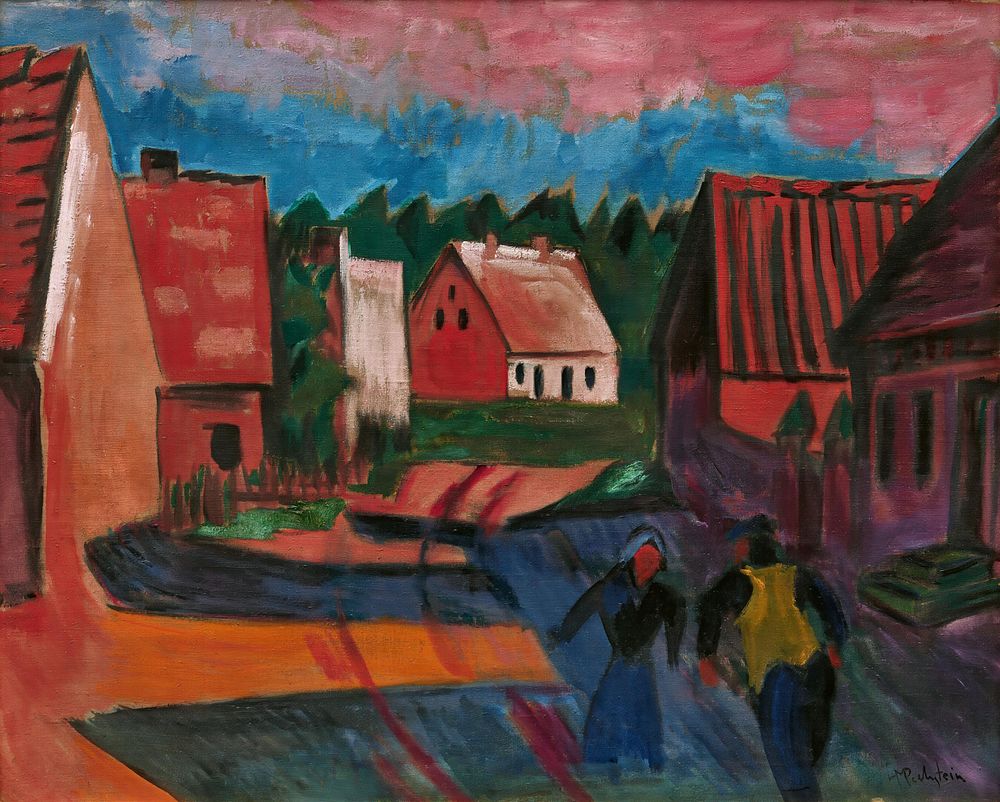
Bidspirit auction | Hermann Max Pechstein: Dorfhäuser
Hermann Max Pechstein: Dorfhäuser - PECHSTEIN, HERMANN MAX 1881 Zwickau - 1955 Berlin Title: Dorfhäuser. Date: 1921. Technique: Oil on Canvas. Mounting: Relined. Measurement: 80,5 x 100cm. Notation: Signed lower right: HMPechstein. Frame/Pedestal: Craftman's frame. The work was doubled by Lilienfeld. On the original canvas, it was originally dated, numbered, titled and signed again: 1921 41 / Village Houses / HMPechstein. In the workshop book kept by Max Pechstein in the 1920s, the painting is listed for the year 1921 with the entry 41 'Dorfhäuser' (Village Houses). Provenance: - Dr. Karl Lilienfeld/Van Diemen-Lilienfeld Galleries, Leipzig/Berlin/New York (already in New York in 1932) - Frank & Henry Tishmann Collection, New York (acquired from the previous owner in the 1960s) - Maison Bernard Art Dealers, Caracas - Private collection, South America/Germany (acquired from the previous owner in 1978) Exhibitions: - (?), Berlin 1921 (according to review) - The College Art Association, New York 1932 Literature: - Soika, Aya: Max Pechstein - Das Werkverzeichnis der Ölgemälde, Vol. II, 1919-1954, Munich 2011, cat. rais. No. 1921/11 - An outstanding example of Expressionist landscape painting - An enormously expressive work of great appeal in terms of composition and colour scheme - Offered on the German art market for the first time in almost 100years Favourite places Remote, secluded, far away from the noise of cities and streets – that's how it had to be, the place where Max Pechstein liked to spend his time ”creating”. Magdalena M. Moeller summed up what drove the painter, draughtsman and brilliant printmaker to seek solitude as follows: ”Throughout his life, Max Pechstein was repeatedly drawn to the sea and to a wide variety of coastal landscapes. Away from the big city of Berlin, where he had lived since 1908, his art as able to unfold freely in the midst of nature. His [. ] travels, including to Dangast on the Jadebusen, Leba, Rowe, Bornholm, Monterosso al Mare, Collioure, but above all to the Palau Islands in the South Seas in 1914, resulted from his need to unite art and nature.” (Moeller, Magdalena. M. in: Neue Forschung und Berichte, Brücke Archiv 21/2008, p.65) In 1921, this longing took him for the first time to Leba in Pomerania, a small town between the Baltic Sea beach, high shifting dunes and a landscape furrowed by small lakes. In it, villages with few houses. Max Pechstein describes how he found Leba in April 1921 and took it into his heart in his ”Memoirs”: ”I finally decided to set up my permanent residence in Leba. I not only came to appreciate the coast, but also to love it.” (Max Pechstein, quoted from: Memoirs, Wiesbaden 1963, p. 107f.). According to his own statement, the artist felt a special connection to the local landscape and its people. In contrast to the hectic Berlin of the years after the First World War, Pechstein found here the ideal of a simple and peaceful life he had longed for. His works from this period are still stylistically committed to traditional expressionism, which is particularly evident in the powerful use of colour. At the same time, the unspoilt nature of the almost untouched landscape had an exceptionally rich influence on his artistic work. The impressions and motifs he gained in Leba had an impact far beyond these years, so that Pechstein repeatedly returned to them even after the Second World War. Max Pechstein's stays in Leba, Pomerania, had a formative influence on his painting. Village houses This was also the case in Dangast, where he visited Karl Schmidt-Rottluff and Erich Heckel in August 1910. A place on the edge of the endless expanse of the sea and the Jade Bay, inland – unique on the entire North Sea coast – characterised by an oak-covered geest ridge that extends to the beach and the mudflats. Max Pechstein absorbed all this and, in the summer of 1910, created his painting ”Fischerhaus” (Fisherman's House) from this abundance. And in 1923, just two years after this creation, another highlight of his elementary design of a secluded corner full of inner peace: the painting ”Rote Häuser” (Red Houses) (Sprengel Museum, Hanover). The colour contrast of red and green dominates the seascape under a lively sky: ”So we painted red, green and blue pictures. We recognised in them our true master craftsmanship.” (Max Pechstein, quoted from ibid.) The painting ”Village Houses” also bears witness to what, as in these two examples, could only have been created in such solitude: a village street with simple houses leaning against each other as if seeking protection. In the foreground are two mysterious figures, shrouded in dark shadows cast by the low sun in the late afternoon. Above them is a sky that touches the edge of the sea. The composition and colour scheme of the painting have an enormous impact on the viewer.