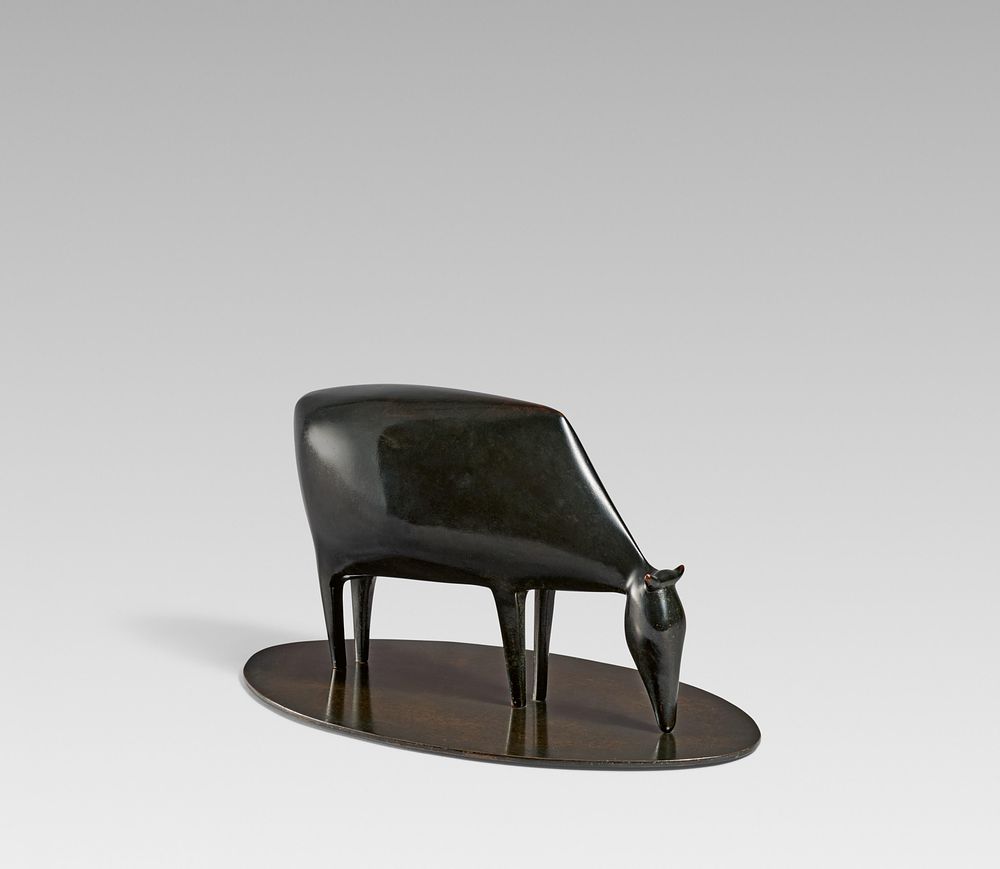
Bidspirit auction | Ewald Mataré: Grasende Kuh II
Ewald Mataré: Grasende Kuh II - MATARÉ, EWALD 1887 Aachen - 1965 Büderich Title: Grasende Kuh II. Date: 1930 (draft). Technique: Bronze, patinated dark brown. Measurement: 15,5 x 32 x 23cm. Notation: Artist's signet above the hind legs: Mataré (ligated). This bronze is an early lifetime cast from a small edition on an oval plinth. We would like to thank Mr Guido de Werd, Cologne, for his kind scientific support. Provenance: - Kunsthaus Lempertz, Cologne 1983 - Private collection - Private collection, North Rhine-Westphalia Literature: - Schilling, Sabine Maja/de Werd, Guido: Ewald Mataré - Das plastische Werk, catalogue raisonné, Vol. II, Cologne 2024, WVZ No. 70a, ill. - Schilling, Sabine Maja: Ewald Mataré - Das plastische Werk, catalogue raisonné, Cologne 1987, cat. rais. no. 64a, ill. - Animals, and cows in particular, have been the artist's favourite motifs since 1917 - One of the most beautiful depictions of cows, impressive in size and perfectly reduced in form - Early lifetime cast in a small edition How coincidence shows an artist the path ”[...] in the absence of boards for woodcuts, made sculptural carvings [...]” (Ewald Mataré, diary entry from 27 June 1922, quoted from: Schilling, Sabina Maja: Ewald Mataré. Das plastische Werk. Cologne, 1987, p. 27) When Ewald Mataré wrote this diary entry in Spiekeroog in 1922, he was a painter who had completed his training at the Berlin Academy. The son of an upper-class family, he managed to make ends meet even in the economically difficult 1920s with occasional commissions and sales. For four years, he had been well connected in Berlin's ”November Group”. Mataré travelled a lot, especially to northern Germany and the sea. As early as 1920, while on Wangerooge, he had the idea of using driftwood boards for woodcuts, but now, two years later, there was only wood suitable for sculpting. The sculptor Ewald Mataré finds his calling. He initially carves people: a walking girl, a head portrait of his future wife Hanna. Soon, however, he also takes up the motif of the ”cow” in his three-dimensional carvings, a motif that had fascinated him since 1917 as a painter and later as a graphic artist in his woodcuts. In future, animal sculptures would characterise the artist's work. Whether cows, horses or cats, whether in wood or bronze, Ewald Mataré's sculptures always invite the eye and hand to touch them. Years later, he wrote about this creative intention of the 1920s: ”I proclaimed for myself and also outside myself that touching, feeling, was the most important thing in design, and with this insight, which I developed from within myself, I stood and still stand alone.” (Ewald Mataré, diary entry from July 1947, quoted from ibid. p. 27). In Dr Eduard Senff from Düsseldorf, Ewald Mataré found a patron and collector who made further travels possible in the following years. His encounter with the closed figures in Giotto's frescoes in Italy became important. In 1926, Fritz Gurlitt's art salon in Berlin showed Mataré's first solo exhibition of sculptures, but without much success. The artist also designed and painted ceramics, including for Mies van der Rohe; Ewald Mataré always incorporated applied art into his work. A monthly salary from a patron, who also bought some of his works, brought an upswing, and he also received financial support from the Ministry of Culture. Ewald Mataré travelled to the Baltic States, Denmark and Finland during the summers. In 1932, he gave up his unsettled life in favour of a professorship at the Düsseldorf Academy. However, this was only a brief interlude, as Mataré was dismissed by the National Socialist authorities in 1933 and later deemed ”degenerate”. Fortunately for him, however, he was not banned from exhibiting or working. During this time, in addition to occasional private sales, contact with the Catholic Church in Cologne proved to be a stroke of luck for the artist. Here he received commissions that allowed him to survive until 1945. After the war, Ewald Mataré was rehabilitated and reappointed to the Düsseldorf Academy. His craftsmanship and material-oriented approach influenced his students: Erwin Heerich, Georg Meistermann and Joseph Beuys are the most prominent among them. In the post-war period, the artist Ewald Mataré became one of the leading sculptors in West Germany. Numerous exhibitions and commissions from the church and state bear witness to this. The four doors of the south façade of Cologne Cathedral and the doors of the World Peace Church in Hiroshima are among his best-known works. Ewald Mataré took part in the first ‘documenta’ exhibitions in 1955 and 1959. The artist died in Büderich in 1965. The whole problem ”cow” When Berlin-based Ewald Mataré turned his attention to animal sculpture around 1920, he was not alone in focusing on this theme. Fellow artists such as August Gaul,