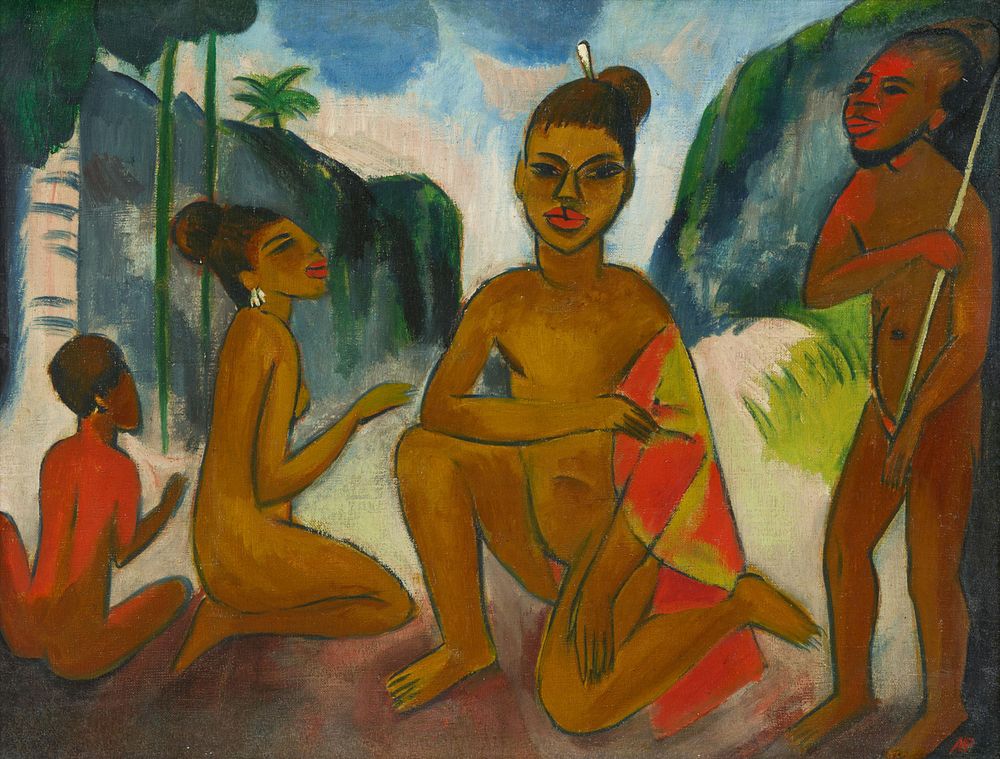
Bidspirit auction | Hermann Max Pechstein: Der Jüngling
Hermann Max Pechstein: Der Jüngling - PECHSTEIN, HERMANN MAX 1881 Zwickau - 1955 Berlin Title: Der Jüngling. Date: 1917. Technique: Oil on canvas, laid down on black card. Mounting: Laid down on canvas. Measurement: 51 x 69cm. Notation: Inscribed by hand other than that of the artist lower right: MP. Frame/Pedestal: Craftman's frame. Verso of the black cardboard, presumably with signature and title 'Der Jüngling' (according to Günter Krüger (ed.), Das druckgraphische Werk Max Pechsteins, 1958). The cardboard backing was later (before 1971) mounted on canvas. Provenance: - Galerie Ernst Beyerler, Basel - Hauswedell & Nolte, Hamburg, 74th auction, 11 May 1957, lot 1033 - Ludwig Lehmann Collection, Berlin/Lugano (1958-64) - Kornfeld & Klipstein, Bern, 112th auction, 27-29 May 1964, lot 1042 - Helen Serger (La Boetie) Art Dealers, New York (1964-71; sticker) - Galerie Thomas, Munich (ca. 1971) - Galerie Levy, Hamburg (ca. 1979) - Galerie Utermann, Dortmund - Private collection (acquired from previous owner in 1981) - Private collection, South America/Germany (1987) Exhibitions: - Berlin Art Exhibition, State Exhibition Building 1919 - University of Notre Dame (Indiana/USA), 1969/70 - Kunstverein Braunschweig, 1982 - Pfalzgalerie, Kaiserslautern 1982 Literature: - Soika, Aya: Max Pechstein - Das Werkverzeichnis der Ölgemälde, Vol. I, 1905-1918, Munich 2011, WVZ No. 1917/73, ill. - Exhibition catalogue Kunstausstellung Berlin, Landesausstellungsgebäude 1919, p. 72, cat. no. 1232 - Exhibition catalogue The German Expressionists and Their Contemporaries - 50 Years of Fantasy and Frenzy, University of Notre Dame (Indiana/USA) 1969/70, cat. no. 99 (here titled: South Sea Figures) - Exhibition catalogue Max Pechstein, Kunstverein Braunschweig/Pfalzgalerie, Kaiserslautern, 1982, p. 91, ill. - One of the extremely rare South Sea paintings on the international art market - Testimony to his deeply formative stay in the former German colony of Palau in 1914 - Outstanding expressionist painting in bright, vivid colours Longing for paradise When Max Pechstein boarded a ship in Genoa on 9 May 1914, following in the footsteps of Paul Gauguin, he left everything behind: the shrill tones of the dissolution of the ”KG Brücke” on 27 May 1913; the doubts that haunt an artist when no one buys his works of art; and finally, the pervasive, corrosive fear of a scene in Europe heated up by the coming war. He first encountered this longing for paradise in 1907/08. He saw paintings by Paul Gauguin. ”From December [1907] onwards, he spent nine months in Paris. He saw the works of Paul Cezanne, Paul Gauguin and Henri Matisse, which would become important for his further development.” (Exhibition catalogue Max Pechstein – Das ferne Paradies, Gemälde, Zeichnungen, Druckgraphik, Städtisches Kunstmuseum Zwickau, 1996, p. 106) ”In February 1908, Pechstein had the opportunity to see paintings by Paul Gauguin at the Galerie Bernheim-Jeune.” (Moeller, Magdalena M.: Zu Pechsteins Stil und Stilentwicklung, in: Max Pechstein – Sein malerisches Werk, Munich 1996/97, p. 44) The simplicity and directness of Gauguin's artistic language made him a role model for Max Pechstein. He desired nothing more than to enter those distant worlds that had led Gauguin to his own distinctive language. This desire grew stronger. Pechstein saw ”[. ] the Gauguin exhibition in September 1910 at Ernst Arnold's in Dresden [and it] seems to have impressed Pechstein even more than his earlier encounter with [his] works in Paris.” (Hoffmann, Meike ‘Max Pechstein in Paris’, in: Max Pechstein - Sein malerisches Werk, Munich 1996/97, p.77) In 1914, the time had come: his journey took him through the Suez Canal via Hong Kong and Manila to the Palau Islands – a German colony east of the Philippines since 1899. Like Emil Nolde the year before, he wanted to gain some distance, start afresh and immerse himself in the magic of a distant, foreign culture. Where? He had seen painted carvings from Micronesia in the Dresden Museum of Ethnology. Among them: a decorated wooden beam from a men's house, a ”bai”, in Palau. Now he wanted to experience the magic of this pictorial language full of originality for himself. Upon arrival, he reports on the beautiful, peaceful people there and raves about the rich, lush nature. A life shaped by completely different cultural origins led him to a foreign carving art, different calligraphic symbols and a previously unknown use of colour on the distant island. He observes, draws, paints: oil paintings, watercolours, sketches. ”In peace and tranquillity, one day followed another. There was nothing to disturb my peace of mind.” (Max Pechstein, quoted from Erinnerungen, Wiesbaden 1963, p. 66) Finally, almost curiously, he acquires an island ”with a small, beautiful, semicircular bay.” (ibid. p. 90) The paintings: these wonderful testimonies to a valuable encounter – were lost! When the First World War broke out in 1914,