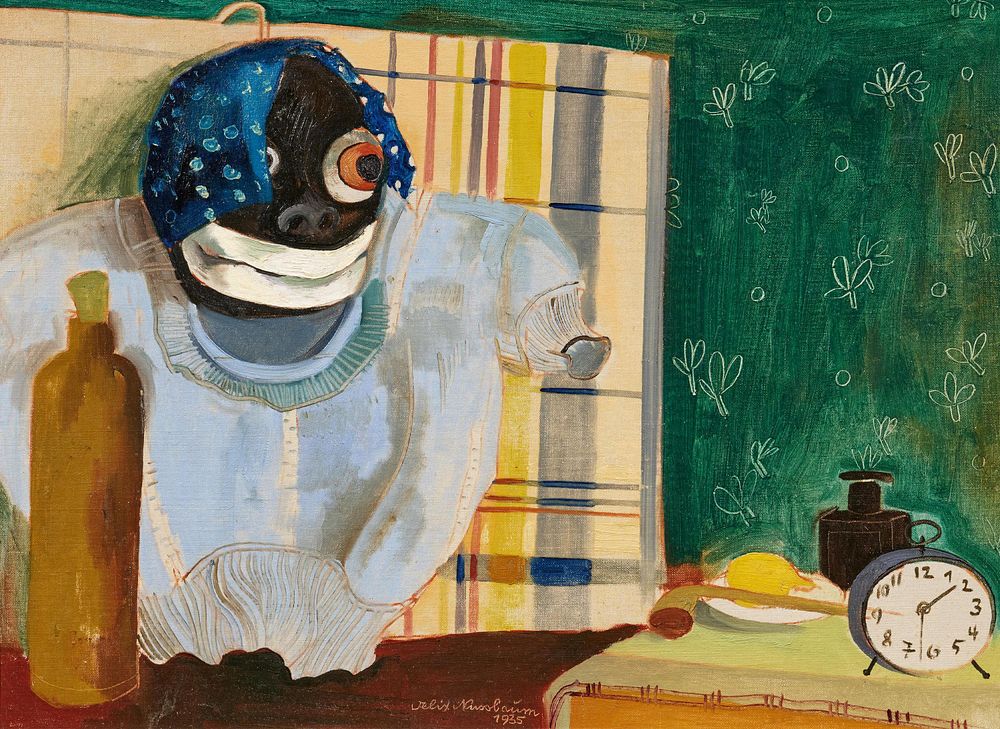
Bidspirit auction | Felix Nussbaum: Stillleben mit Maske
Felix Nussbaum: Stillleben mit Maske und Pullover - NUSSBAUM, FELIX 1904 Osnabrück - 1944 Auschwitz Title: Stillleben mit Maske und Pullover. Date: 1935. Technique: Oil on canvas. Mounting: Relined. Measurement: 47.5 x 65cm. Notation: Signed and dated lower centre: Felix Nussbaum 1935. Frame/Pedestal: Framed. The painting is registered in the Felix Nussbaum Archive. It is listed in the online catalogue raisonné of Felix Nussbaum's works, currently in progress, under catalogue number 215. We would like to thank Ms Anne Sibylle Schwetter, Felix Nussbaum House, Osnabrück, for her kind academic support. The Felix Nussbaum House in Osnabrück has requested to borrow the painting offered here for the planned exhibition 'Felix Nussbaum. Masquerades' from November 2026 to April 2027. Provenance: - Private collection, Belgium - Lempertz Auction House, Cologne, 788th auction, 7th June 2000, lot 15 (label) - Private collection, North Rhine-Westphalia - A still life that is as humorous as it is ominous, reflecting Nussbaum's fear of the future during his exile in Ostend, Belgium - Nussbaum's intimate and socially critical works occupy a special place in art history - Paintings of this quality are rarely offered on the auction market A curious arrangement? At first glance, the artist has arranged a friendly still life with a good dose of humour: a tall earthenware liquor bottle, a clock, a white plate with a pipe and a lemon on it, and a black (ink?) bottle behind it. These are all familiar elements in still lifes. However, the composition is dominated by a light blue women's top with short sleeves hanging on a coat hanger, in the neckline of which is placed a caricatured mask of a person of colour. A blue cloth with white dots has also been placed on the mask's head, further enhancing the absurdity of the figure – especially since the shading of the garment, the slightly raised left sleeve and the fluttering hem suggest liveliness. A smoothly hung, checked tea towel on the left side of the picture acts as a screen against the background. On the right side, the objects on the table are set against a dark green wallpaper. This composition exudes tremendous intensity. Looking at it for longer reveals ambiguities: what is the liquor bottle on the left edge of the picture standing on? What time is it on the clock, whose pointers appear to be almost the same length? Is there really a black bottle on the table, or is it rather a small, extinguished lantern? And all the objects are charged by the grotesque, but also eerie-looking ”mask creature”. Painted in exile When Felix Nussbaum, aged thirty, painted this picture in 1935, he was living in exile in Ostend because of his Jewish faith. Trained at the Berlin Academy of Arts, most recently as a master student of Hans Meid, and strongly influenced by Carl Hofer, he had enjoyed his first successes at the end of the 1920s. In 1932, he was awarded a working scholarship for the Villa Massimo in Rome. Together with his partner, the painter Felka Platek, he was caught up in the Nazi seizure of power there. His scholarship ended immediately after a dispute, and after stays in Italy and France, the couple ended up in Ostend, Belgium, in 1935. Felix Nussbaum knew the city from previous trips and had friends there. With a tourist visa that excluded any gainful employment, he was only allowed to stay and study art. In order to obtain an extension of his visa and registration in the foreigner's register, James Ensor, whom Nussbaum had known for some time, wrote an expert opinion on his painting. But the story would not end well. Felix Nussbaum manages to escape and go into hiding after his first arrest and internment in 1940, but in the summer of 1944 he is denounced and deported to the Auschwitz-Birkenau concentration camp, where he dies, probably on 31 July 1944. Ciphers, symbols and metaphors Against this biographical background, the subtle vagueness, oppressiveness and interpretative demands of ”Still Life with Mask” take on even greater intensity. Felix Nussbaum's oeuvre is full of recurring motifs that are not easy to decipher. In 1935 in particular, he repeatedly used masks in his compositions. Hiding, changing identities, is part of survival for a persecuted person. However, the threatened Jew cannot hide behind the mask shown here, as the skin colour and racist depiction immediately expose its wearer. Felix Nussbaum used this very mask in another still life in the same year. In the endless waiting and inability to do anything, the exact time loses its meaning. A lemon may remind us of the past, initially beautiful time in Italy. The precariously floating liquor bottle with its slightly slanted cork shows another possibility of escapism. The checkered dish towel that recurs repeatedly in Felix Nussbaum's work has not really been interpreted. However,