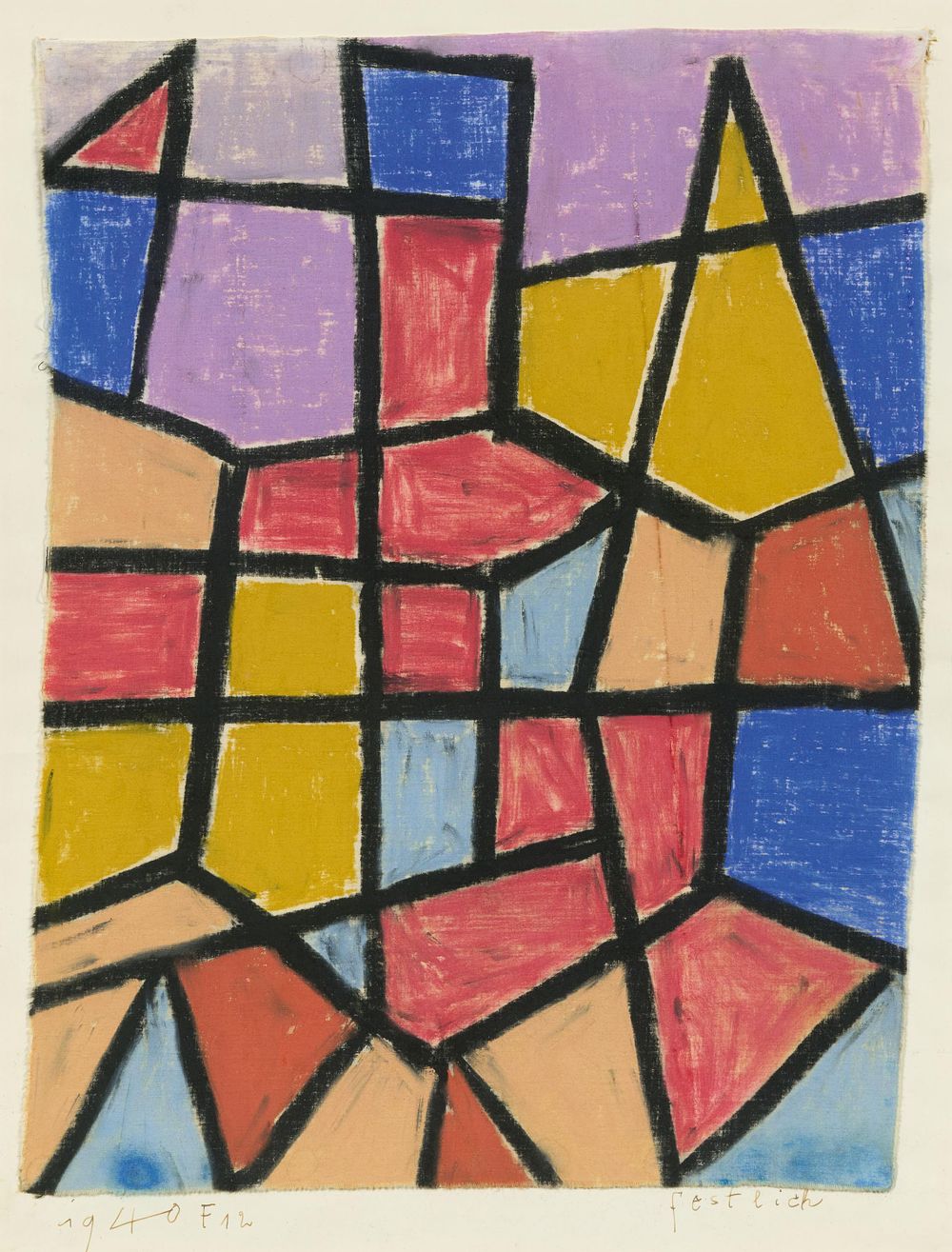
Bidspirit auction | Paul Klee: ”Festlich”
Paul Klee: ”Festlich” - KLEE, PAUL 1879 Münchenbuchsee - 1940 Muralto/ Ticino Title: ”Festlich”. Date: 1940. Technique: Pastel and charcoal on Linnen, laid down on paper. Measurement: 41 x 31cm. Backing board: 46.7 x 36.2cm. Notation: Signed lower right: Klee (fadedd beyondrecognition). Dated, inscribed and dated on the backing board: 1940 F12 festlich. Frame/Pedestal: Craftman's frame. This work is accompanied by a photo certificate from Josef Helfenstein and Stefan Frey, Paul Klee Foundation, Bern, dated 2 October 1995. Provenance: - Lily Klee, Bern (1940-1946) - Klee Society, Bern (1946-1947) - Galerie Rosengart, Lucerne (1947-1948) - Theodor Schempp, Paris/New York (from 1948) - Private collection - Christie's New York, auction 8 November 1995, lot 280 - Galerie Neher, Essen (label) - Private collection North Rhine-Westphalia (acquired from previous owner in 1998) Exhibitions: - Musée national d'Art Moderne, Paris 1948, no. 182 - The Arts Club, Chicago 1962, no. 65 - Galerie Neher, Essen 1996, ill. - Galerie Neher/Westdeutsche Kunstmesse International, Cologne 1997 - Galerie Neher/Westdeutsche Kunstmesse International, Cologne 1998 - Museum Schloss Moyland, Bedburg-Hau 2000 - Kurpfälzisches Museum der Stadt Heidelberg, 2002 Literature: - Paul Klee Foundation/Kunstmuseum Bern (ed.): Paul Klee - Catalogue raisonné, vol. 9, Bern 2004, cat. rais. no. 9371, ill. - Paul Klee Foundation/Kunstmuseum Bern (ed.): Paul Klee, Verzeichnis der Werke des Jahres 1940, Stuttgart 1991, cat. rais. no. 1940, 352 (F12), ill. - A work of quiet monumentality that reveals the spiritual depth and formal mastery of the late Klee - From the last year of the artist's life, which was marked by great creative energy - A vibrant tension between the black grid and the play of light and colour Creative addiction in his final years Paul Klee's oeuvre is characterised by a conflict between abstraction and figuration, music and painting, thought and feeling. This ambivalence makes him one of the central pioneers of modernism to this day. After studying at the Munich Academy and early stylistic experiments, Klee joined the artist group ”Der Blaue Reiter” in 1911, where he formulated a new, spiritually imbued form of art in dialogue with Wassily Kandinsky and Franz Marc. His years of teaching at the Bauhaus in Weimar and Dessau from 1921 to 1931 and at the Düsseldorf Academy from 1931 onwards influenced a generation of artists and established his status as one of the most influential teachers of modernism. In 1933, Klee was defamed as ”degenerate” by the National Socialists and dismissed from his post. In the same year, he emigrated to Switzerland, where he began a late, intense creative phase in Bern. In 1935, Klee fell ill with scleroderma, an incurable autoimmune disease. The consequences of the illness and exile plunged Klee into a deep depression. A brief period of inactivity in 1936, during which his strictly maintained list of works recorded just 25 pieces, was followed in 1937 by a seemingly explosive unleashing of creative energy and inspiration. In a race against time, he tried to put as much as possible down on paper. In the last four months of his life alone, in 1940, he created 366 works. In a letter to his son, he himself described this state as follows: ”Production is increasing at a very rapid pace, and I can no longer keep up with these children. They are springing forth.” (Paul Klee in a letter to Felix Klee dated 29 December 1939, quoted from Klee, Felix (ed.): Paul Klee, Letters to the Family 1893-1940, Vol. II (1907-1940), Cologne 1979, p. 1295) During this period, Klee's pictorial themes are characterised by an ambivalence between his personal fate, the political situation in Germany and depictions of joie de vivre. In May 1940, he began his final journey to a sanatorium in Ticino, where he died on 29 June 1940. Creative addiction in his final years Paul Klee's oeuvre is characterised by a conflict between abstraction and figuration, music and painting, thought and feeling. This ambivalence makes him one of the central pioneers of modernism to this day. After studying at the Munich Academy and early stylistic experiments, Klee joined the artist group ”Der Blaue Reiter” in 1911, where he formulated a new, spiritually imbued form of art in dialogue with Wassily Kandinsky and Franz Marc. His years of teaching at the Bauhaus in Weimar and Dessau from 1921 to 1931 and at the Düsseldorf Academy from 1931 onwards influenced a generation of artists and established his status as one of the most influential teachers of modernism. In 1933, Klee was defamed as ”degenerate” by the National Socialists and dismissed from his post. In the same year, he emigrated to Switzerland, where he began a late, intense creative phase in Bern. In 1935, Klee fell ill with scleroderma, an incurable autoimmune disease. The consequences of the illness and exile plunged Klee into a deep depression.