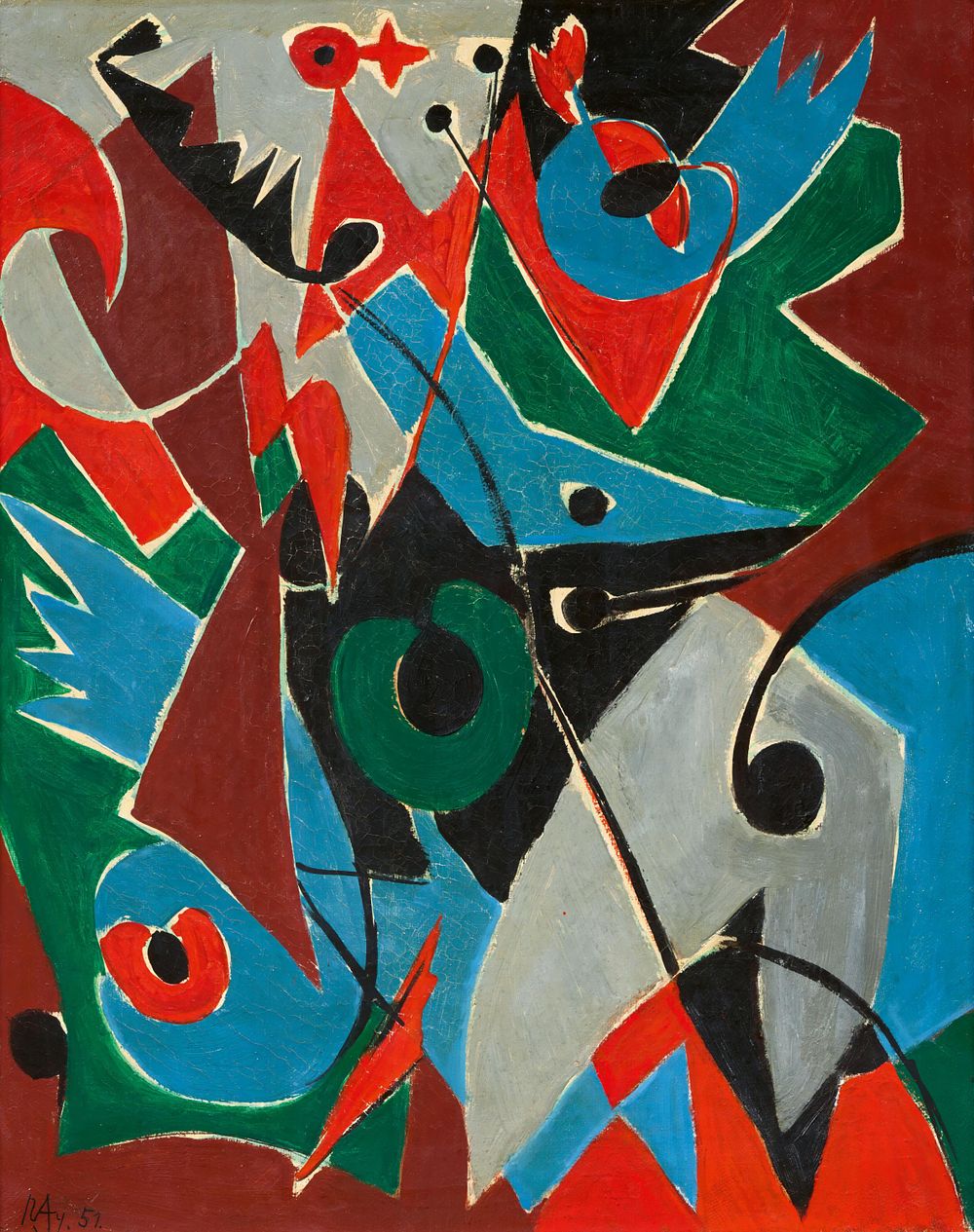
Bidspirit auction | Ernst Wilhelm Nay: ”Der Jäger”
Ernst Wilhelm Nay: ”Der Jäger” - NAY, ERNST WILHELM 1902 Berlin - 1968 Cologne Title: ”Der Jäger”. Date: 1951. Technique: Oil on canvas. Measurement: 50 x 40cm. Notation: Signed and dated lower left: Nay. 51. Additionally inscribed: Nay - ”Der Jäger” 1951. Frame/Pedestal: Craftman's frame. Provenance: - Wolfgang Ketterer Auctions, Munich, 2nd auction, 21st May 1969, lot no. 970 - Galerie Dreiseitel, Cologne - Private collection, Rhineland (acquired from previous owner in 1974) Literature: - Ernst Wilhelm Nay Foundation (ed.): Catalogue raisonné - www.nay.aps-info.de, cat. rais. no. WV-S 563 (last accessed 8th October 2025) - Scheibler, Aurel: Ernst Wilhelm Nay - Catalogue raisonné of oil paintings, vol. II 1952-1968, Cologne 1990, cat. rais. no. 563, ill. - From Nay's seminal creative phase between figurative and non-representational painting - Dynamic, dramatic hunting scene in an interplay of suggestion and dissolution - Nay's deeply felt, powerful painting has lost none of its significance to this day - In private ownership for 50 years Design and Reflection Ernst Wilhelm Nay is one of the most important protagonists of 20th-century modern painting and occupies a firm place in the German and European art canon. His unique oeuvre, spanning more than four decades, reflects an impressive stylistic development from his expressive, figurative beginnings to the luminous, abstract compositions of the post-war period. Influenced by travels to the Baltic Sea, the Lofoten Islands, France and the USA, a painterly oeuvre of extraordinary diversity and charisma unfolds. Nay's works thrive on a diverse formal language, intense colourfulness and an often musically conceived pictorial logic. At the same time, Nay was a clear-sighted intellectual who not only helped shape the art of his time, but also reflected on it – in dialogue with literature, philosophy and social change. As an artist of international standing, Nay stands for deeply felt, powerful painting that has lost none of its significance to this day. Painting at a turning point The period after the Second World War – especially the years from 1949 to 1951 – is considered a time of experimentation and transformation in Nay's work. In his studio in Hofheim, the artist experienced an extremely fruitful and groundbreaking creative phase on his way to pure, non-representational painting. Ideas for paintings that could only be hinted at in sketches on paper during the war years were now consistently realised in his paintings. Nay subjected his pictorial means to intensive examination, which received decisive impetus from his graphic work on a series of ten lithographs printed in Worpswede in the summer of 1949. The formal world of Nay's painting gained in clarity and precision, with coloured surfaces emerging with sharper contours and merging into a complex mosaic of clearly defined, powerfully interlocking forms. The hunt as a dramatic interplay of lines, surfaces and movement The artist approaches the motif for the painting ”Der Jäger” (The Hunter) in 12 preliminary sketches (WV C-51 246-257). Strictly delineated colour compartments, bordered by white contours, characterise the two-dimensional structure of the painting. With a tense colour scheme of bright and deep red, dark green, cool blue and grey, as well as black and contrasting light tones, Nay unfolds an almost eruptive dynamic. Sharp-edged forms jostle against each other, overlap and interpenetrate – a visual force field that seems to be in constant motion. Neither the hunter nor the hunted animal can be clearly identified; only shadowy hints of eyes, wings and beak silhouettes flash into view without coalescing into tangible figures. The representational interpretation suggested by the title is deliberately undermined by the energetic interplay of forms. Instead of meticulously tracing the hunt in narrative form, Nay translates the moment of the shot into a dramatic interplay of lines, surfaces and rhythms. The turbulent movement of a bird flapping its wings pervades the picture as an abstract cipher. The far-reaching, fragmented forms and abrupt changes in the direction of the lines evoke the moment of the fatal shot, the twitching of the wings, the wild fluttering of the struck body, the unchecked fall. The interplay between suggestion and resolution unfolds a suggestive power that convincingly and intensely expresses Nay's creative brilliance and artistic vision in the field of tension between figuration and pure painting. Doris Hansmann Estimated shipping costs for this lot: Arrangement after the auction. Explanations to the Catalogue Ernst Wilhelm Nay Germany Abstraction Post-War Art Modern Art 1950s Craftman's frame Hunting Painting Oil Abstract