Bidspirit auction | Ulrich Rückriem: Vier Jahreszeiten
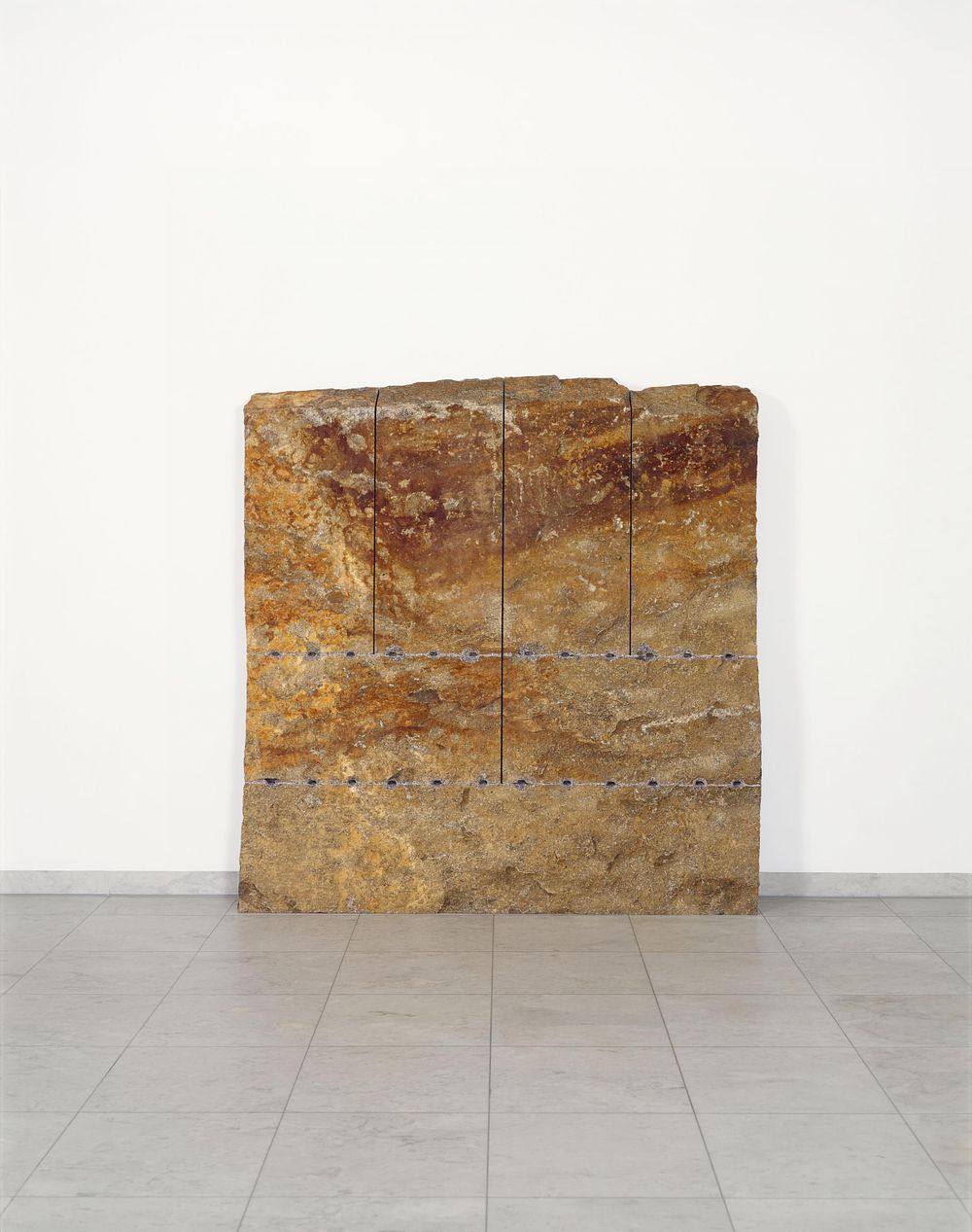
Ulrich Rückriem: Vier Jahreszeiten - RÜCKRIEM, ULRICH 1938 Düsseldorf Title: Vier Jahreszeiten. Subtitle: Wall relief, 4-part. Date: 1986. Technique: Bleu de Vire granite (Normandy), split, cut, reassembled to its original shape. a) 200 x 205 x 26.5 cm (7 parts) b) 212 x 205 x 30.5 cm (7 parts) c) 202 x 202 x 33 cm (6 parts) d) 206 x 203 x 32 cm (6 parts) Weight each ca. 2,5 t The work can be viewed by appointment at a warehouse near Cologne. Provenance: - Private collection, North Rhine-Westphalia Exhibitions: - Museum Abteiberg Mönchengladbach, 1987 - Museum Abteiberg Mönchengladbach, 2009 Literature: - Exhib. cat. Strange I've Seen That Face Before - Object, Form, Phantom, Städtisches Museum Abteiberg Mönchengladbach, Cologne 2006, p. 68, ill. - Kersting, Hannelore: U.R. - Granit bleu de Vire, split, cut and reassembled into its original form ('Four Seasons') 1986, visitor sheets of the Städtisches Museum Abteiberg Mönchengladbach 1997 - Exhib. cat. Luis Jacob, 7 Pictures of Nothing Repeated Four Times, In Gratitude, Museum Abteiberg Mönchengladbach, Cologne 2009, p. 15, ill. no. 23 - Stemmler, Dierk: Municipal Museum Abteiberg Mönchengladbach, Berichte aus westdeutschen Museen, in: Wallraf-RichartzJb, Vol. L, Cologne 1989, p. 389 - Junkers, Claudia: Die Geschichte der Kunst wird von der Erfindung getrieben; Von der Klassischen Moderne bis zur Gegenwart, Part II, in: immer am Ball, Mönchengladbach senior citizens' magazine, issue 185, August 2008, p. 14, ill. - Stemmler, Dierk: Städtisches Museum Abteiberg Mönchengladbach, Berichte aus westdeutschen Museen, in: Wallraf-Richartz Jb, Vol. LI, Cologne 1990, p. 387f, ill. - Rückriem is one of the most important representatives of German Minimal Art - Monumental installation of museum quality - Can be installed both indoors and outdoors - The artist is represented in renowned public collections, including Hamburger Bahnhof, Berlin, Museum für Moderne Kunst, Frankfurt am Main, Tate Britain, London Craftsmanship as a foundation Before Ulrich Rückriem, a native of Düsseldorf, began studying at the Cologne Werkschule under Ludwig Gies, he had already completed an apprenticeship as a stonemason in Düren. In his youth, Rückriem came into contact with architectural drawing and soon broke off his artistic training – craftsmanship was to become the foundation for his later artistic work. Rückriem initially put his skills to use at Cologne Cathedral and also earned his living as a freelance stonemason, crafting gravestones. His encounter with gallery owner Konrad Fischer helped Rückriem's independent sculptural work gain worldwide recognition. Since 1966, he has participated in numerous international group exhibitions, including documenta 5 (1972), documenta 7 (1982), documenta 8 (1987) and documenta IX (1992), as well as the 1978 Venice Biennale. ”Split, cut, ground and polished” His characteristic stone sculptures, carved from a single block of stone, are created through a process that is also the result of precise planning: ”When I saw a sculpture in a block, I made a drawing and then it was split, cut, ground and polished. These are the four processes of production.” (Ulrich Rückriem quoted by Franziska Leuthäußer, Café Deutschland – In conversation with the first art scene of the FRG: Ulrich Rückriem, Städel Museum, 28 November 2017) Starting with mostly cuboid blanks that he selects from various quarries, Ulrich Rückriem determines a simple basic form, which he designates as a free-standing ”stele”, ”cube” or ”disc”’ or as a ”wall” or ”floor relief”, depending on its placement in the space. Once he has determined this basic form, Rückriem draws up a design for dividing the blank, which follows strict architectural rules. At the end of this process, which is specific to Rückriem, the result is a sculpture whose individual parts are assembled to form the original shape of the block. Traces of the impact of the hammer, iron wedges or circular saw on the material remain visible at open interfaces and thin cracks in the rock. They make it possible to trace the individual steps of the process: ”That was the most important thing of all. That everything I do to the stone can be read: what was the first thing, what was the second, the third, and so on. What came after the split, what came after the cut, what came after the surface.” (Ibid.) The extreme reduction of form and the renunciation of any illusionistic effect or individual artistic signature in favour of mechanical or industrial processes connects Rückriem with the artists of Minimal Art. The fact that for Rückriem the location is always part of the work brings him closer to Land Art. Physical volume and two-dimensional drawing This work consists of four approximately square blocks of shallow depth made of Bleu de Vire granite. This stone, which comes from Normandy, is mostly blue-grey, fine-grained and rich in mica. Due to its durability, it can be used in many ways,