Bidspirit auction | Hann Trier: ”Keltern”
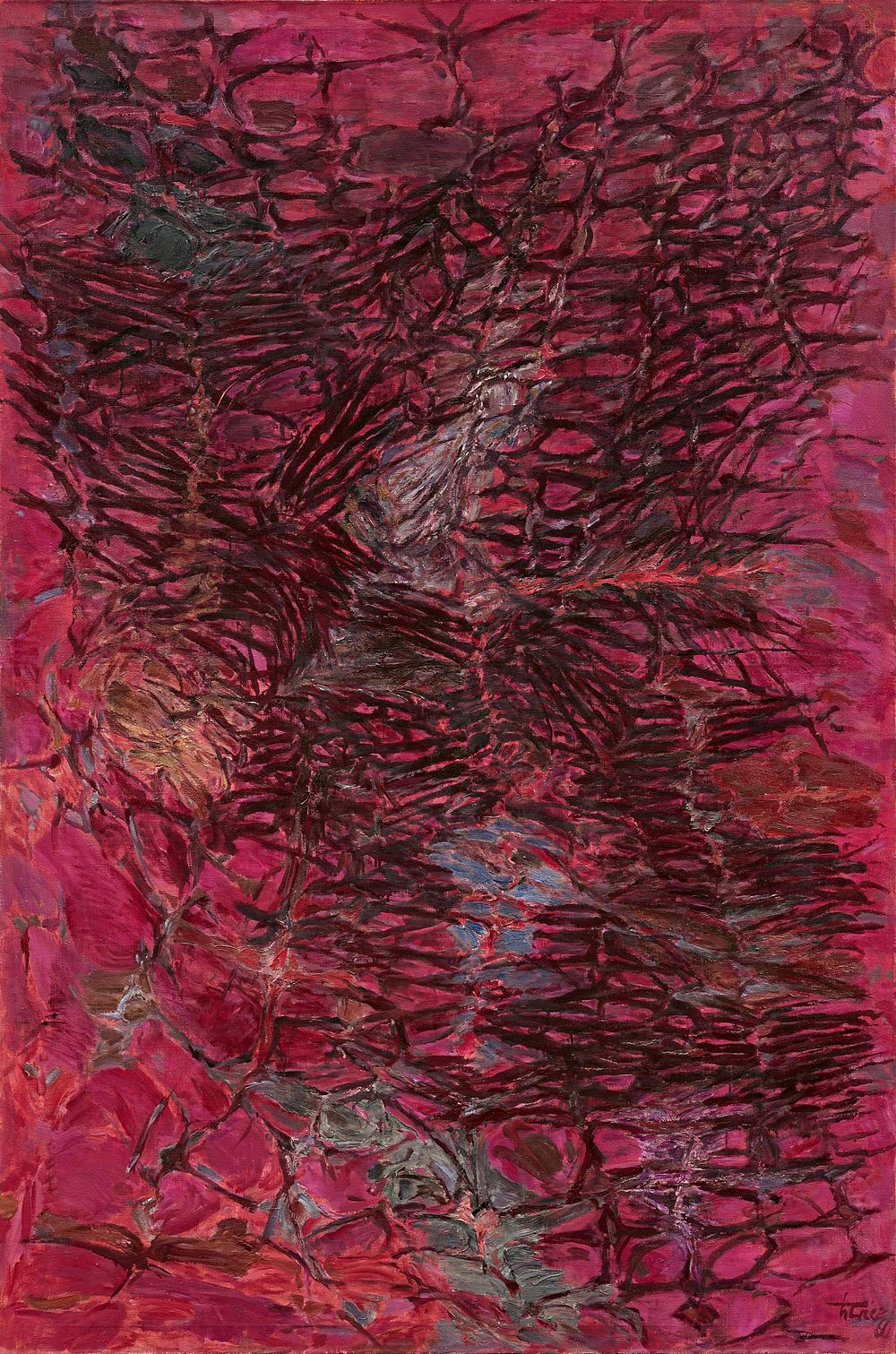
Hann Trier: ”Keltern” - TRIER, HANN 1915 Kaiserswerth - 1999 Castiglione della Pescaia Title: ”Keltern”. Date: 1960. Technique: Oil on canvas. Measurement: 195.5 x 129.5cm. Notation: Signed and dated lower right: hTrier 60. Signed, dated and titled verso top left: hTrier 1960 ”Keltern”. Frame/Pedestal: Framed. Provenance: - Villa Grisebach, 123rd auction, lot 395 (label) - Galerie Henze & Ketterer, Wichtrach/Bern (label) - Private collection Switzerland Exhibitions: - Mathildenhöhe Darmstadt, 1961 (adhesive label) Literature: - Fehlemann, Sabine (ed.): Hann Trier - Monographie und Werkverzeichnis, Cologne 1990, cat. rais. no. 303, ill. - Exhib. cat. Neue Darmstädter Sezession. Grosse Herbstausstellung 1961, cat. no. 377, ill. - Trier's art thrives on energy and movement, which he reflects above all in his painting technique using two brushes - Today, he is considered one of the most important representatives of German Art Informel The courage to embrace abstraction Born in Kaiserswerth near Düsseldorf in 1915, Hann Trier is now one of the best-known representatives of German Informel. Hann, a nickname given to him by his brother Eduard when they were children, began drawing and painting at an early age. He sought inspiration for his work in nature and through regular visits to exhibitions in museums and the Cologne Art Association. While Hann Trier was primarily influenced by modernist trends during his time at the Düsseldorf Art Academy and sought his artistic truth in naturalism, after the Second World War he was among those who turned away from representational painting in their artistic work. Trier was one of the artists, art historians and art lovers who founded the so-called Donnerstagsgesellschaft (Thursday Society) in Alfter near Bonn shortly after the end of the Second World War. Current topics from the worlds of art, culture, society and politics were discussed at the regular meetings. In addition to lectures, exhibitions were also held as part of the Donnerstagsgesellschaft. The first exhibition, in which Hann Trier also participated with his works, was presented on 20 July 1947 under the title ”Day of Abstract Art”. Hann Trier found his artistic expression in abstraction. Encounters with other abstract movements, such as the French Informel, inspired him to find his own visual definitions. After spending time in Colombia, New York and Hamburg, numerous international exhibitions and participation in the first Documenta in 1955, Hann Trier accepted a position at the University of the Arts in Berlin in 1957, where he taught as a professor until his retirement in 1990. Dancing with brushes At the beginning of the 1950s, the line became the central pictorial element for Hann Trier. For him, it represented energy and movement. The representational character receded more and more into the background, while the painting was intended to reflect the painting process itself. The focus of his work was movement. In the 1950s, Hann Trier began painting with two brushes at the same time – one in each hand. By the time he created his work ‘Keltern’ in 1960, he had already developed his two-handed painting technique. The viewer is presented with an impenetrable network of lines that combine to form a grid structure. The black lines on a red background create a contrast, yet the colours in the composition harmonise with each other in an interesting way. The depth of the black almost creates an impression of three-dimensionality. The longer one looks at the work, the more layers of the composition open up to the viewer. Over time, one begins to discover the rhythm, movement and energy that influence Hann Trier's work. If we look closely, we can see the different directions of the brushstrokes that result from the two-handed painting technique. The varying density of the lines reveals glimpses of the red background here and there, revealing the facets of its intensity. With his work ”Keltern”, Hann Trier succeeds in capturing energy and movement in the picture. The combination of intertwined lines and contrasting colours makes the picture pulsate. If you look at the picture long enough, it reveals what Hann Trier meant when he said he danced with his brushes. Estimated shipping costs for this lot: Arrangement after the auction. This lot will be sold under standard taxation (Condition of Sale §V5.1) Explanations to the Catalogue Hann Trier Germany Informel Post-War Art Modern Art 1960s Framed Abstract Painting Oil