Bidspirit auction | Günther Uecker: ”Lichtkasten”
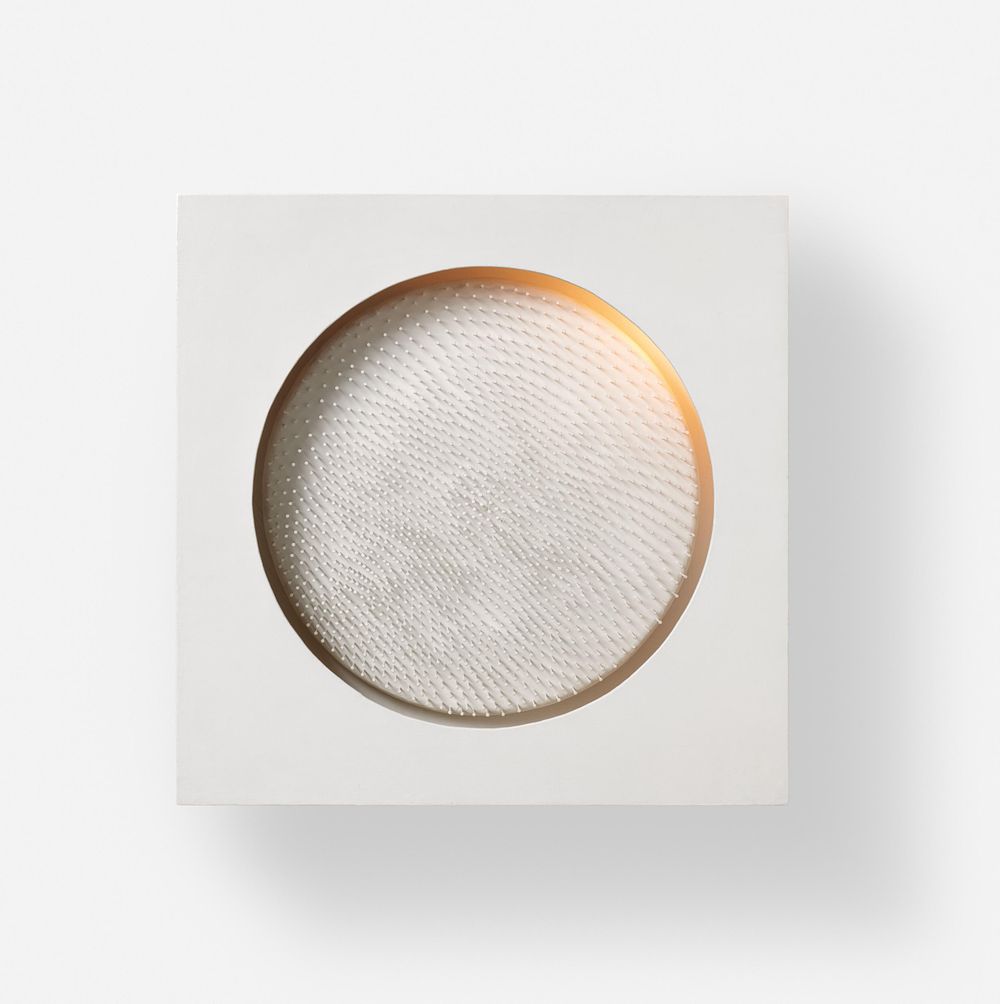
Günther Uecker: ”Lichtkasten” - UECKER, GÜNTHER 1930 Wendorf - 2025 Düsseldorf Title: ”Lichtkasten”. Date: 1966. Technique: Hammered-in nails and white paint on canvas, on a wooden disc. In wooden box, polychromed white. Illuminated and wired for electricity. Measurement: 80 x 80 x 17cm. Notation: Twice signed and titled on the back of the front wooden panel at the top: Uecker Lichtkasten. The work is fully functional. This work is registered in the Uecker Archive under the number GU.66.035 and will be noted for inclusion in the forthcoming Uecker catalogue raisonné. Provenance: - Gimpel Fils Gallery, London (label) - Sotheby's, London, Auction 22nd October 1998, lot 38 - Galerie Heseler, Munich (acc. to consignor) - Private collection North Rhine-Westphalia Literature: - Honisch, Dieter: Uecker, Stuttgart 1983, cat. rais. no. 503, ill. - Kinetic light object from the ZERO period - From the small group of works known as 'Light Discs' with which Uecker achieved a new aesthetic dimension from 1961 onwards - Captivating visual power through the interplay of moving light and shadow The radical decision The “light discs” are arguably the most fascinating and poetic works in Günther Uecker's oeuvre. The first kinetic light discs were created as early as the 1960s. After Uecker came into contact with Yves Klein's “monochromes” in the late 1950s, he was soon inspired by the use of pure, monochrome white surfaces, which enhance the effect of light and lend the works a meditative and spiritual undertone. Born out of a desire to radicalize artistic expression, Uecker devoted himself in 1957 to the use of nails, a medium that is now synonymous with his artistic work. The developments and discoveries that Uecker made during this formative period were very much in the spirit of the avant-garde artist movement ZERO, to which Uecker also belonged. The “Light Box” was created in the year that the Düsseldorf ZERO group around Günther Uecker, Heinz Mack, and Otto Piene disbanded after almost nine years of collaboration and exhibitions. Their joint journey ended on November 25, 1966, with the ZERO demonstration “ZERO is good for you” at Rolandseck Station. Mack wrote about the celebration: ” In 1966, Zero came to a positive end. Over a thousand people celebrated it in one night. I myself had wished for this ending: an ending that I found just as liberating as the beginning of Zero.“ (quoted from: Schmitt, Ulrike: ”Zero ist gut für Dich, ” in: Sediment. Mitteilungen zur Geschichte des Kunsthandels. Issue 10. 2006). Sculptural quality in motion The simplicity of the materials and the power of their combined, lyrical effect are decisive for the captivating visual power of the light object. In a circular arrangement, the artist hammers hundreds of nails into the round wooden panel before coating it with a uniform white paint. Starting at one point in the composition, the artist inserts one nail after another, creating an attractive composition that reaches into the viewer's world. As a kinetic work, the disc is attached to a motor that rotates it and illuminates it from one point. This creates a beguiling dance of light and shadow. Protruding far from the wall, the work has a sculptural quality that is further enhanced by its mobile nature. When viewing the rotating work, one senses a certain tension between the pull of passing time and the meditative, captivating frenzy of the spinning nails. Estimated shipping costs for this lot: Arrangement after the auction. Explanations to the Catalogue Günther Uecker Germany ZERO Post-War Art Sculptures 1960s Nail Object Mixed media Light