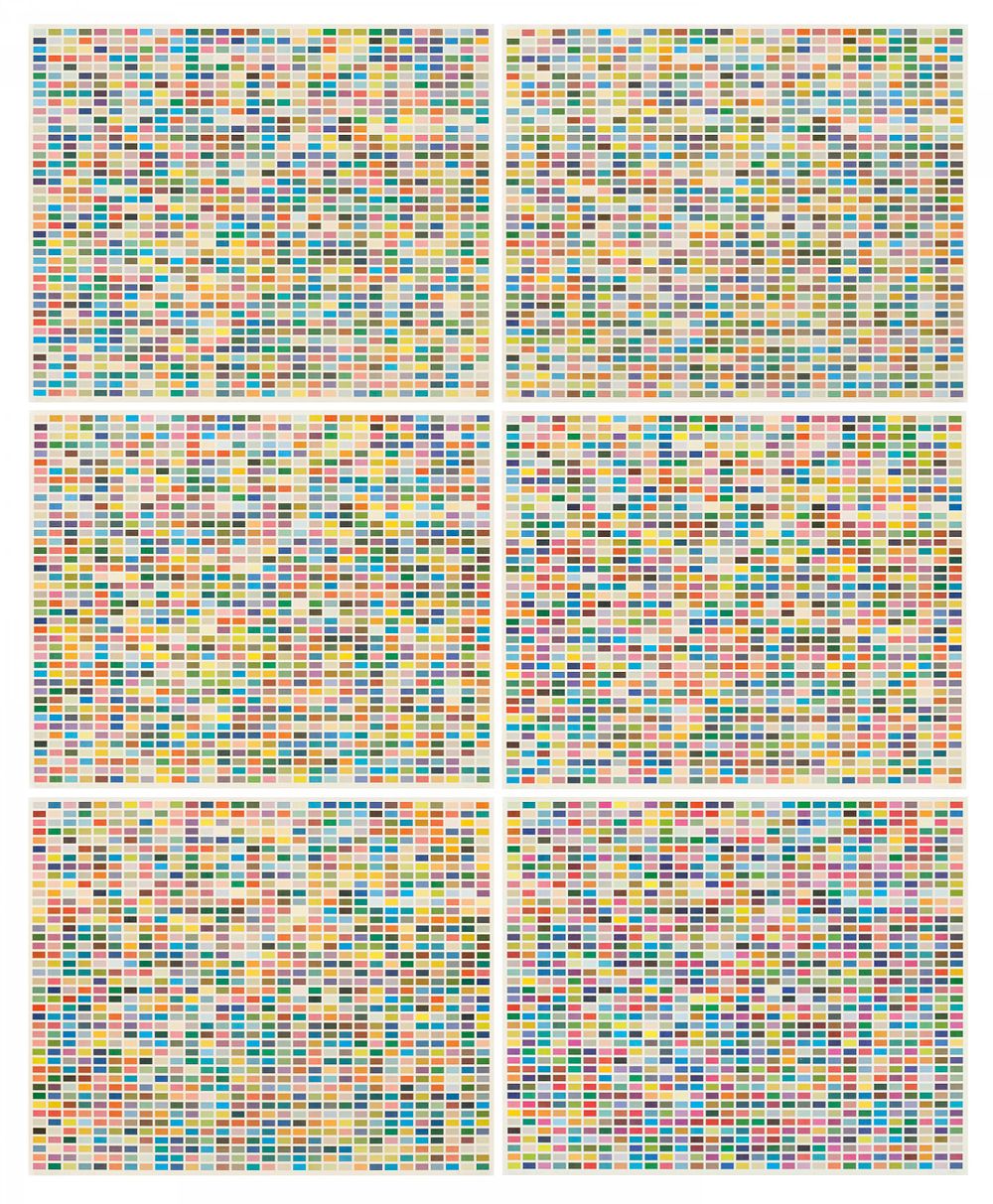
Bidspirit auction | Gerhard Richter: Farbfelder. 6 Anordnungen
Gerhard Richter: Farbfelder. 6 Anordnungen von 1260 Farben - RICHTER, GERHARD 1932 Dresden Title: Farbfelder. 6 Anordnungen von 1260 Farben. Subtitle: Complete collection of six prints. Date: 1974. Technique: Each: Offset on white card. Depiction Size: 62.5 x 77.5cm. Sheet Size: 64.5 x 79cm. Notation: Each inscribed, numbered, signed and dated. Publisher: Galerie Heiner Friedrich, Munich (publisher). Number: 21/32. Frame: Each framed. Not examined out of the frame. The work is listed under Editionen (Editions) on the artist's official website. (www.gerhard-richter.com) Provenance: - Villa Grisebach, 268th Auction, 2nd December 2016, lot 845 (label) - Private collection North Rhine-Westphalia Literature: - Butin, Hubertus/Gronert, Stefan/Olbricht, Thomas (eds.): Gerhard Richter - Editions 1965-2013, Ostfildern/Cologne 2013, cat. rais. no. 51, p. 215, ill. - One of Gerhard Richter's most significant editions - Random serial arrangement creates calm and unrest in the viewer - Complete portfolios are rarely offered on the auction market Chance as a principle of image composition The portfolio “Color Fields. 6 Arrangements of 1260 Colors, ” produced in 1974, is one of Gerhard Richter's most important editions. The six offset prints each contain 1260 colors in the form of small rectangles arranged horizontally and vertically, with each sheet showing a different distribution of colors. The artist did not allow any subjectivity in determining the colors, but rather used chance as a principle for constructing the image. The color compositions were determined by drawing three pieces of paper with the numbers one to nine from a pot for each box. The numbers generated in this way indicate the different proportions of the three primary colors; For example, 482 means a mixing ratio of four parts blue, eight parts red, and two parts yellow when printing. Drawing lots as a random generator inevitably prevents any order according to the gradations of a color spectrum or intended compositional contrasts. Instead, the color scheme exhibits a deliberately organized chaos in the sense of a state of utmost disorder. Order and disorder In addition to chance, the principle of seriality as a repetition of the same is the second fundamental category that characterizes the “color fields.” The sheets exhibit a strict image organization based on a serial and symmetrical principle of order: the rectangular arrangement of the color boxes with white spaces between them forms a uniform grid structure. All pictorial elements are in an egalitarian relationship to one another, as they are not only uniform in principle, but also completely equal. While the rectangles thus display a maximum of order through the grid, the distribution of colors conveys a maximum of disorder. Richter's portfolio of prints is thus a prime example of a non-hierarchical language of art. Hubertus Butin Estimated shipping costs for this lot: Arrangement after the auction. Explanations to the Catalogue Gerhard Richter Germany Abstraction Capitalistic Realism New Realism Post-War Art Silkscreen Each framed. Not examined out of the frame Colour Print Offset Geometric Abstraction