Bidspirit auction | Otto Piene: Schwarz-Schwarz (Rasterbild)
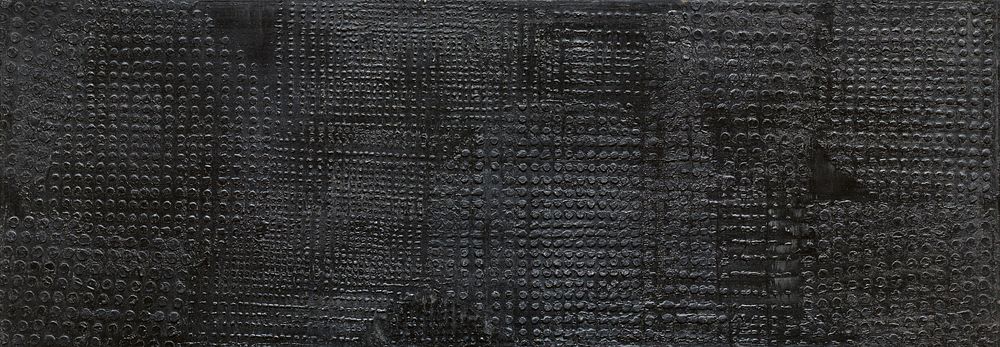
Otto Piene: Schwarz-Schwarz (Rasterbild) - PIENE, OTTO 1928 Laasphe/Westphalia - 2014 Berlin Title: Schwarz-Schwarz (Rasterbild). Date: 1958. Technique: Oil on canvas. Measurement: 60 x 170cm. Notation: Signed and dated verso top right: Piene (circled) 58. Additionally with directional arrow. Provenance: - Alfred Schmela Gallery, Düsseldorf - Private collection, Cologne (acquired from the previous owner in 1964) Exhibitions: - Museum am Ostwall, Dortmund 2008/2009 Literature: - Exhib. cat. Otto Piene: Spectrum, Museum am Ostwall, Dortmund 2008/2009 - A rare painting from the early years of the ZERO movement, which are in high demand - Otto Piene: Pioneer of a radical artistic new beginning - Key work of formal reduction and exploration of light Reduction and New Beginnings – Otto Piene's Early Grid Paintings With the Düsseldorf-based ZERO group, a radical young post-war avant-garde established itself in Germany in the late 1950s. In response to the lyrical, expressive gestures of Tachism and Informel, Heinz Mack, Otto Piene, and later Günther Uecker sought a consistent artistic new beginning. Materials such as fire, water, light, glass, nails, aluminum, and plastic found their way into their works, the boundaries between artwork and space were removed, and light and movement became central design elements. At the very beginning of this development, the classic panel painting was able to maintain its traditional place for a while longer—but it underwent a radical reinterpretation. Polychromy and composition were replaced by principles such as monochromy and grids, which determined the effect of the image. As early as 1957, Otto Piene developed his first “semi-mechanical” grid paintings, which were largely cleansed of traces of individual handwriting. To do this, he pressed oil paint through screens he had made himself, the holes in which he had punched into the material with a punch. Depending on the size and density of the openings, a variety of structures emerge on the canvas: uniform grids covering the entire picture surface, narrow stripes or circles, and textures that resemble woven fabrics when viewed from a distance. In these early years, the variety of colors was reduced to a minimum. Otto Piene relies on bright, light-reflecting tones such as white, yellow, silver, and gold, while black also plays a role as a contrasting counterprinciple. “From the light images, from the bright images that directly strive for light, ” says the artist, “the negatives, so to speak, were created, which used darkness to provoke light.” (Otto Piene, quoted from: Otto Piene - Retrospective 1952-1996, exhibition catalog, Kunstmuseum Düsseldorf im Ehrenhof, Cologne, 1996, p. 51.) Monochrome and structure - the black grid image as a perception experiment Created in 1958, this slender landscape format shows an almost completely black surface covered with a finely structured grid of raised dots and subtly modulated structures. The almost relief-like design creates a sensitive play of light on the black background. The interplay of order and irregularity unfolds an exciting dynamic—a lively, vibrant surface. With works such as this, Piene liberates painting from its traditional, pictorial character. The substance and materiality of the paint take center stage: the monochrome effect lends the picture surface a sense of calm and concentration, while the grid of the slightly raised color structure reveals both aesthetic diversity and subtle modulation. This tension between austerity and liveliness is a special quality of Otto Piene's work. “Schwarz-Schwarz” exemplifies the early ZERO concept, which, following the individual gesture of Informel, strives for a new, quiet form of artistic expression focused on clarity and order. Doris Hansmann Estimated shipping costs for this lot: Arrangement after the auction. Explanations to the Catalogue Otto Piene Germany ZERO Light Art Post-War Art Post War 1950s Abstract Painting Oil