Bidspirit auction | Frans II. Francken: An Allegory
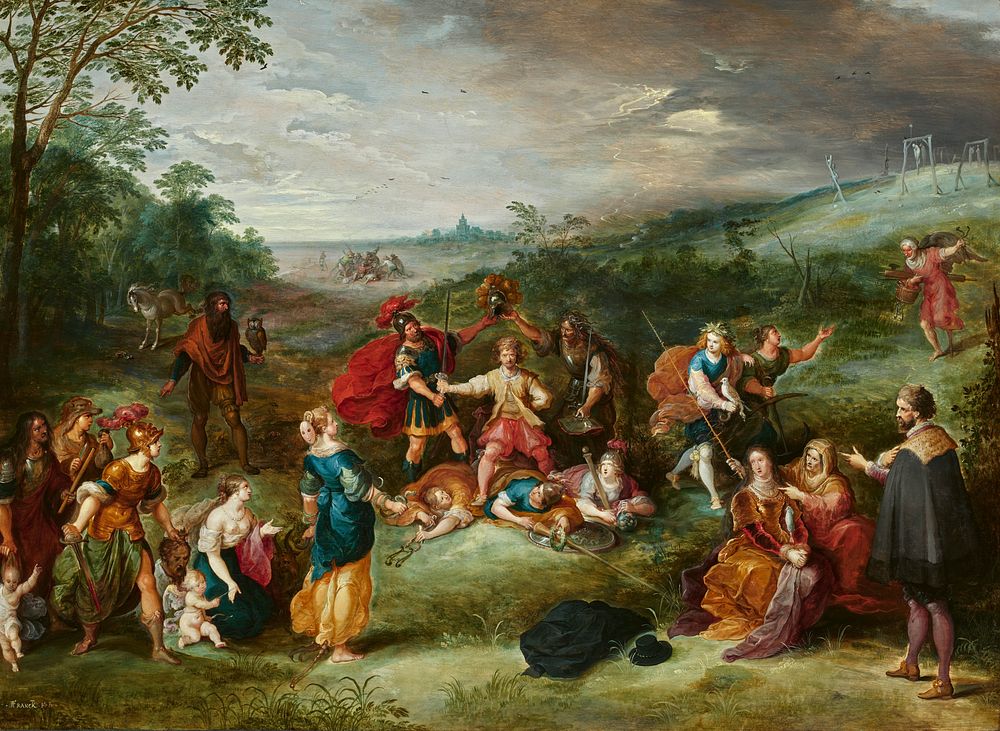
Frans II. Francken: An Allegory of the Consequences of War - FRANCKEN , FRANS II. 1581 Antwerp–1642 Antwerp Title: An Allegory of the Consequences of War. Date: Ca. 1615. Technique: Oil on wood. Measurement: 55 x 76cm. Notation: Signed lower left: FFrancken F IN. Frame: Framed. Provenance: - Private ownership, Germany, since 1924, as a gift/fee from the Vereins Haus Wettin Albertinische Linie to one of the advisers in connection with the settlement agreement; Vereins Haus Wettin Albertinische Linie, 1924 (following its return by the Free State of Saxony under the terms of the settlement agreement); State Art Collections Dresden, 1918 (with the end of the monarchy); Collection of the Saxon Elector Frederick Augustus I, also King Augustus II of Poland (see inventory book 1722–1728, inventory no. 371), since 1722 (through the mediation of Count von Wackerbarth as „alt Franck, Eine Thesis, mit Sinnbildern“). Literature: U. Härting: Frans Francken der Jüngere (1581-1642). Die Gemälde mit kritischem Oeuvrekatalog, Freren 1989, p. 351f, no. 379 with ill. As described here as ”Allegorie der Laster (?)”. Appraisal: Ursula Härting, Hamm 16.03.2026. This painting by Frans Francken the Younger, originally examined by Dr Ursula Härting, stands out among its allegorical counterparts particularly for the clarity of its concept, the sophistication of its compositional execution and its timeless relevance. The brushwork and colour palette, consisting of subtle blue-green nuances and muted tones in the background figures, masterfully reflect Francken’s characteristic style from around 1615. Frans Francken the Younger lived in Antwerp, in the southern Netherlands (now Belgium). His hometown was regarded as a Catholic stronghold, and the Cathedral of Our Lady as a Catholic landmark visible from afar. Francken’s era was shaped by territorial and religious wars in Europe. To this day, he remains the most outstanding artist among several generations of the Antwerp Francken painting dynasty. This composition, with its allegorical figures, was revealing to the humanistically educated elite of his time and, in view of the hostilities in Flanders, understandable and topical. Over the centuries, however, interpretations of this enigmatic painting have led to various titles, and it has not yet been definitively deciphered. The interpretation presented here for the first time is based on the conceptual imagery derived from the comprehensive literary knowledge of the period. The allegory draws on moral concepts familiar to Francken’s generation. It is kept general and has a humanistic focus, meaning that Francken does not portray or attack any specific individuals and thus does not expose himself to personal danger. He drew the figurative elements primarily from Cesare Ripa’s widely circulated Iconologia, which contained texts and interpretations of classical personifications and their specific attributes. In the centre, a belligerent, hot-tempered figure storms towards the viewer; his sword, however, is guided by Mars, the god of war, at his left, whilst Mars, together with Furor (Fury), holds the helmet above his head and crowns him as an instrument of wrath in war. Beneath a threatening sky, a massacre is depicted in the background on the left and a field of gallows on the right as symbols of the horrors of war; from this direction, a gaunt old woman approaches carrying a basket of what appear to be instruments of torture. Before the raging warrior lie Temperantia, representing moderation and wearing a bridle; Fortitudo, representing strength in the earthly struggle against evil; and Europa, crowned and holding a globe and a pillar. To their right are depicted further victims of war. Thus, fleeing from war and wrath, the laurel-crowned Poesia with a dove of peace, and with her Spes, Hope with an anchor: they symbolise refugees in times of war. At the lower right-hand edge of the picture sits a refined lady, virtuosely folding her hands in prayer. Close beside her, the personified Penitentia urges her towards atonement and insight. Penitence holds a fish, a symbol of Christianity, above the praying hands and marks the boundary to the opposite side of the composition with her excessively long scourge. An elegantly dressed gentleman, having respectfully removed his hat and coat, places one hand confessionally on his chest, whilst pointing with the other towards Penitence and thereby addressing the viewer at the same time. On the opposite side, further key figures reach towards the central figure: these are the vices, the vices: Lady World with a mask and a treacherous bird’s claw – the common depiction of Voluptas as a bare-breasted figure of lust with Cupid, bow and arrow – Vendetta armata, vengeance, armed, striding forth with a severed head and sword – Crudelitas, cruelty as a child-murderer with a stick and a small child by the scruff of the neck – Avaritia,