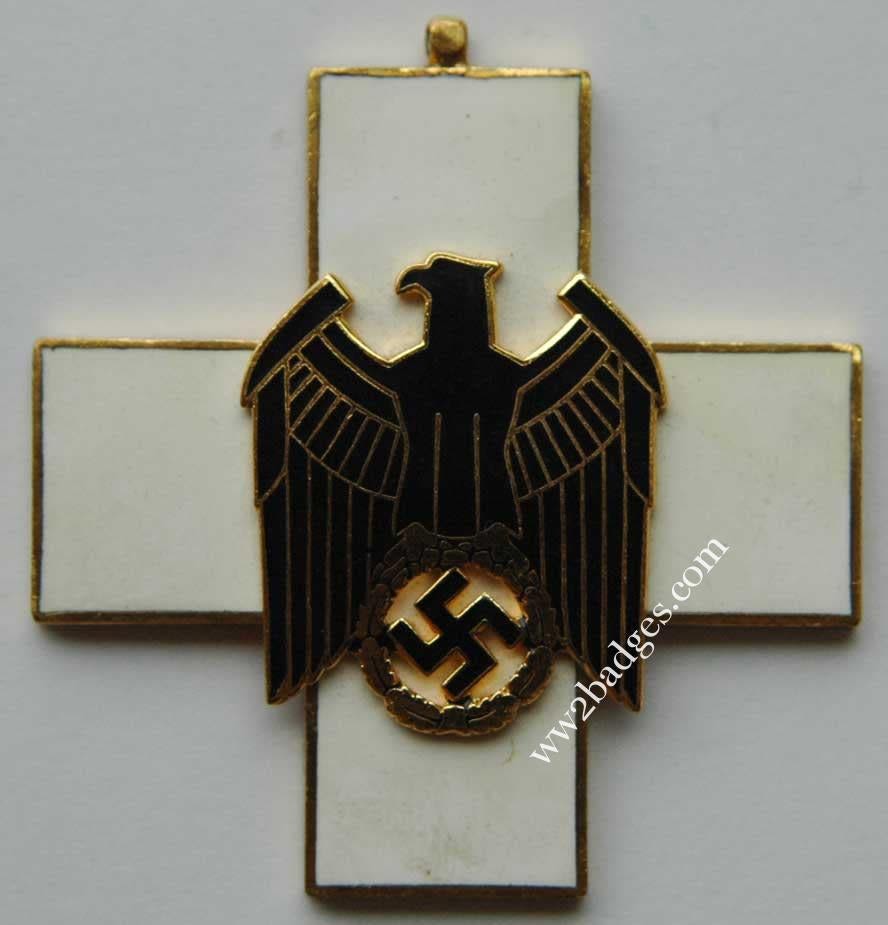
Bidspirit auction | GERMAN WW2 CROSS CIVIL WELFARE
GERMAN WW2 CROSS CIVIL WELFARE 1st CLASS for NECK - RARE GERMAN WW2 CROSS CIVIL WELFARE 1st CLASS for NECK Ehrenzeichen fur Deutsche Volkspflege Award Cross. The cross is among the more rare German WW2 civil badges. The award was introduced to recognize German citizens for meritorious services in welfare i.e. The Winterhilfswerk winter charities. There were 4 classes of this award of which this sample is the 1st class level both side are enamelled. REFERENCEs : Detlev Niemann 'Price Guide. Orders and decorations Germany', 2004, page 270, catalogue price is 1200 EURO ($1500 - 16 years ago !!!). Lothar Hartung, catalogue 'Auszeichnungen des 3. Reiches', spezialkatalog 2005/2006, item 300, page 98, catalogue price is 1900 EURO ($2400) Please note: last image is for sample only. ESTIMATE PRICE : $2000 - $2500. OFFER : If an item is NOT SOLD, you can still give us a reasonable offer - please save the link of this page. PAYMENT : Credit Card payment, Wire transfer, Check or Money Order payment are also available. International bidder can use PayPal for payment. PAY in PARTS : You can pay for any item during 2-3 months. Just make a deposit 10% and the item will wait for you. SHIPPING : Let us Handle Your Shipping. We are one of the few places that offer full service shipping. For your convenience we will ship your item - shipping costs will be included in the invoice. Combined shipping is available - next item will be ONE DOLLAR for shipping. NEW : Returning customer will have FREE SHIPPING in USA and 50% DISCOUNT on international shipping. WIKIPEDIA : The Nationalsozialistische Volkswohlfahrt (NSV), meaning 'National Socialist People's Welfare', was a social welfare organization during the Third Reich. The NSV was established in 1933, shortly after the NSDAP took power in Germany. Its seat was in Berlin. The structure of the NSV was based on the Nazi Party model, with local, county (Kreis) and group administrations. With 17 million Germans receiving assistance under the auspices of National Socialist Peoples Welfare (NSV) by 1939, the agency 'projected a powerful image of caring and support.' The National Socialists provided a plethora of social welfare programs under the Nazi concept of Volksgemeinschaft which promoted the collectivity of a 'peoples community' where citizens would sacrifice themselves for the greater good. The NSV operated '8,000 day-nurseries' by 1939, and funded holiday homes for mothers, distributed additional food for large families, and was involved with a 'wide variety of other facilities.' The Nazi social welfare provisions included old age insurance, rent supplements, unemployment and disability benefits, old-age homes, interest-free loans for married couples, along with healthcare insurance, which was not decreed mandatory until 1941. One of the NSV branches, the Office of Institutional and Special Welfare, was responsible 'for travelers' aid at railway stations; relief for ex-convicts; 'support for re-migrants from abroad; assistance for the physically disabled, hard-of-hearing, deaf, mute, and blind; relief for the elderly, homeless and alcoholics; and the fight against illicit drugs and epidemics.' The Office of Youth Relief, which had 30,000 branch offices by 1941, took the job of supervising 'social workers, corrective training, mediation assistance,' and dealing with judicial authorities to prevent juvenile delinquency.