Bidspirit auction | KARL GUSTAV GUNSAM* ( Vienna
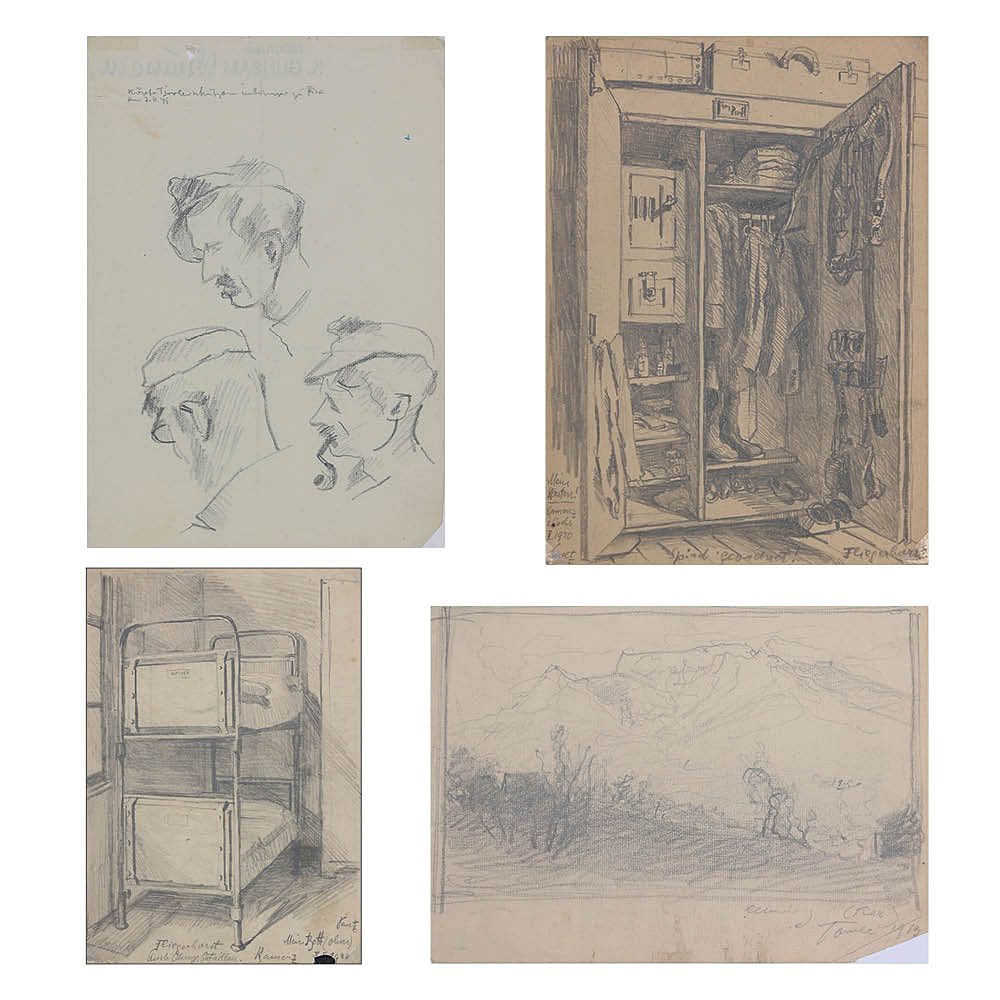
KARL GUSTAV GUNSAM* ( Vienna 1900 - 1972 Vienna ) - Bundle with various accompaniments 1| Karl Josef Gunsam* ( Vienna 1900 - 1972 Vienna ) Head posture, 1945 pencil/paper 15 x 10,6 cm dated 7.6.45 inscribed Tiroler Schützen in Kampo in Risa verso estate stamp K. Gunsam Accompaniment: 1| Georg Pevetz* ( Pettau 1893 - 1971 Vienna ) My bed, 1940 pencil/paper 14,7 x 10,5 cm signed Pevetz, dated 3.5.1940 inscribed Fliegerhorst, Ausbildungsbataillon, Kamenz 2| Georg Pevetz* ( Pettau 1893 - 1971 Vienna ) My wardrobe, 1940 pencil/paper 14,7 x 10,5 cm signed Pevetz, dated 3.5.1940 inscribed Fliegerhorst, Ausbildungsbataillon, Kamenz, Spind geordnet! 3| Heinrich Tomec ( Prague 1863 - 1928 Vienna ) Rax, 1913 pencil/paper 13,3 x 18,5 cm sigend Tomes, dated 1913 inscribed Zeichnung Rax SCHÄTZPREIS / ESTIMATE °€ 50 - 100 STARTPREIS / STARTING PRICE °€ 50 Karl Josef Gunsam was an Austrian artist. Gunsam first studied painting at the Academy Vitti in Paris while working as a professional footballer, then with Dobrowsky (whose assistant he was for a long time) and Kolig at the Academy of Fine Arts in Vienna. Later he undertook study trips to France, Italy, Greece and in the USA. From 1932 member of the Hagenbund, from 1945 of the Secession. Painted landscapes, still lifes and portraits (Cezanne admirer). He participated in numerous exhibitions in Vienna. 1958 he received the title of professor. Gunsam specialized in architecturally constructed landscapes in bold colours. - Georg Pevetz was an Austrian painter and graphic artist. Pevetz mostly painted vibrantly colored and expressive landscapes, nudes, and still lifes, and in his later years also abstractions. As a graphic artist, he created woodcuts, etchings, and lithographs, mostly with expressive elements. From 1912 to 1914 and from 1919 to 1921, he studied painting at the Vienna Academy under R. Jettmar, R. Bacher, and J. Jungwirth, and art history at the University of Vienna under M. Dvorak. In 1921, he received his doctorate there. From 1914 to 1918, he served in the military; he was taken prisoner by the British. Around 1922, Pevetz established contact with the Nötsch circle around Wiegele and Kolig. From 1922 until the early 1930s, he undertook study trips through Germany, France, the Netherlands, Sweden, Croatia, Bosnia, and Slovenia, spending extended periods in Berlin and Paris. He was acquainted with M. Slevogt, M. Liebermann, A. Vollard, M. D. Vlaminck, and H. Matisse. From 1933 to 1940, he taught in Vienna (Realgymnasium) and Villach. In 1940 he was drafted again. He returned from French captivity in 1946. He settled in Egg am Faakersee and took up a teaching position in Villach. In 1953 Pevetz retired and moved to Vienna. Pevetz was a member of the short-lived Viennese art association ”Brücke, ” the ”Kunstschau, ” and from 1926 to 1928 the Hagenbund; from 1930 he was a member of the Vienna Künstlerhaus. Important works by Georg Pevetz: stained glass window designs: Baptismal Chapel in Angern (Lower Austria), Church in Föhrenau (Lower Austria), Votivkirche (Votive Church) Vienna (large rose window). Collectives during his lifetime: e.g. 1926 Galerie Würthle Vienna, 1928 Kunsthalle Hamburg, 1931 Vienna Künstlerhaus, 1934 Galerie Würthle, 1948 Neue Galerie Graz, 1956 Austrian State Printing Office Vienna. Works by Pevetz are included in the following collections: Belvedere, Albertina, Vienna Museum, Carinthian State Gallery Klagenfurt, Joanneum Graz, Museum of Lower Austria, Gemeentemuseum Den Haag, Pushkin Museum Moscow, British Museum London, and Museum Villach. Honors and awards (selection): 1914 Academy Prize for Nude Drawing; 1953 Gold Medal from the Vienna Künstlerhaus; 1963 Golden Laurel from the Vienna Künstlerhaus; 1969 Austrian Cross of Honour for Science and Art; Honorary grave at the Vienna-Hietzing Cemetery. - Heinrich Tomec was an Austrian artist and brother-in-law of the painter J. N. Geller. As a painter, Tomec primarily created impressionistic landscapes with motifs from the Wachau Valley, the Vienna area, and Bohemia, especially Prague. From 1879 to 1884, he worked as a theater painter in the workshop of the Czech Theater in Prague, and from 1887 to 1892, he studied painting under E. von Lichtenfels at the Vienna Academy. From 1896 to 1900, he was a member of the Vienna Künstlerhaus and, in 1900, a founding member of the Hagenbund. In 1901, he returned to the Vienna Künstlerhaus. Tomec, along with J. N. Geller, M. Suppantschitsch, and E. Strecker, is counted among the so-called ”Wachau painters.” He created illustrations for the work ”The Austro-Hungarian Monarchy in Word and Image.” Works by Heinrich Tomec are included in the following collections: Austrian Gallery Belvedere, Albertina, Museum of the City of Vienna, Museum of Lower Austria, and National Museum Prague. Honors and awards (selection): 1900 Honorable Mention at the Paris World Exhibition; 1905 Grand Gold State Medal; 1906 Gold Medal in Bucharest;