Bidspirit auction | ”Sod HaTefillin” Handwritten Glosses by
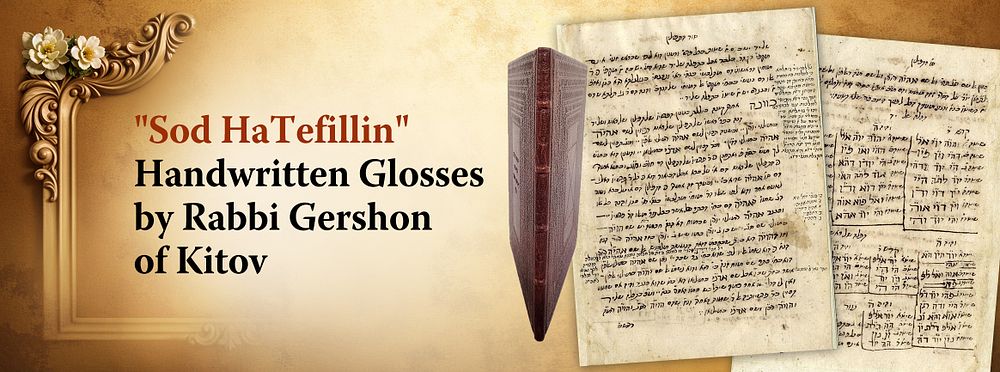
”Sod HaTefillin” Handwritten Glosses by Rabbi Gershon of Kitov on Sha'ar HaKavvanot by the Ariza”l - ”My brother-in-law, the famed and G-dly gaon for whom the paths in Heaven are opened ...” (The Besh”t) Kabbalistic manuscript ”Sod HaTefillin” from the Ariza”l's Sha'ar HaKavvanot [Derushei HaTefillin, Drush 1]. Copy that belonged to the Besh”t's brother-in-law and his closest associate, the G-dly Kabbalsit Rabbi Gershon of Kitov, rabbi of the sacred Rabbi Tzvi son of the Besh”t. Along the length of the second page of the manuscript are about a hundred words (!) of deep Kabbalistic glosses handwritten by Rabbi Gershon of Kitov. Aside from the incomprehensible segulah value of this manuscript, used for study and prayer by the wonder-worker and the closest person to the light of the seven seas, the Besh”t, and aside from the sacred Names and the upper sephirot in his own penmanship, which we will expand upon later, there is also the Kabbalistic-Chassidic value of the manuscript, more precious than gold - unknown and deepest Kabbalistic insights by the sacred Rabbi Gershon of Kitov, one of the patriarchs of Chassidut and the person closest to the Ba'al Shem Tov. None of his Torah was printed except for a few famous missives to his brother-in-law, the Besh”t, and his disciple, Rabbi Tzvi Ben HaBesh”t, which certainly contain the deepest secrets, but explicit Kabbalistic chiddushim - or chiddushim at all, for that matter, of his have not been printed. Much is related in Chassidic historic literature about Rabbi Gershon of Kitov's connection to leading Kabbalists in Jerusalem, and that he was one of the leading disciples of the sacred Rasha”sh - and this here is explicit documentation of this - in his deep Kabbalistic insights on Kitvei HeAr”i, in his own penmanship. It is worth noting that all along the leaf are chilling tear stains from the tears shed by Rabbi Gershon Kitover as he lay his tefillin according to the kavvanot. Scholar Rabbi Yechiel Goldhaber, in his series of articles about Rabbi Gershon of Kitov, concludes from this manuscript that Rabbi Gershon of Kitov was the one who led the prayers in the Rasha”sh's Beit-E-l yeshivah (MiShulchano shel Yechiel Goldhaber, Ma'amar 2, parashat Achrei-Kedoshim, 2015). Kabbalists of our days pray according to the Rasha”sh's intentions, which are different and more expansive than the standard intentions of the Ar”i HaKadosh. The Besh”t and all the Kabbalists until the period of the Rasha”sh would pray according to the Ar”i's standard intentions, as appears in the siddurim of the Besh”t's disciples, such as Siddur Rabi Shabtai and Siddur Rabi Avraham Shimshon Ben HaToldot. Rabbi Gershon of Kitov also certainly prayed with the Ar”i's standard intentions, as can be seen from the many usage marks and the remnants of tears on this sacred manuscript. However, it is possible that in his glosses in the margins of the manuscript, he added on to the Kavvanot HaAr”i from the words of his teacher, the Rash”sh. Regarding the extent of Rabbi Gershon of Kitov's sanctity and spiritual level, what demonstrates it most of all is the fact that he was the closest associate of the light of the seven seas - the Besh”t, and indeed, it was not for nothing that the Besh”t chose him, out of all of his disciples, to send to him the famous letter known ever since as 'The Chassidic Manifesto' in which he asked the Mashiach, ”When are you coming?” and the Mashiach responded, ”When your wellsprings burst forth” and there are those who consider it the Besh”t's most important Torah, as it is from his actual writing. And much more than this, Rabbi Gershon of Kitov was one of those who paved the way for the Besh”t's intentions in prayer, as the Maggid of Kozhnitz notes in his Sefer Avodat Yisrael (Parashah Metzora p. 159 second column): ”I heard it said that our Rabbi Gershon once said to his brother-in-law, the Besh”t, z”l, when his level was not yet known, as follows: Every time one can still say Baruch Atah in prayer, as You wish, know that you have reached the intent of prayer, because a person must be so open that none of him has the power or knowledge in the matter of the prayer, and these are true matters.” It is very interesting to note that this manuscript here deals with these words, Baruch Atah. Refer to the Hebrew catalog text for a brief biography of Rabbi Avraham Gershon of Kitov. [2] pages, 20.5x15.5 cm. The text for the kavvanot are in characteristic Sephardic script. The glosses by Rabbi Gershon of Kitov are in Rash”i script. Fine condition. Aging and tear stains. Restored worming perforations. New leather binding.