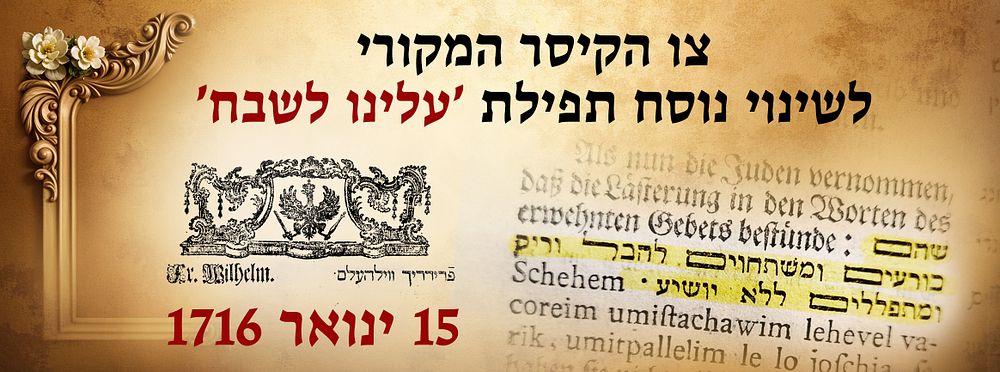
Bidspirit auction | Historical Item – The Original
Historical Item – The Original Decree That Changed the Wording of the Aleinu Prayer - Why was the phrase ”For they bow to vanity and emptiness and pray to a god who does not save” omitted from the Aleinu prayer? The original decree issued by Emperor Frederick I of Prussia prohibiting the recitation of the phrase ”For they bow to vanity and emptiness and pray to a god who does not save.” The decree commanded that Jews must refrain from saying this passage, and additionally, in synagogues, the rabbi or cantor must recite the entire Aleinu prayer aloud to publicly demonstrate that the forbidden phrase was not being uttered. The decree instructed Jewish rabbis and leaders to strictly enforce this prohibition in both synagogues and private homes and to deal severely with violators, warning that any infraction could bring punishment upon all the Jews of the kingdom. Jews were also required to print the prohibition in both Hebrew and German and to display it in synagogues and distribute it in Jewish communities. The decree was declared to be eternal. Berlin, January 15, 1716. The Original Decree as Printed by the Prussian Government Due to its significance and its relevance to Jews, the decree was printed in both German and German using Hebrew script. Historical Background The initial decree was issued in 1703, banning the recitation of the passage. However, since Jews continued to recite it in practice, a new, expanded decree was enacted, including additional enforcement measures, such as a mandate requiring rabbis to ensure compliance and an order to display the prohibition prominently in all synagogues. The decree also carried a severe warning that anyone who removed or tampered with the posted prohibition would be expelled from the country and possibly subjected to physical punishment, including the death penalty. The Aleinu prayer was composed by Joshua bin Nun, and some traditions suggest it was recited at the fall of Jericho's walls. Some sources find a hint of Joshua's name in an acrostic pattern in the prayer: ”Aleinu leshabeach, ” ”Shelo asanu, ” ”Va'anachnu korim, ” ”Hu Eloheinu”—spelling ”Hoshea” (Joshua’s original name) in reverse. Others see a reference in the phrase: ”Al ken nekaveh...”—with the initials forming ”Achan” (a biblical figure associated with Jericho). Despite the prayer’s ancient origins, Christians found certain phrases offensive, such as the word ”V’Reik” (translated as ”and emptiness”) which, in gematria, equals Yeshu (Jesus). Rabbi Yom Tov Lipmann Mühlhausen reported that in 1398, a Jewish convert to Christianity named Peter (formerly Pesach) accused Jews of directing the phrase ”For they bow to vanity and emptiness” specifically against Christians. He argued against this interpretation. The issue resurfaced due to the anti-Semitic scholar Johann Andreas Eisenmenger (1650–1703), who, in his infamous 1700 book ”Entdecktes Judenthum” (Judaism Unmasked), reignited accusations about the phrase. The book was widely read and influential among Germans. In response, in 1703, Emperor Frederick I of Prussia (1688–1740) banned the recitation of the phrase. Since the ban was not strictly enforced, in 1716, a more detailed and severe decree was issued (the present document), including a directive to post the prohibition in synagogues. Frederick I sent inspectors to synagogues and threatened severe punishments for any Jewish community that failed to comply. Due to this Christian censorship in Germany, this passage was omitted from most Ashkenazi prayer books from that time onward, a practice that continues in many editions today. The omission became so ingrained in Jewish tradition that some scholars argued against reinstating the phrase even today, asserting that its exclusion serves as a lasting memorial to the self-sacrifice of Jews who, despite harsh decrees and disruptions to their prayers, maintained what they could. A Volume Containing Prussian Royal Decrees from 1705 to 1778 [12] pages, double columns, approx. 28 cm. German and German in Hebrew script (includes Hebrew translation). Condition: Very good.