Bidspirit auction | Brit HaLevi – A Kabbalistic
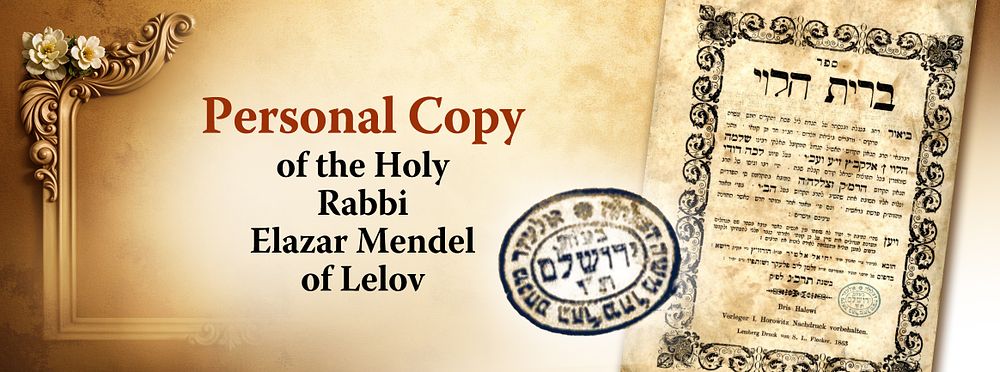
Brit HaLevi – A Kabbalistic Commentary on the Passover Haggadah (with Part of the Haggadah Text) – The Personal Copy of the Holy Rabbi Elazar Mendel of Lelov - At the Head of All Festivals is Carried Pesach Sefer Brit HaLevi – Commentary in Revealed and Hidden Aspects on the Passover Haggadah, authored by the Kabbalist Rabbi Shlomo Alkabetz, author of Lecha Dodi. [Lemberg], printed by Zalman Leib Flecker & Partners, [1863]. First edition. This is the personal copy of the third Rebbe of Lelov, the holy Rabbi Elazar Menachem Mendel Biderman, from his time in the holy city of Jerusalem. The book contains nineteen chapters, with commentary on the Haggadah. In chapters 16-19, part of the Haggadah text is printed in the center of the page with commentary surrounding it [starting from Ha Lachma Anya, the Four Questions, Avadim Hayinu, the story of Rabbi Elazar ben Azariah… and Rabbi Akiva reclining in Bnei Brak, Rabbi Elazar ben Azariah saying ”Behold, I am like a seventy-year-old man, ” Baruch HaMakom, the Four Sons—Wise, Wicked, Simple, and the One Who Does Not Know to Ask, and VeHigadeta LeVincha, from ”In the beginning our ancestors were idol worshippers” until ”And Jacob and his sons went down to Egypt”]. On the title page and other locations appear the personal stamps of the holy man of God, Rabbi Elazar Menachem Mendel Biderman of Lelov, one of the greatest Rebbes of the generations and the leading Rebbe in the Land of Israel. The stamp reads: ”Elazar Menachem, son of the rabbi, Rabbi Moshe, of blessed memory.” This sacred Kabbalistic book served Rabbi Elazar Mendel in his holy service at his home facing the Temple Mount, on the night of Passover—the highest night of the year with the greatest revelations among the Hasidic tzaddikim! It is deeply moving to see throughout the book many liquid stains, characteristic of Haggadot, remnants from the table of this man of God. It is known that in the Lelov dynasty, they observed strict stringencies during Passover, using special utensils, garments, and even a separate residence for the holiday. A famous story tells of a Hasid who once came to Rabbi Elazar Mendel on the eve of Passover, pleading for prayers for his gravely ill wife. The Rebbe asked, ”Perhaps there is chametz left in your house?” The man searched thoroughly and found nothing, returning disheartened to the Rebbe. The Rebbe then instructed him to check a particular book he had studied while eating kugel on Shabbat. Indeed, the man found a stray noodle between the pages. As soon as he burned the chametz, his wife recovered. Therefore, it is likely that the signs of use and remnants in this book are from the Seder night itself, as it was probably not used after Passover. It is fitting to quote the Divrei Chaim of Sanz regarding Rabbi Elazar Mendel’s Seder night: ”We are in heaven, and we have seen that the most beautiful Seder of all was conducted by Rabbi Elazar Mendel of Jerusalem.” Rabbi Elazar Menachem Mendel Biderman of Lelov [1827–1883], was a holy man of God, known for his prophetic spirit and miraculous deeds. He was the son of Rabbi Moshe of Lelov, grandson of the holy Jew of Peshischa, and son-in-law of Rabbi Tzvi, son of the Seer of Lublin. Great Hasidic tzaddikim like the Divrei Chaim and the Tiferet Shlomo of Radomsk praised him highly. He immigrated to Jerusalem in 1851 and was the first Rebbe to lead a Hasidic community in the city. He became renowned for his lengthy prayers at the Western Wall, which he visited daily. Especially on Friday nights, he revealed hidden secrets with intense fervor, his heart and eyes directed heavenward. He famously told his son, Rabbi Dov Tzvi Shlomo of Lelov, that when he says ”Good Shabbos” to the Western Wall, the Wall responds, ”Good Shabbos” in return. Few know that Rabbi Elazar Mendel established the traditional Jerusalem attire known as the goldene kapoten (golden robe), sewn according to his instructions with 26 pieces of fabric corresponding to the Tetragrammaton. He taught that the patriarchs wore this garment while in the Land of Israel. He also introduced the Jerusalem-style hanging oil lamp (heingleichter), designed with ten wicks corresponding to the ten sefirot. [2], 44 leaves. 25 cm. The stamps appear on the title page, leaf 21, and the front guard leaf. On leaf [2b], there is a beautiful stamp of his son, Rabbi Yerachmiel Yosef, who inherited the book from his holy father. Overall good condition. Numerous sacred stains and signs of use. Tears on the first two leaves and small tears on several others. Original worn binding, partially detached front board.