Bidspirit auction | Ma'aseh Yeshu HaNotzri: Significant Jewish
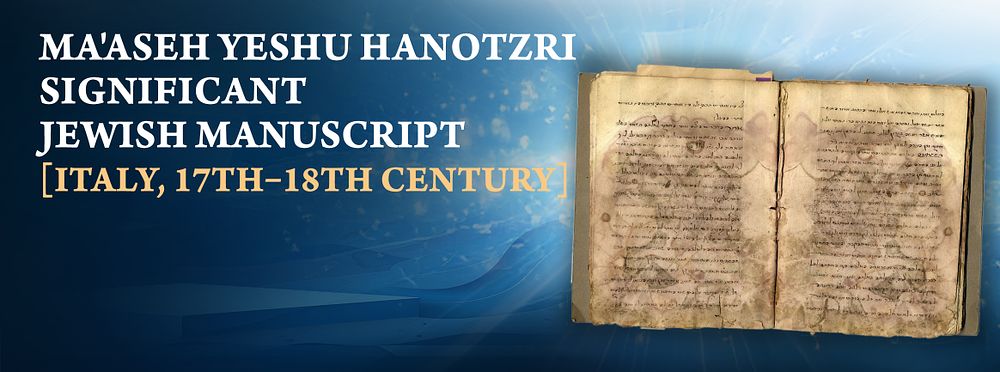
Ma'aseh Yeshu HaNotzri: Significant Jewish Manuscript [Italy, 17th–18th Century] - Italian manuscript from approximately the 18th century, containing historical Jewish tales, some of which are unknown today. Professional, clear, and aligned Italian script. [Italy, 17th–18th century]. A rare and important historical manuscript. The first part of the manuscript [from page 1 to approx. page 84] contains about ten different tales, some of which are historical and some unknown in modern literature. The second part of the manuscript [from page 87 to page 137] presents the story of the appearance of Yeshu and the founding of Christianity—from a distinctly Jewish perspective that completely rejects the Christian narrative. This is an ancient Jewish work of unknown authorship, recounting the history and events surrounding “that man.” The work is known by various names: Sippurei Korot HaNotzrim, Ma'aseh Yeshu, Toldot Yeshu HaNotzri, or Aggadata d’Shimon Keifa. In this manuscript, the story is titled: “Ma'aseh Shehayah Kach Hayah” (”A Story That Truly Happened”). Naturally, the book was never printed by Jews due to fear of persecution. It was only transmitted in manuscript form, as a sort of “hidden scroll.” Over time, it passed through the hands of various scribes, resulting in multiple textual variations (see: Eisenstein, Otzar Vikuchim). It appears that Rashi—who lived during the time of the First Crusade—was familiar with this work, and even alluded to it in a passage that was censored from the Babylonian Talmud. His commentary on it was likewise censored (see attached reproduction and explanation). Approx. [140] pages, 20×15 cm. Thick Italian paper, survived fungal damage. Condition: Fair–poor. Severe mildew stains. Most leaves remain intact. Approx. [10] leaves torn with losses. Background: According to the version cited in the censored Rashi passage—and also preserved in this manuscript—the Christian “apostles, ” John Paul and Peter (whose real name was Shimon Keifa), were actually Jewish impostors. After the execution of Yeshu, his followers began persecuting Jews. Shimon Keifa devised a plan: he took the Shem HaMeforash (the explicit Name of God), traveled to the cities of the Christians, performed miracles using it, and claimed to be a messenger of Yeshu. In Yeshu's name, he commanded the people to separate from Israel and taught that Yeshu did not desire the destruction of the Jews. Rather, he wished their existence to serve as a reminder of his suffering, and that their punishment would come only in Gehinnom, in the World to Come. Thus, if a Jew strikes a Christian on the left cheek, the Christian must offer the right cheek as well. Later, in order to secretly continue observing Judaism and fulfilling mitzvot, Shimon Keifa instructed that a tall tower be built for him, where he would live on bread and water and compose liturgical poems.