Bidspirit auction | Extremely Rare – Autograph Signature
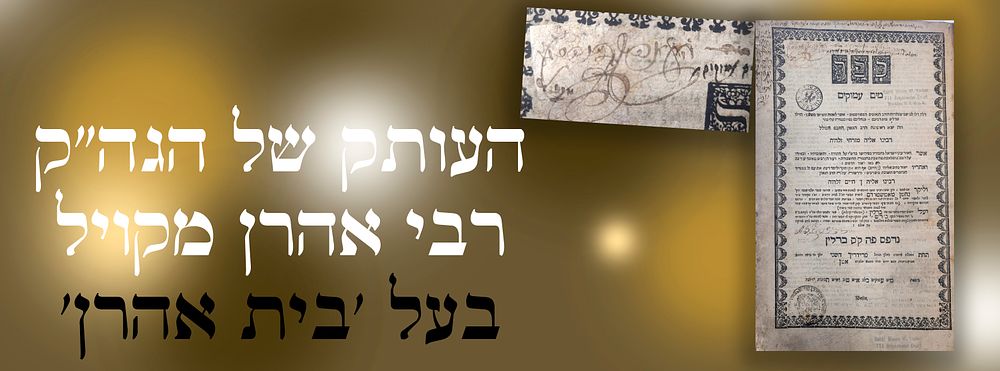
Extremely Rare – Autograph Signature of the Holy Gaon Rabbi Aharon of Kuyl, Author of Beit Aharon, Patriarch of the Engelman Family – on She’elot u-Teshuvot Mayim Amukim – Berlin, 1778 - She’elot u-Teshuvot Mayim Amukim, by Rabbi Eliyahu Mizrachi (the Re’em) and Rabbi Eliyahu ben Chaim (the Ranach). New edition by Rabbi Nachman of Amsterdam, with numerous approbations from the great sages of the generation. Berlin, 1777–1778. This sacred copy belonged to the holy Gaon Rabbi Aharon Engelman of Kuyl, author of Beit Aharon, one of the great tzaddikim of Poland and progenitor of a large and distinguished Hasidic family. On the title page appears his beautiful autograph inscription in his own holy hand: “This book belongs to me, which God has graciously granted me, the small Aharon son of R. Gershon, and my prayer to He who dwells in the heavens is to enlighten my eyes to understand in the Mayim Amukim, here in Kuyl.” To the best of our knowledge, no copy of a book belonging to the holy Gaon, author of Beit Aharon, of Kuyl has ever before appeared in public sale. The holy Gaon Rabbi Aharon Engelman, Av Beit Din of Kuyl (1797–1845), was among the great tzaddikim and Hasidim of Poland—a Gaon, a saint, and an outstanding preacher. He was a close friend of the holy Kabbalist Rabbi Eliyahu Rogeler of Kalish. “During his time as rabbi in Kuyl, the town was filled with Torah” (Beit Aharon, biographical appendix). He was the son of the distinguished R. Gershon Placzkier (mentioned in his inscription). He passed away at a young age, and his descendants spread throughout Poland, many becoming outstanding Hasidim and Torah leaders. His teachings were published in Beit Aharon (Piotrków, 1931), which includes his will and biography. Among his sons: Rabbi Moshe Naftali, Av Beit Din of Kuyl after his father’s passing, who refused to accept payment for his service. Rabbi Gershon Engelman, Av Beit Din of Kroshnovitz, disciple of R. Avraham of Tchechnov and the Sfat Emet; remembered as “holy and pure all his life, ” and highly honored by the Sfat Emet. Rabbi Avigdor Shmuel, Rosh Yeshiva of Kroshnovitz, called by the Avnei Nezer: “the great tzaddik of Poland.” The magnate R. Yissachar Yaakov—renowned for Torah and wealth combined. It was said of him: “Without exaggeration, one may say that whoever did not behold in his lifetime the majesty of the house of R. Yaakov Engelman, never saw true Jewish honor.” He served as president of Kollel Warsaw, and many Polish rabbis and rebbes would stay at his estate, among them the Avnei Nezer, the “Good Jew” of Gostynin, the author of Nefesh Chayah, and many others. [104] leaves. 33.8 cm. Condition: Good–fair. Loss of text in a few lines of the last two leaves. Some wear and staining at edges. Small wormholes. Old simple binding. ––– On the title page is an additional inscription testifying that this book belonged to the holy Gaon author of Beit Aharon, written and signed by Rabbi Raphael Ze’ev Leventhal of Kuyl, son of Rabbi Ephraim of Kuyl and son-in-law of the Chemdath Shlomo of Warsaw. Rabbi Raphael Ze’ev writes: “Belongs to the sharp and brilliant rabbi, prince and leader, dwelling in the tent of Torah, our master Aharon, son of the distinguished R. Gershon… 1817. Signed by the small Raphael Ze’ev, son of the Gaon R. Ephraim HaLevi, Av Beit Din of Kuyl.” Rabbi Aharon and Rabbi Raphael Ze’ev were related: Rabbi Aharon’s wife was the daughter of Rabbi Alexander Yehudah Margaliyot, author of Midrash Ketubah (Warsaw, 1823), who was an uncle of Rabbi Raphael Ze’ev. Rabbi Raphael Ze’ev HaLevi Leventhal, Av Beit Din of Zokroczyn (Chachmei Polin, p. 149), was one of the great Gaonim of Poland. Son of Rabbi Ephraim HaLevi, Av Beit Din of Kuyl (d. 1831), and son-in-law (first marriage) of Rabbi Shlomo Zalman, Av Beit Din of Warsaw, author of Chemdath Shlomo, with whom he edited that work. In Igrot R. Akiva Eiger (p. 57, n.), it is recorded that in 1831 R. Akiva Eiger wanted him to succeed his father in the rabbinate of Kuyl. ––– “It is told by the elders of Kuyl: booksellers were reluctant to show Rabbi Aharon new books to examine, for once he looked through them he would know the entire content by heart from beginning to end, and there would no longer be any need to purchase the book” (Beit Aharon, p. 247).