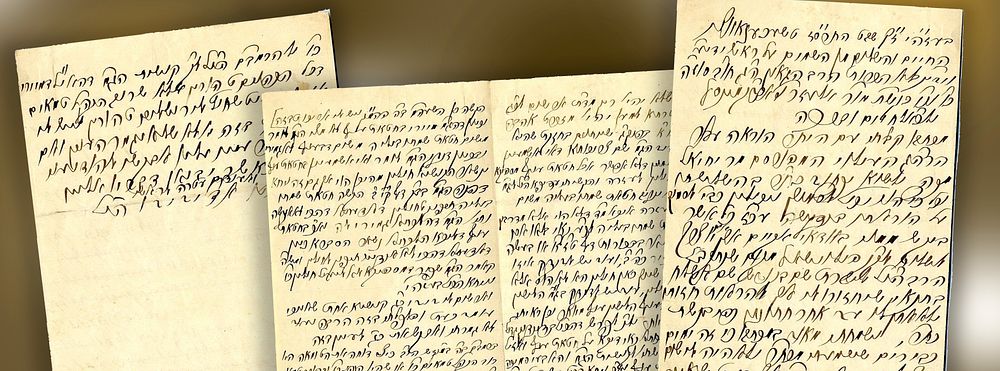
Bidspirit auction | “Zikhron Ahavah” – Beautiful Torah
“Zikhron Ahavah” – Beautiful Torah novellae letter from the Gaon Rabbi Yehuda HaChanuchi to the Gaon Rabbi Eliezer Rabinowitz, Av Beit Din of Minsk - Three-and-a-half-page letter in the handwriting and with the signature of the Gaon Rabbi Yehuda HaChanuchi, Av Beit Din of Tschechnovitz, son-in-law of the “Saba of Slabodka” and grandfather of Rabbi Nosson Tzvi Finkel, Rosh Yeshivat Mir. Tschechnovitz, 1907. The letter was sent to the renowned Gaon Rabbi Eliezer Rabinowitz, Av Beit Din of Minsk, one of the great leaders of Orthodox Jewry in Lithuania in those years. The first page deals with granting a heter hora’ah for “the renowned prodigious Gaon R. Yechiel Mifeh, ” which would be written only after his marriage, in keeping with custom. Thereafter, he writes an additional two and a half pages as a “Zikhron Ahavah”, with Torah novellae on the laws of sacrifices and a question concerning the laws of purity in Jerusalem. The Gaon Rabbi Yehuda HaChanuchi, Av Beit Din of Tschechnovitz (1857–1923), son-in-law of the Saba of Slabodka and grandfather of Rabbi Nosson Tzvi Finkel, Rosh Yeshivat Mir. Already in his youth, his genius was recognized, and he became known as “the Illui of Brestovitza.” He was considered a great Torah authority, and many turned to him in financial disputes. He often sat in judgment together with Rabbi Kammai, and it is known that Rabbi Chaim of Brisk would at times invite him to sit with him on complex halachic cases. His writings and novellae were lost in the great fire ignited by the Cossacks during World War I. At that time, many rabbis fled with their communities to Russia, but Rabbi HaChanuchi resolved not to abandon his town. He bore the suffering together with his townspeople and declined many invitations to serve as rabbi in larger towns. He served in his rabbinic post for thirty-seven years, until his passing. The Gaon Rabbi Eliezer Rabinowitz, Av Beit Din of Minsk – one of the greatest Torah sages of his generation, a preeminent genius and renowned for his sharp insight. Because of his extraordinary acumen, he was often called upon to adjudicate difficult halachic disputes. He participated in the rabbinic conferences in Petersburg, which deliberated pressing issues of the generation. Rabbi Eliezer was a foremost disciple of the Beit HaLevi in Slutsk, and afterward studied in the Volozhin Yeshiva. In 1879, he was chosen by the “Gadol of Minsk” as his son-in-law, and after the Gadol’s passing, he succeeded him as rabbi of Minsk, a position he held until his own passing in 1924. A small portion of his writings, smuggled out of Russia, was published in 1962 under the title Mishnat Eliezer. [See: HaGadol MiMinsk, pp. 88–91; Rabboteinu She’baGolah, vol. I, pp. 96–98.] [1] folded leaf, 13x21 cm. Good condition.