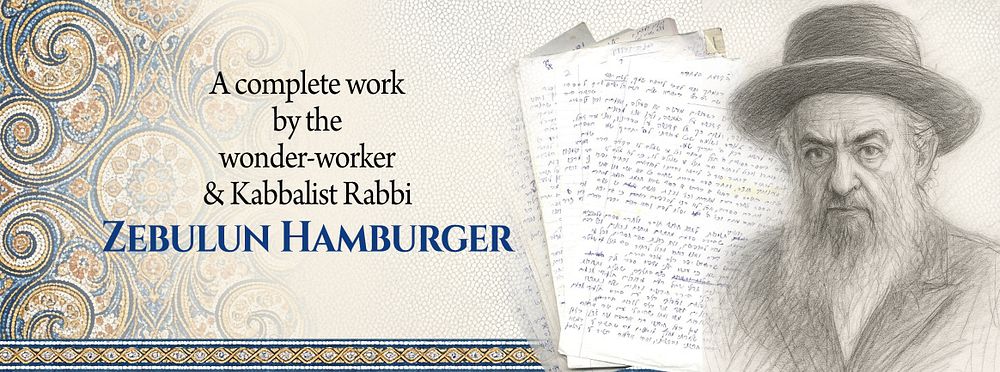
Bidspirit auction | Manuscript – “BeKo’ach Emunah U’Bitachon”.
Manuscript – “BeKo’ach Emunah U’Bitachon”. a complete work by the wonder-worker and Kabbalist Rabbi Zebulun Hamburger - ”And I ask that whoever reads a story in this booklet — should say it in my name and in the name of my book, and then he shall be blessed with all goodness!” (From the author’s introduction) A rare and sacred autograph manuscript — the original handwritten draft of the renowned work “BeKo’ach Emunah U’Bitachon” (Through the Power of Faith and Trust) by the Jerusalem Kabbalist Rabbi Zebulun Hamburger (Zatzal), author of the thirteen-volume series “Sha’arei Zevul.” [Jerusalem, 2002]. The manuscript spans approximately fifty-two large folio pages, densely written in the author’s clear, flowing hand. It is an autograph copy, containing numerous revisions and corrections throughout the text. This work — together with the author’s other writings — was warmly received among the leading sages and righteous figures of the generation, earning enthusiastic approbations from preeminent rabbis such as the Gaon of Tchebin, Rabbi Yosef Shalom Elyashiv, Rabbi Shlomo Zalman Auerbach, Rabbi Chaim Kanievsky, and others. A book of segulah (spiritual merit): At the beginning of the printed edition, the author emphasized the mystical and spiritual potency of the work, which is based on true stories and events from contemporary life, intended to strengthen the reader’s faith and trust in God. In his remarkable promise, the Kabbalist wrote: ”And I ask that whoever reads a story in this booklet — should say it in my name and in the name of my book, and then he shall be blessed with all goodness!” This autograph manuscript — from the pen and hand of one of Jerusalem’s great Kabbalists and Torah giants of the last generation — represents a living synthesis of mysticism, revealed Torah, and moral teaching, reflecting the spiritual atmosphere of the “Jerusalem Above.” Approximately 52 large folio leaves (29×21 cm), densely written in the author’s sacred handwriting, with corrections and additions throughout. A printed transcription is included. Condition: good to very good; light age stains. Biographical Note Rabbi Zebulun Hamburger (1942–2019) — the Jerusalem Kabbalist and author of Sha’arei Zevul — was revered as a wonder-worker and spiritual guide whose blessings were considered to bring salvation. One of the foremost Torah scholars and mystics of his generation. Named after his grandfather, the righteous Jerusalem sage Rabbi Zebulun Charlap, he studied at Etz Chaim Talmud Torah and Yeshiva, and later at Yeshivat Tchebin under Rabbi Dov Berish Weidenfeld — who granted an approbation to his first book, Sha’arei Zevul. He continued his studies in the Slonim and Mir yeshivot under leading Torah authorities. After his marriage to Rickel, daughter of Rabbi Yeshayahu Williams, he settled in Moshav Gimzo, where he served for decades as rabbi and spiritual mentor, delivering profound Torah lectures in the central synagogue. Alongside his mastery of Kabbalah, he was a distinguished halachic scholar. After his father’s passing, he published his father’s Torah insights in three volumes: Avnei Chen, Ataret Moshe, and Chidushei Rabbi Avraham Moshe. Rabbi Zebulun was known for his piety, humility, and holiness. He was learned in the mystical wisdom of the hand and face, received many visitors seeking blessings and counsel, and countless people testified to miraculous salvations through his words. His blessings were regarded as possessing extraordinary spiritual power. In 1990 (תש״ן), he undertook one thousand fasts “for the merit of the People of Israel, ” and upon completing the thousandth fast, collapsed from weakness. Even during his final years, after suffering a severe stroke, he continued to receive visitors and offer blessings. He passed away on the 2nd of Shevat, 2019 (תשע״ט), and was buried on Har HaMenuchot in Jerusalem. His writings — especially the thirteen-volume Sha’arei Zevul series — continue to be studied and cherished, regarded as a wellspring of wisdom and Kabbalistic insight in the modern era.