Bidspirit auction | Asaf HaMazkir. Venice, Bragadin Press,
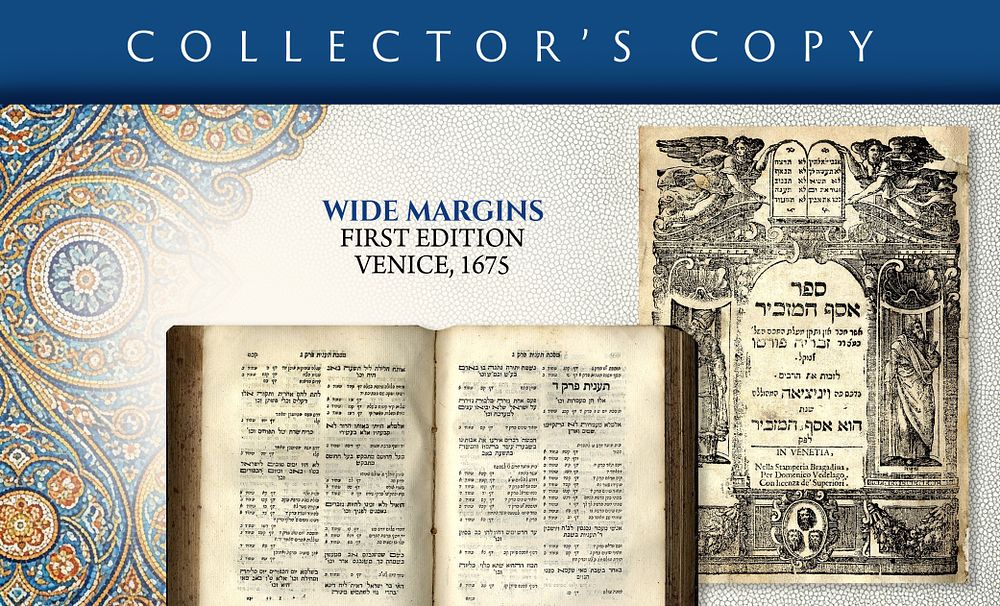
Asaf HaMazkir. Venice, Bragadin Press, 1675. First Edition. Wide Margins - A rare and important work from the golden age of Hebrew printing in seventeenth-century Italy. Asaf Ha-Mazkir (“The Collector Who Reminds”) is a systematic index of references and citations to sermons, kabbalistic and ethical works in which the Aggadic passages of the Talmud—as compiled in Ein Yaakov—are discussed. It represents one of the earliest attempts to create a structured cross-reference system for rabbinic homiletic literature and remains a primary source for tracing the dissemination of rabbinic legend in post-Talmudic writings. The author, Zechariah Porto (see Otzar Ha-Rabbanim no. 5582), was among the learned and affluent figures of the Italian Jewish intelligentsia in the late seventeenth century. A descendant of the distinguished Porto family of Rome and Florence, he was a man of learning, means, and generosity—a patron of Torah scholars and of Jewish communal life, though not a rabbi in the formal sense. Contemporary records describe him as a devoted scholar and benefactor who supported educational and literary endeavors throughout the Italian communities. He passed away in 1675, the very year this volume was issued. The book was printed posthumously at the initiative of the Hevrat Bene Talmud Torah of Rome, fulfilling the author’s testamentary wish. The Bragadini press of Venice, one of the finest Hebrew printing houses of its time, produced the volume with remarkable typographical and paper quality. Among the many sources cited by Porto are rare and early homiletic and kabbalistic works, some of which were unknown in print during his lifetime. Modern bibliographers (including Mordechai Narkiss and Joseph Simcha Lewinger) have shown that several of these works appeared in print only decades later, indicating that Porto had access to manuscripts and oral sources now lost to history. Consequently, Asaf Ha-Mazkir serves not only as a reference tool but also as a unique bibliographical repository preserving traces of vanished Hebrew compositions. The work was later reprinted within several editions of Ein Yaakov, notably the Amsterdam edition of 1725–1726 [Taf-Pei–Taf-Pei-Vav], where it became an integral part of the text. The title page is beautifully framed and ornamented with woodcut decoration, typical of the refined Venetian aesthetic of the late seventeenth century. [4], 300 leaves. 21.5 cm. Very good condition. Fine, crisp paper, wide margins, light stains only. New half-leather artistic binding.