Bidspirit auction | Semichat Chachamim – Two Parts.
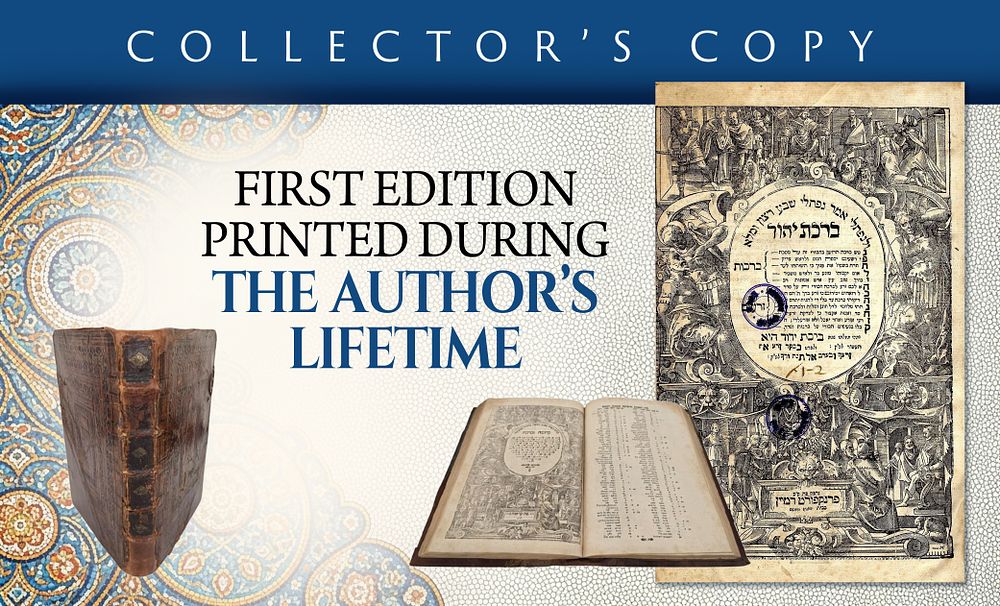
Semichat Chachamim – Two Parts. Frankfurt am Main, 1704–1706. First Edition, Printed During the Author’s Lifetime - A complete and impressive copy, bound in its original wooden boards covered with leather, partially and artistically restored. The celebrated work Semichat Chachamim by Rabbi Naftali Katz, eminent scholar and kabbalist, printed during the author’s lifetime and regarded as his first major publication. The volume is divided into three sections: Semichat Chachamim – an analysis of the structure and sequence of the Orders and Tractates of the Mishnah, and the conceptual connections (semichot) between them. Introduction to Semichat Chachamim – a study of the names and internal relationships of the Mishnah’s divisions. Kedushah u’Berachah – novellae and insights on Tractate Berachot. The work was composed during the first year of Rabbi Katz’s tenure as Chief Rabbi of Frankfurt am Main and already demonstrates his extraordinary mastery of both the revealed and esoteric dimensions of Torah, along with his rare ability to harmonize the two with clarity and depth. Rabbi Naftali Katz (1650–1719) was among the great kabbalists of Ashkenaz in the 17th–18th centuries. He served as rabbi and Av Beit Din of Ostroha, Poznań, and Frankfurt am Main, and from his youth was famed for his sanctity and prodigious diligence—reportedly knowing the entire Talmud by heart. At a young age he was appointed head of the Ostroha Yeshivah, later Chief Rabbi of Poznań, and eventually became the head and leader of the Council of the Four Lands, the supreme rabbinic authority of Polish and Ashkenazic Jewry. In 1704 he assumed the rabbinate of Frankfurt am Main. His resting place in Constantinople remains a site of pilgrimage and prayer to this day. On the second leaf appears a poem printed in the shape of a star, a feature lacking in many known copies. The leaf, printed on larger paper than the rest of the book, is folded at its edge. [1], 140 leaves. 33.5 cm. Condition: Very Good. Printed on white, high-quality paper with minor age-staining. Original wooden boards covered with brown leather, expertly restored, retaining the original blind-tooling and traces of brass clasps. Both title pages are considered among the most beautiful and artistic in Hebrew printing, richly adorned with numerous figures, ornaments, and elaborate engravings.