Bidspirit auction | A rare and fascinating relic
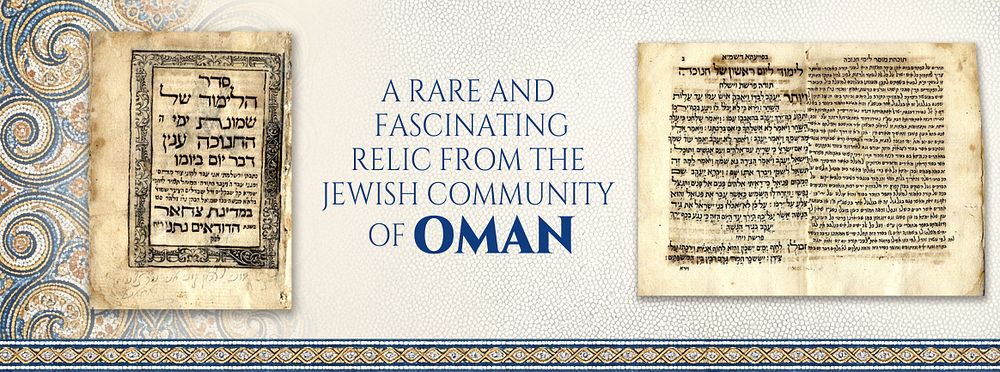
A rare and fascinating relic from the Jewish community of Oman – a beautiful kabbalistic manuscript of “The Order of Study for the Days of Hanukkah, ” dated [1809] - The manuscript is complete and rare, adorned with elegant and meticulous calligraphy. On the title page appears, in large letters: “Order of Study for the Eight Days of Hanukkah – the Subject of Each Day in Its Turn.” Below, in smaller script: “Written and completed by me, a servant to my Creator, my Rock and my Protector; a servant of God and of the Torah, ever hopeful for divine mercy, the least of the least and the poorest of the poor, Shmuel son of our teacher and master Menashe, grandson of the honored elder Shmuel HaKohen, may his light shine, may his memory be blessed, amen, selah.” And further in larger script: “In the city of Tsahar (modern Sohar, Oman), in the year ‘The mandrakes have given forth their fragrance’ (1809).” Around the title page is affixed a rectangular printed decorative border, apparently added at a later period. In a later ownership inscription in pencil on the title page is written: “Eliezer Vazana.” The work contains a daily study cycle for Hanukkah, based on verses from the Torah, the Prophets, the Writings, and passages from the Zohar, following the order of Ḥemdat Yamim. At its conclusion appears a long and profound kabbalistic prayer, intended to be recited after the study session. The introduction, extending over three pages under the heading “Words of Moral Reproof for the Days of Hanukkah, ” offers a rare glimpse into the spiritual world and customs of the Jewish community of Tsahar – a community that disappeared in the early 19th century. The author records ancient local traditions, including a well-known Ashkenazic custom in which schoolchildren would bring their teachers “Hanukkah money” as a token of honor and holiday joy. Another manuscript by the same author, concerning the Days of Awe and the Selichot period, was once held in the collection of Rabbi David Solomon Sassoon, of blessed memory (see Otsar HaChokhmah, Ohel David, p. 855, item 794, under the title “Otsar Neḥmad”). On the Jews of Oman: The Jewish presence in Oman was among the most ancient and remote communities in the Arabian Peninsula. As early as the ninth century, Jewish settlements are mentioned in coastal trading cities such as Sohar, then one of the major ports of the Indian Ocean. Historical records indicate active commercial and cultural connections between the Jews of Oman and those of Babylonia, Yemen, and India. In the twelfth century, Rabbi Benjamin of Tudela visited the region and described an organized Jewish community engaged in commerce and crafts. In later centuries the community declined due to persecution, growing Islamization, and emigration to Basra and Bombay. Yet 19th-century testimonies still speak of remnants of Jewish families, mainly descendants of Baghdadi Jews who had fled there in times of oppression. By the end of that century the Jewish presence in Oman had vanished entirely, leaving behind only traces in travel accounts and manuscripts. The present manuscript therefore stands as an exceptionally rare and tangible relic of that vanished community’s spiritual and cultural legacy, reflecting a fascinating blend of Babylonian, Sephardic, and kabbalistic influences. 111 leaves. Size: 16 cm. Condition: Good. Without the original binding; minor water stains and ink smudges.