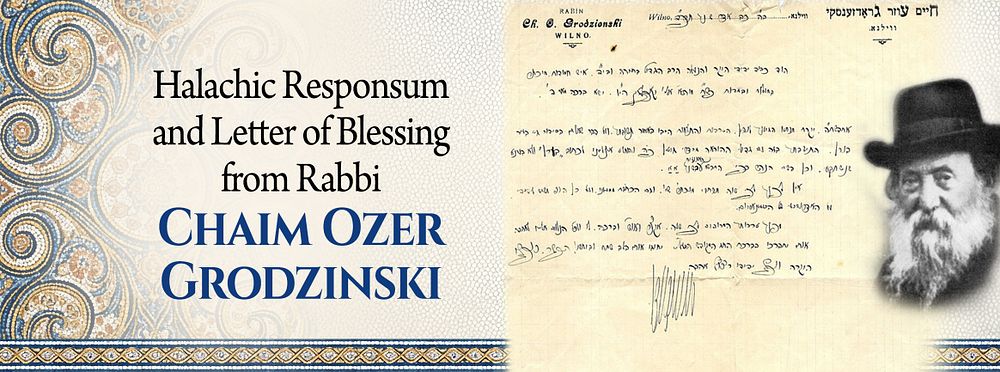
Bidspirit auction | Letter by Rabbi Chaim Ozer
Letter by Rabbi Chaim Ozer Grodzinski - Halachic Responsum and Letter of Blessing from Rabbi Chaim Ozer Grodzinski addressed to a young Torah scholar who passed away about two months after receiving it. Vilna, 5682 [1922]. A handwritten halachic response and personal letter by the renowned Gaon, Rabbi Chaim Ozer Grodzinski, addressed to Rabbi Avraham Eliyahu Kaplan of Berlin. In this letter, Rabbi Chaim Ozer refers to him with exceptional honorifics: “My dear and esteemed friend, the great rabbi in Torah and in judgment, a man of grace, crowned with virtues and refined character…” Thus the leading halachic authority of his generation addressed the young scholar—only thirty-four years old at the time. [1] leaf on official stationery. 21×26 cm. Condition: good; minor tears. Rabbi Chaim Ozer Grodzinski (1863–1940) – Chief Rabbi of Vilna, President of the Council of Torah Sages (Mo’etzet Gedolei HaTorah), and author of Shu”t Achiezer. He was the foremost leader of Lithuanian Jewry in the early 20th century, alongside the Chafetz Chaim and Rabbi Chaim of Brisk. The Chafetz Chaim referred to him as “the Nasi (leader) of all Israel.” Rabbi Avraham Eliyahu Kaplan (1890–1924) – Rosh Beit HaMidrash for Rabbis in Berlin and one of the leading figures of the Mussar movement. Born in Kėdainiai, Lithuania, to a family of distinguished rabbis—his father, known as “the prodigy of Rakov, ” died five months before his birth, and he was named after him. He studied in the famed Lithuanian yeshivot of Telz, Kelm, and Slabodka, where he became close to the Saba of Slabodka. In 1920 he married and shortly thereafter was appointed lecturer at the Rabbinical Seminary of Berlin, bringing the spirit of Lithuanian Torah and Mussar to Germany. Alongside his halachic writings, he published profound essays in Jewish thought and poetry. A talented violinist and composer, he wrote the well-known poem “Shak’a Ḥamah” (“The Sun Has Set”). During the High Holidays he would return to the Slabodka Yeshiva to serve as cantor on Yom Kippur, composing a new melody each year for “Ya’aleh Tachanuneinu”—one of which is still sung today at the Hebron Yeshiva. After only four years in Berlin, he passed away suddenly on the 15th of Iyar, 5684 (1924), at the age of just 34.