Bidspirit auction | Large and Impressive Hand-Illuminated Ketubah
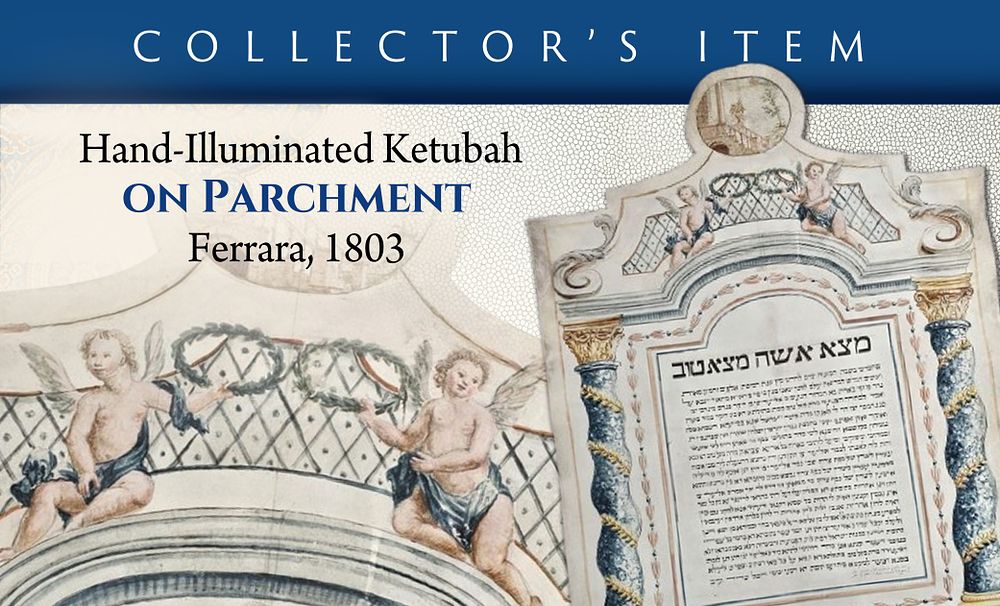
Large and Impressive Hand-Illuminated Ketubah on Parchment – Ferrara, 1803 - A rare and magnificent handwritten and hand-painted ketubah, executed on fine, thick parchment, combining elegant calligraphy with rich decorative artwork—an exceptional example of Italian-Jewish manuscript art from the early 19th century. The marriage contract was drawn up for the wedding of the groom, Eliezer son of the esteemed Pinchas Minervi, and the bride, Mazal Tov, daughter of the honorable Rabbi Moshe Sanguiniti, both members of distinguished Jewish families in the community of Ferrara. The text is written in beautiful, square Hebrew script, with the signatures of the witnesses appearing at the bottom. The text is enclosed within a rectangular frame topped by an arched design, surrounded by an additional floral border of delicate, colorful motifs. On either side rise the ornate columns of Jachin and Boaz, richly decorated with gilding and painted detail, standing upon a floral base (threshold) adorned with blossoms. The lower section is embellished with small geometric decorations that complement the overall harmony of the design. Above the columns extends a gracefully arched ceiling, painted with artistic finesse, featuring two angels, one on each side, holding garlands of laurel leaves—symbols of joy, blessing, and triumph. Above them, a large central medallion contains a tasteful pastoral scene viewed through a stairway, perhaps a poetic allusion to the newlywed couple ascending together to build their home. The top edge of the parchment is delicately cut and scalloped, lending the ketubah a refined and majestic appearance. This ketubah exemplifies the harmony between classical technique, balanced color composition, and symbolic depth, characteristic of Italian-Jewish ketubot—where art, tradition, and poetic grace unite in a single masterpiece. Dimensions: Height 80 cm | Width 56.5 cm Condition: Very good. More than a marriage document, this ketubah stands as a work of visual art, a testament to the cultural and aesthetic richness of Italian Jewry, and to a tradition that infused holiness, love, and beauty into the very fabric of Jewish life.