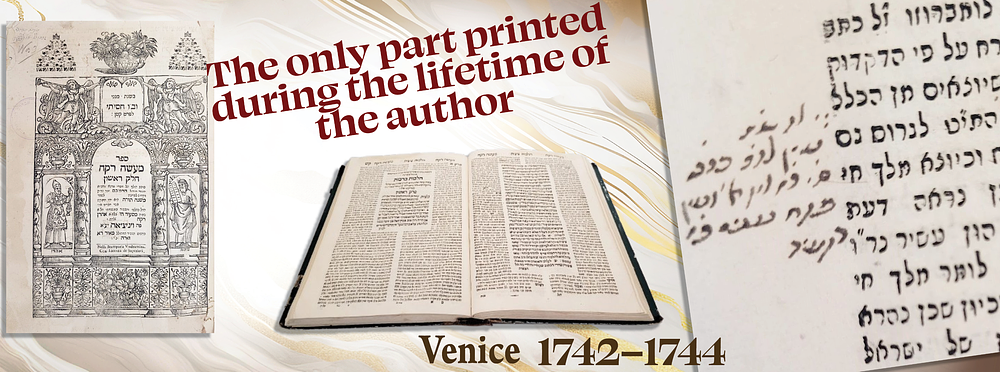
Bidspirit auction | Ma‘aseh Roke’aḥ. Venice, [1742–1744]. The
Ma‘aseh Roke’aḥ. Venice, [1742–1744]. The only part printed during the lifetime of the author - Ma‘aseh Roke’aḥ. Venice, 5502–5504 [1742–1744]. The only part printed during the lifetime of the holy author. A comprehensive commentary on Mishneh Torah by Maimonides, by the The terrible genius Rabbi Mas‘ud Ḥayy Roke’aḥ, among the leading sages of Izmir and later Chief Rabbi of Tripoli. Part One – First Edition. An important and early foundational work in the commentaries on Mishneh Torah, authored by The immense and terrible Kabbalah genius Rabbi Mas‘ud Ḥayy Roke’aḥ, one of the foremost Eastern rabbinic authorities of the eighteenth century. Presented here is the first edition of the first part, which is also the only part published during the author’s lifetime. The book was printed with the text of the Rambam at the center, without the glosses of the Ra’avad—a striking and unconventional feature in Rambam printing. In his introduction, the holy author explicitly addresses the anticipated question—“And here the son asks”—why he departed from accepted practice. His principled answer is that his aim was not to engage in “answers and repartees” to the Ra’avad’s objections, since these had already been addressed by the Maggid Mishneh and the Kesef Mishneh; and that “it is not proper to mention the objection without the response.” Accordingly, it would be improper to print the objections without the accompanying explanations. This approach reflects a sharp methodological stance and exceptional scholarly integrity. At the beginning of the book, the holy author copied commentaries on the Rambam from earlier authorities, foremost among them Rabbeinu Abraham ben Maimonides. Of particular significance is the fact that Ma‘aseh Roke’aḥ served for many years as the only printed edition of the writings of Rabbeinu Abraham ben Maimonides, a circumstance that granted the work a central and exceptional status in the history of Rambam interpretation. The book is regarded as one of the foundational works on Mishneh Torah not only for its establishment of the Rambam’s text, achieved through a systematic comparison of seven different textual versions, but also for the depth of the commentary itself, which combines vast erudition, textual precision, and broad halakhic judgment. The author—Rabbi Mas‘ud Ḥayy Roke’aḥ (c. 1690 – 10 Av 5528 [1768]): In his youth he studied Torah with the rabbis of Izmir, including Rabbi Ḥayyim Abulafia (the younger) and Rabbi Yitzḥak Kohen Rappaport. He later immigrated to the Land of Israel and, in 5509 [1749], went as an emissary to North Africa. Upon completing his mission, he settled in Tripoli, Libya, where he was appointed Av Beit Din, alongside Rabbis David Tayyar and Benjamin Atori. His leadership brought about a profound spiritual transformation among Libyan Jewry, which after years of persecution and dispersion was in need of a central Torah authority. His influence extended throughout all the Jewish communities of Libya. He passed away in Tripoli on 10 Av 5528 [1768]. He left behind novellae on the Talmud, commentaries on the Five Megillot, and homiletic writings—mostly in manuscript, with some works lost over time. Even before his arrival in Tripoli, he maintained close ties with the communities of Venice and Livorno and visited them; his great esteem there is vividly described by his grandson, Rabbi Abraham Ḥayyim Adadi. [8], 286 leaves, including index leaves at the end, which are not present in all copies. 28.5 cm. Condition: good. Light age staining. Simple binding. A fine copy of an important Rambam commentary, in its first edition and the only part printed during the author’s lifetime—a sought-after item for collectors and rabbinic libraries.