Bidspirit auction | A list of Lithuanian yeshiva
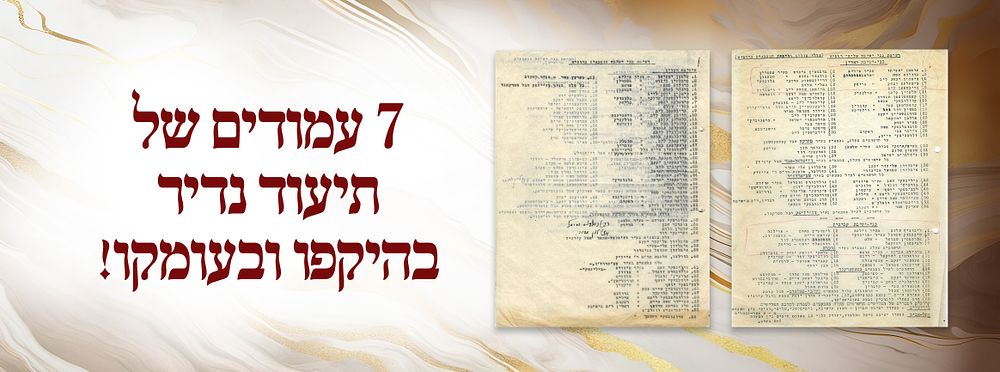
A list of Lithuanian yeshiva students during the Holocaust — a Torah-historical Holocaust document of exceptional significance - Original nominal lists of the Vaad HaYeshivot, containing full details of hundreds of yeshiva students from Lithuania and Poland who were exiled—together with their rabbis and in an organized manner—from cities in occupied Europe to the expanses of Russia during the Holocaust period. Eretz Israel, circa 1940. Before us is documentation rare in both scope and depth: across approximately seven large sheets are printed the complete particulars of hundreds of yeshiva students who were uprooted from their places of study as the Nazi occupation advanced in Poland and Lithuania. Each entry records the student’s full name, family name, city of origin, the yeshiva in which he studied, and the city or region to which he was exiled in Russia. This is a primary source of the highest order for understanding the routes of exile, dispersal, and rescue of the yeshiva world during the first years of the war. Breakdown of yeshivot and registrants: From the Radin Yeshiva — 53 names, with places of origin noted, organized by cities of exile. From the Beit Yosef–Bialystok Yeshiva — 54 names, organized by cities of exile. From the Kletsk Yeshiva — 33 names, with places of origin and exile destinations noted. From the Kamenitz Yeshiva — 28 names, with places of origin and exile destinations noted. From various yeshivot — approximately 50 additional names, including students from the yeshivot of Grodno, Mir, Bobov, Slabodka, and Pinsk (on two separate sheets). At the end of the document, the purpose of publishing the lists is stated: relatives and acquaintances of the listed refugees are asked to make contact and assist them through the offices of the Hebron Yeshiva in Jerusalem, as well as via the office of the Heichal HaTalmud Yeshiva in Tel Aviv. Some of the students appearing in this document perished during the Holocaust; however, many survived, and they later formed the central nucleus for the rehabilitation of the yeshiva world in Eretz Israel and the United States. The young men listed here constitute the human foundational core of the post-Holocaust yeshiva world. Upon them the destroyed world of Torah was rebuilt: from among them emerged roshei yeshiva, mashgichim, rabbis, and educators who established and led the principal yeshivot in Israel and the Diaspora. These names—written at the darkest hour for the Jewish people—are the vital link between the pre-Holocaust yeshiva world and its remarkable rebirth afterward. The students recorded here—those who survived the Holocaust—are the “etzem haluz” from which the yeshiva world returned to life, and the present document serves as living testimony to the beginnings of that immense enterprise of renewal and continuity. [7] leaves, approx. 28 cm. Typewritten, with contemporary handwritten corrections. Thin paper. Condition: good to very good. Age stains, fold marks, and filing holes. Historical background to the document: With the outbreak of World War II in 1939, yeshiva students fled from Poland to Vilna in Lithuania, which at that time was briefly an independent state. After the annexation of the Baltic states by the Soviet Union, the Soviet authorities began mass deportations of those deemed “undesirable, ” including Jewish refugees and yeshiva students. Ironically, this deportation—to Siberia, the Komi Republic, and regions of Central Asia—saved the lives of thousands of yeshiva students, as it removed them from areas of German occupation before the Nazi invasion of the Soviet Union in June 1941 (Operation Barbarossa). The most famous case is the Mir Yeshiva, which survived almost intact; however, students of the Kamenitz, Radin, Bialystok, Novardok, and other yeshivot were also deported to labor camps under harsh conditions, engaged in a daily struggle for survival and for the preservation of their religious identity. Survivors of the Russian and Siberian exile were, after the war, among the central forces in the rebuilding of the world of Torah and the yeshivot in Israel and the United States.