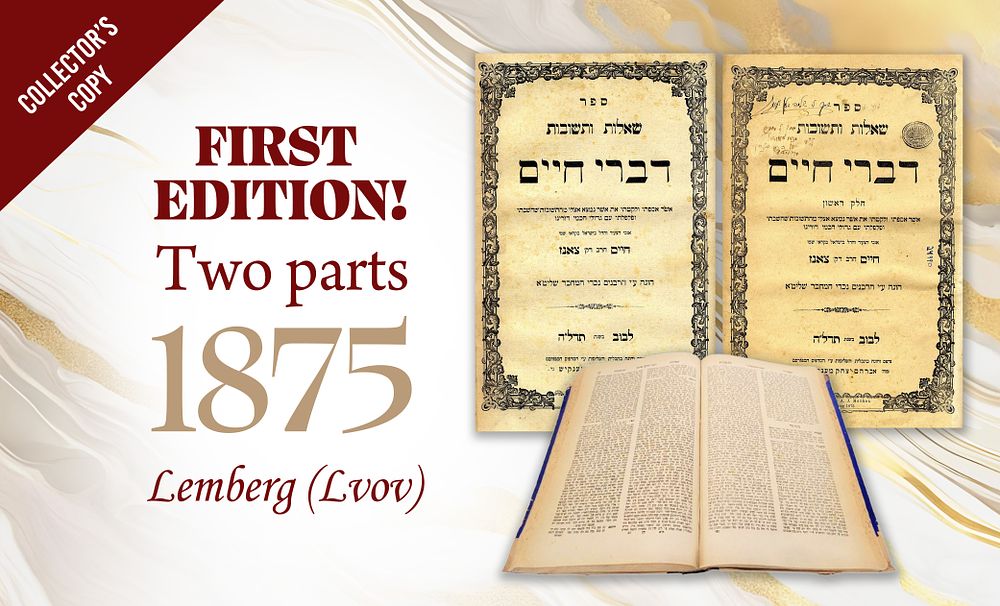
Bidspirit auction | Responsa Divrei Ḥayyim, Sanz. Lemberg
Responsa Divrei Ḥayyim, Sanz. Lemberg (Lvov), 1875. Two parts. First edition - Sefer She’elot u-Teshuvot Divrei Ḥayyim. Responsa on the four sections of the Shulḥan Arukh. Lemberg (Lvov), 1875. First printing. Two parts in one volume. First edition. The responsa Divrei Ḥayyim were published during the author’s lifetime, the holy Rabbi of Sanz. On the title pages he writes: “Which I have gathered and collected from among the responsa that I have written and discussed with the great sages of our time— I, the young and impoverished among Israel, called Ḥayyim, the rabbi of the holy community of Sanz.” With an especially brief introduction by the author. The book was printed by his grandsons, Rabbi Shlomo Halberstam of Bobov and Rabbi Moshe Halberstam of Bardejov. Regarding his work in arranging and editing the responsa for print, it is related that after midnight the Divrei Ḥayyim would sit with his scribe, Rabbi Avish Meir, and dictate to him the final wording of his responsa—the author reciting and the scribe writing from his mouth. After dictating several sections, the Divrei Ḥayyim would go to immerse in the mikveh. Following the immersion, he would return and continue dictating the responsum. After several more sections he would again go to immerse, and then return to continue dictating—“and thus he would immerse five times each night during the period in which the scribe was committing to writing half a responsum, or one short responsum in its entirety, on the cold nights of Tevet, in order to produce novel Torah teachings in holiness and purity” (see Mekor Ḥayyim, Belz, 1912, §13). Rabbi Ḥayyim Halberstam of Sanz (1797–1876), rabbi of the city of Sanz in Galicia and founder of the Sanz Hasidic court, was among the foremost leaders of Eastern European Jewry in the 19th century. He was a disciple of the righteous Rabbi Naftali Zvi of Ropshitz and Rabbi Zvi Hirsch of Zidichov. Most of his sons and sons-in-law served as rebbes, the most famous among them being his son Rabbi Yeḥezkel Shraga Halberstam of Shinova. His descendants led numerous Hasidic dynasties, including Sanz–Klausenburg, Bobov, and Stropkov. At the same time, Rabbi Ḥayyim was renowned as one of the most significant halakhic decisors of the later period. He was ordained by Rabbi Ephraim Zalman Margalioth of Brody and corresponded on matters of halakhah with the leading rabbis of his generation. He is particularly known for his stringent rulings in the laws of mikva’ot; for his strong opposition to the use of machine-baked matzot; and to the wearing of tzitzit spun by machine. Several of his halakhic rulings stirred the Hasidic world, including his decision that unmarried men should don tefillin on Ḥol ha-Mo’ed, and his ruling that Hasidic leadership should not pass by inheritance. A considerable number of followers and interpreters of his halakhic approach were active in Galicia and Hungary. His responsa, Divrei Ḥayyim, are included in the modern rabbinic halakhic canon. Stefansky, Hasidut 119. Stefansky, Sifrei Yesod 312. Part I: [2], 134 leaves. Part II: [4], 120 leaves. Large format: 38 cm. Condition: very good. Plain binding.