Bidspirit auction | Beit Lechem Yehudah – the
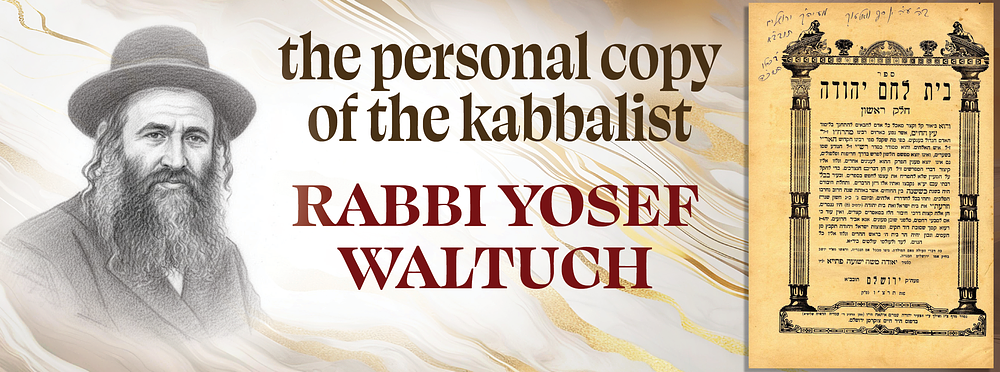
Beit Lechem Yehudah – the personal copy of the kabbalist Rabbi Yosef Waltuch - Beit Lechem Yehudah – commentary on Etz Chaim by Rabbi Chaim Vital, by the kabbalist Yehuda Moshe Petaiah. Part I and Part II. Jerusalem, 5696–5697 [1936–1937]. On the title page of Part I: an autograph presentation inscription by the kabbalist Rabbi Yosef Waltuch. Rabbi Yehuda Petaiah (5619–5702 | 1859–1942), among the foremost kabbalists of Baghdad and a disciple of the Ben Ish Chai, was referred to by some kabbalists as “the Ari of Babylon.” Although he sought to conceal his kabbalistic mastery, he became widely known as a wonder-worker following a celebrated episode in which he opposed a certain foreign-derived custom that had spread among the women of Baghdad; he offered prayers on behalf of the sick to those who accepted upon themselves to abandon the practice, and many testified to immediate recoveries. He was deeply involved in dream interpretation, kabbalistic tikkunim and amulets, and for years dealt with cases of dybbuks and harmful spirits, as reflected in his work Ruachot Mesaprot. In 5694 he immigrated to the Land of Israel, and during World War II composed prayers and kabbalistic rites and organized gatherings of leading kabbalists to pray for the salvation of the Jewish community in the Land of Israel. Among his works: Beit Lechem Yehudah, Matok LaNefesh, Afikei Mayim, Yayin HaRokeach, and others. Rabbi Yosef Waltuch (5681–5743 | 1921–1983), a revered “hidden tzaddik, ” was associated with a remarkable circle of concealed righteous men active together in the Land of Israel in the early years of the State—an extraordinary phenomenon with no clear parallel before or after. This circle included figures known as “the Sandlar” (Rabbi Moshe Yaakov Rabikov), “the Painter” (Rabbi Leon Patillon), Rabbi Avraham Fish of Tel Aviv, “Rabbi Mendel of Bnei Brak, ” and others. Rabbi Waltuch was of distinguished lineage, said to be the seventh generation in a chain of בעלי רוח הקודש tracing back to the Maggid of Zlotchov. He maintained close קשרים with leading Hasidic rebbes, including Rabbi Shlomo’ke of Zvhil, the Rebbes of Ruzhin, and the Rebbe of Lelov, who spoke of him in exceptionally exalted terms and directed חסידים to seek his blessing. Collation: [1], 135; [1], 175; [4] leaves; plus a Luach Tikkunim for both parts. Size: 31 cm. Condition: Very good. A few wormholes. Simple binding.