Bidspirit auction | Ḥiddushei Ri Migash – the
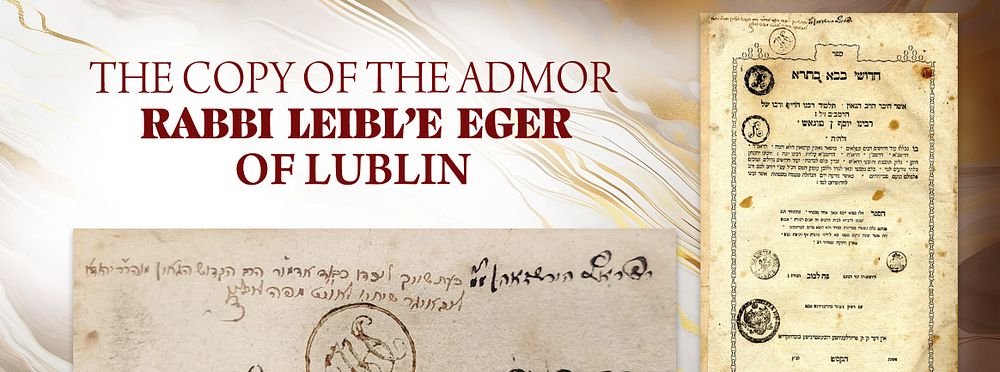
Ḥiddushei Ri Migash – the attributed copy of the Admor Rabbi Leibl’e Eger of Lublin - Ḥiddushei Bava Batra. Novellae by Rabbeinu Yosef ibn Migash (the Ri Migash). Lemberg (Lvov), 1809. On the title page appears the following note: “This book was found by a wise and eminent scholar from Spain, who was aroused and labored for many years to bring it to the printing press. Nevertheless, almost all [the manuscripts] remained in the lands of Spain… and that which has now been printed and come into our hands was obtained with great exertion and anguish of soul…” Ownership inscription on the title page: “Yisrael Hirschzahn… now belonging to his grandson, the honorable Admor, the holy rabbi and gaon, our master Rabbi Yehuda Leib Eger, may he live long, here in Lublin.” Add more Rabbi Yehuda Leib Eger (known as Rabbi Leibl’e; 1815–1888) was the grandson of Rabbi Akiva Eger and a disciple of Rabbi Menachem Mendel of Kotzk and Rabbi Mordechai Yosef Leiner of Izbica, author of Mei Ha-Shiloach. In 1854 he began serving as Admor in Lublin and became the founder of the Lublin Hasidic dynasty. He was born in Poznań to Rabbi Shlomo Eger, rabbi of Kalisz and Poznań, son of Rabbi Akiva Eger, and to the daughter of Rabbi Yisrael Hirschzohn of Warsaw (whose signature appears on the present title page). In his youth he was close to his grandfather. He married the daughter of Rabbi Azriel Gerstein of Lublin and for several years lived at his father-in-law’s table in Lublin. Like his forebears, Rabbi Leibl’e was initially among the opponents of Hasidism. However, under the influence of Hasidim of Lublin he traveled to Rabbi Menachem Mendel of Kotzk and became his disciple. When his father, Rabbi Shlomo, learned that he had become a Hasid, he mourned him and sat shiv‘ah for him. His grandfather, Rabbi Akiva Eger, however, did not distance him and maintained their relationship. Many stories about this were transmitted in Hasidic tradition. One of the best known relates that when people complained to Rabbi Akiva Eger that his grandson Rabbi Leibl’e Eger was late for prayers, he replied that it is a known principle that one transgression leads to another; since this act of Rabbi Leibl’e did not lead to any further transgression and he was regarded as holy and pure, it follows that this too was not considered a transgression in his case. Irregular pagination. Large format: 37.5 cm, with wide margins. Condition: good to very good. A few wormholes and light age staining. Worn plain binding.