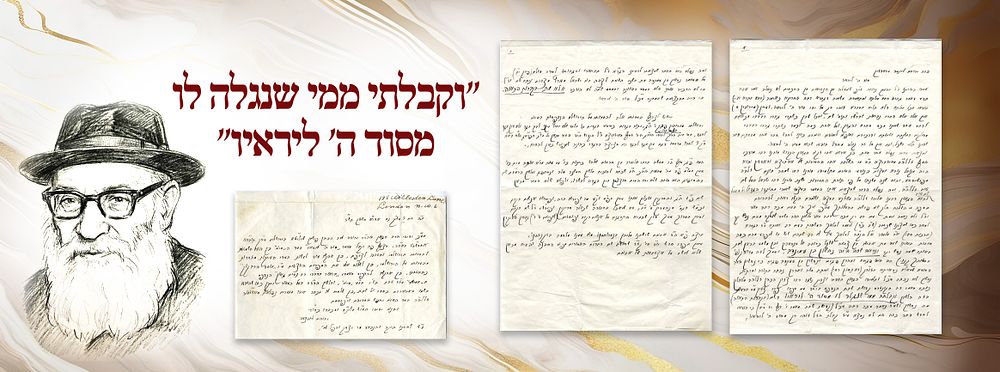
Bidspirit auction | “And I Received It from
“And I Received It from One to Whom the Secret of the Lord Is Revealed” — A Remarkable Epistle by the Rebbe of Radzin, the Holy and Righteous Rabbi Yerucham Leiner zy”a - A lengthy and profound Torah epistle, comprising three pages, by the Rebbe of Radzin, the holy and righteous Rabbi Yerucham Leiner zy”a, written entirely in his own hand and signed twice with his signature. London, Rosh Chodesh Cheshvan 5707 (1946). A fascinating Torah document that has never been printed. The epistle was sent from the Diaspora to the Land of Israel during one of the most turbulent years in the history of the Jewish people and the Land—the year in which the State of Israel was established. The addressee is Rabbi Yehuda Leib Fishman (Maimon), editor of the important Torah journal Sinai, who would later become the first Minister of Religious Affairs of the State of Israel. The Rebbe of Radzin, like many of the leading Torah figures of his generation, regularly published Torah articles in this journal—and the present epistle concerns the preparation of an additional article for publication. The epistle is composed of two clearly defined parts: The first part, written on a separate sheet, is a personal, signed letter of greeting, containing words of friendship, Torah matters, and a reference to the founder of the dynasty, the holy Rabbi Yaakov, author of Beit Yaakov of Radzin, son of the holy Rabbi Mordechai Yosef of Izhbitza, author of Mei HaShiloach. The second part is a complete Torah essay, ready for print, written in an elevated and rich style, bearing the highly significant title “Sod Hashem LiYere’av” (“The Secret of the Lord Is with Those Who Fear Him”). In the accompanying letter, the Rebbe asks Rabbi Maimon to publish it in one of the forthcoming issues of Sinai. At the heart of the essay, the Rebbe presents a remarkable innovation in the name of the founder of the dynasty, the elder Rebbe of Izhbitza, author of Mei HaShiloach—one of the bold and storm-provoking renewers of Hasidic thought in Hasidic Poland—according to which Nachshon ben Amminadav died at Kivrot HaTa’avah. This innovation, which appears in Mei HaShiloach, is here developed with broad conceptual grounding. The Rebbe of Radzin formulates a deep principle: when two great Torah authorities independently arrive at the same novel insight that does not stem from logical reasoning—and especially when their methods of study are fundamentally opposed—this constitutes proof that the idea was stated through divine inspiration. Since the Vilna Gaon, whose approach stands in contrast to the Hasidic path, likewise advances this very same innovation, this serves as clear evidence that it represents a prophetic revelation. At the conclusion of the epistle, the Rebbe added four brief notes on various Torah topics, completing the portrait of his broad intellectual horizons. Against the backdrop of the hardships of the time, on the eve of the establishment of the State—when the addressee was among its leaders and a signatory to the Declaration of Independence—and amid the fierce struggles with the Arabs and the British, the essay was not printed in Sinai and was not included in the Radzin works (to the best of our knowledge). Only eighty years after it was prepared for publication is it presented here for the first time. [3] Three leaves, various sizes. Good to very good condition. Folding marks. The Rebbe of Radzin, Rabbi Yerucham Leiner zy”a (1888–1964), author of Tiferet Yerucham. One of the great figures of Torah and Hasidism of his generation—a towering scholar in both the revealed and hidden realms, a prolific Torah thinker, and an important Hasidic leader in the transitional era before and after the Holocaust. Born in 1888 to his father, the Rebbe Rabbi Avraham Yehoshua Heshel of Chelm–Radzin, author of Likutei Divrei Torah, and the younger brother of the Rebbe Rabbi Gershon Chanoch Leiner, author of Sidrei Taharot and the renewer of the mitzvah of tekhelet. Already in his youth he displayed exceptional talents, broad mastery, and rare analytical depth. He was renowned as a genius in both Talmudic scholarship and mystical wisdom, combining rigorous analytical precision with profound Hasidic thought. He maintained correspondence with the leading sages of his generation, including Rabbi Shalom Mordechai Schwadron of Brezhan (the Maharsham); a responsum addressed to him was published in She’elot u-Teshuvot Maharsham. In 1935 he arrived in England, where he established the Radzin Hasidic study hall, which became an important spiritual and Torah center. In 1950 he moved to the United States and founded his study hall in Borough Park, New York, where he continued his Torah and Hasidic activity until his passing. His figure represents a rare synthesis of deep Hasidic tradition, towering scholarly genius, broad-minded Torah research,