Bidspirit auction | Ḥoshev Maḥashavot. Rabbi Immanuel Ḥai
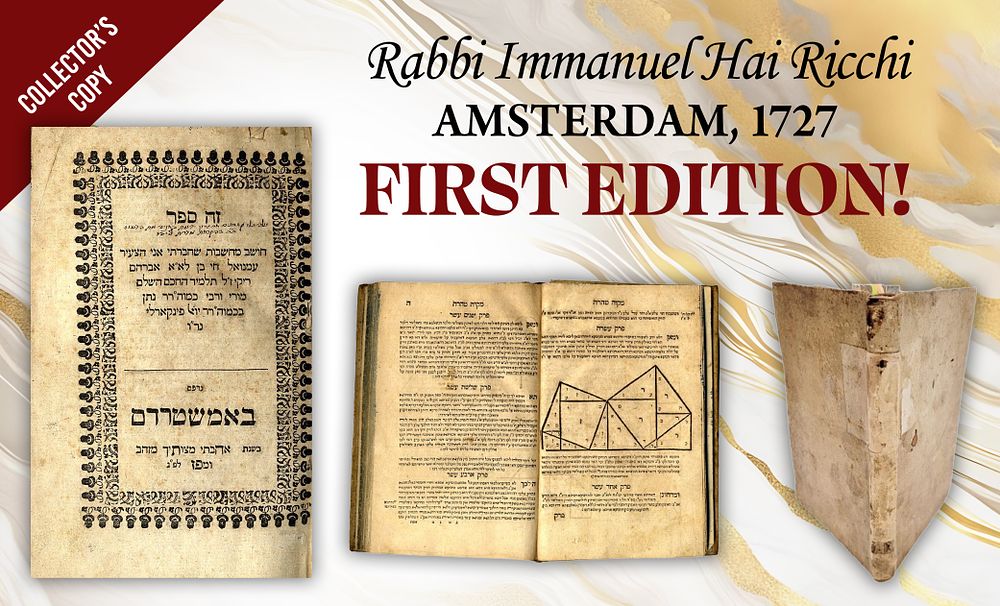
Ḥoshev Maḥashavot. Rabbi Immanuel Ḥai Ricchi. Amsterdam, 1727. First edition - Ḥoshev Maḥashavot, by the kabbalist Rabbi Immanuel Ḥai Ricchi. Amsterdam, 1727. First edition. A kabbalistic work containing commentaries on the Bible and the Mishnah, discussions of the laws and measurement of the ritual bath (mikveh), and the question of wearing tefillin on the intermediate days of the festivals, all according to the teachings of Kabbalah. The book is divided into three parts: Part I: Taharah ve-Kedushah – including the treatise Mikveh Taharah, on the measurement of the mikveh (with diagrams). Part II: Kolot Mayim – explanations and novel insights “on verses of the Bible, arranged according to the order of the Bible.” Part III: Me’orei Esh – explanations and novelties “on the Oral Torah… on Midrashim and various subjects.” In this work was first published the essay Tefillin de-Marei Alma, dealing with the prohibition of wearing tefillin on the intermediate days of the festivals—an essay that stirred considerable halakhic controversy. The author, the kabbalist Rabbi Raphael Immanuel Ḥai Ricchi (1687–1743), is best known for his work Mishnat Ḥasidim, a foundational text for the study of Lurianic Kabbalah. At the age of thirty he immigrated to the Land of Israel and settled in Safed, where he studied Kabbalah and engaged deeply with the writings of the Ari. After about two years, following an outbreak of plague, he moved to Livorno, where he composed Mishnat Ḥasidim. From there he was invited to serve as rabbi in Florence. In his later years he returned to the Land of Israel and settled in Jerusalem. He maintained close ties of friendship and mutual esteem with his cousin Rabbi Joseph Ergas: Rabbi Ergas wrote an approbation for Ricchi’s Hon Ashir, and Ricchi in turn wrote an approbation for Ergas’s Shomer Emunim. During one of his journeys abroad to print his books, Ricchi was attacked by bandits and murdered; a week later he was brought for burial in Cento, near Bologna. In his courtyard in Jerusalem, the holy Or Ha-Ḥayyim later established his yeshiva, Knesset Yisrael. 78, [2] leaves, with errata leaf. Approx. 18.5 cm. Condition: Very good. Light age-staining. Nice old vellum binding.