Bidspirit auction | Kesef Tzarūf, by the kabbalist
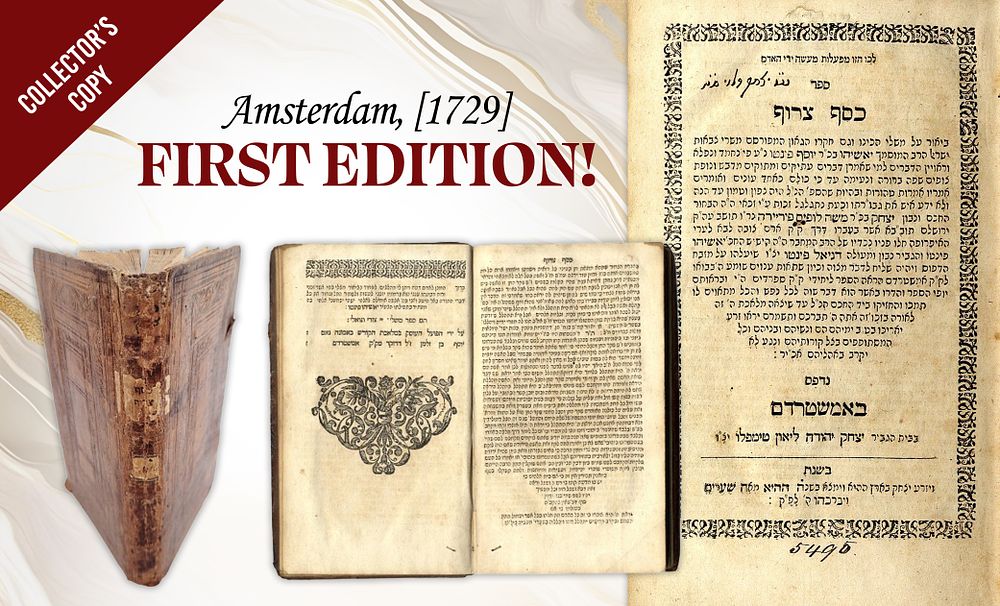
Kesef Tzarūf, by the kabbalist Rabbi Yoshiyahu Pinto. Amsterdam, [1729] First edition - Kesef Tzarūf — Commentary on the Book of Proverbs (with the biblical text). By the Gaon and kabbalist Rabbi Yoshiyahu Pinto, of blessed memory. Amsterdam, 5489 [1729]. Printed by Isaac Judah Leon Timpelo. First edition. An important kabbalistic–homiletical work by Rabbi Yoshiyahu Pinto, among the foremost sages of the East and pillars of Kabbalah in his generation. Kesef Tzarūf is a comprehensive commentary on the Book of Proverbs, printed with the biblical text at the center of the page and the author’s exposition surrounding it, combining peshat, derash, and sod. The book was printed in Amsterdam in the year 5489 [1729] at the press of Isaac Judah Leon Timpelo. The present copy is the first edition of this work, one of the sought-after books of the Sephardic–Eretz Israel kabbalistic tradition. The author — Rabbi Yoshiyahu Pinto (born 5326 [1566]): A native of Damascus and a descendant of the Spanish exiles. He studied Torah in the yeshivah of Rabbi Jacob Abulafia and later studied Kabbalah with Rabbi Ḥayyim Vital, the foremost disciple of the Ari. His son, Rabbi Samuel, later became a disciple and son-in-law of Rabbi Isaac Luria Ashkenazi (the Ari). In 5385 [1625] Rabbi Yoshiyahu Pinto immigrated to the Land of Israel with his family, settling first in Jerusalem and later in Safed. After the death of his son Rabbi Joseph, he returned to Damascus, where he was appointed Av Beit Din. He authored many works, including Kesef Nivḥar, Kesef Mezukkak, Me’or Einayim, Nivḥar mi-Kesef, as well as additional compositions that remain in manuscript. [2], 99, [1] leaves. 22 cm. Handsome wide margins. Condition: very good. Light age staining to the blank margins. Binding: ornate wooden boards covered with leather, with remnants of clasps. A fine copy of an important kabbalistic work, in its first edition, by one of the leading disciples of Rabbi Ḥayyim Vital—an item sought after by collectors of kabbalistic literature and Amsterdam imprints.