Bidspirit auction | Responsa of Mahari Bassan —
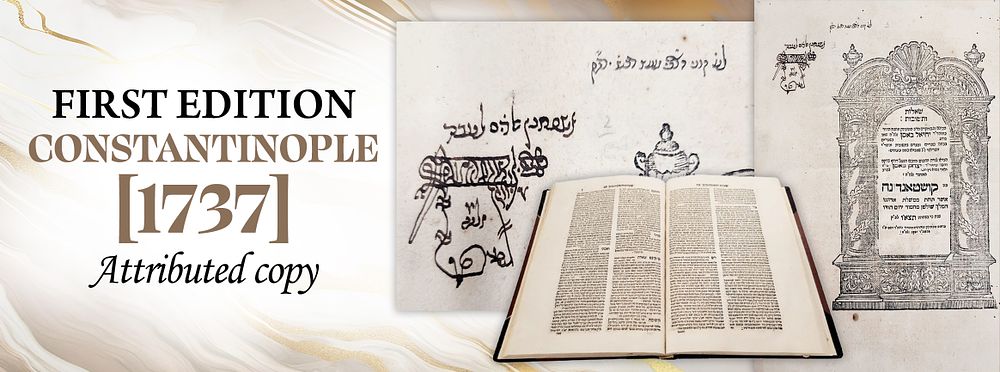
Responsa of Mahari Bassan — First Edition. Constantinople, [1737]. Copy attributed to Rabbi Yehuda ben Diwan, Av Beit Din of Hebron - Responsa of Rabbi Yechiel Bassan — one of the earliest and most important responsa collections, widely cited by leading halakhic authorities of later generations. First edition. Constantinople, 5497 [1737]. The book was printed on especially thick, high-quality paper, with wide margins — a rare and impressive copy. At the top of the title page appears the well-known ornamental signature of the Av Beit Din of Hebron, Rabbi Yehuda Diwan — one of the foremost sages of the Land of Israel, author of Zivḥei Shelamim, and the uncle (his father’s brother) of the miracle-working Rabbi Amram ben Diwan. (For this signature, see: Winner’s Auctions, Sale 140, Part I, Lot no. 44.) Alongside Rabbi Yehuda Diwan’s signature appears an additional rabbinic ownership inscription, later in date, of Rabbi David ben Shimon — author of Sha‘ar Ha-Ḥatzer, rabbi of the Maghrebi (Western) community in Jerusalem, known by the sobriquet “Tzofeh Devash.” 90 leaves (pagination misprinted as פ״ט), 29 cm. Fine paper. Wide margins. Condition: Good. Minor wormholes. Half-leather binding. Biographical Notes Rabbi Yehuda Diwan (c. 1682–1752) was among the leading sages of the Land of Israel, holding senior rabbinic posts in all three Holy Cities: – Head of the yeshiva in Safed (1737), – Av Beit Din of Hebron (1751), – Member of the Jerusalem rabbinical court (1741) under the Rishon LeZion Rabbi Nissim Moshe Mizraḥi, author of Admat Kodesh. He was a disciple of Rabbi Yaakov ben David HaKohen and married his daughter. He traveled as an emissary of the three Holy Cities to Persia, where he resided for several years. In his work Ha-Ḥut Ha-Meshulash he sheds light on Jewish life in Persia, including sermons delivered there — such as a discourse given in 1703 in Hamadan — and halakhic questions addressed in Kashan. Due to persecution by local rulers, he temporarily remained in Aleppo before returning to Jerusalem. In 1741 he was appointed judge in the court of Rabbi Nissim Moshe Mizraḥi and co-signed several communal enactments with the sages of Jerusalem. In 1742 he also signed, together with Rabbi Eliezer Naḥum, the approbation to Tzaḥ ve-Adom by the kabbalist Rabbi Raphael Trivash. His works include Zivḥei Shelamim (Constantinople, 1728) and Ha-Ḥut Ha-Meshulash (Constantinople, 1739), containing his own teachings as well as those of his teacher and father-in-law Rabbi Yaakov HaKohen and his father Rabbi David HaKohen. He died during his travels in Morocco in 1782. His nephew was the renowned miracle-worker Rabbi Amram Diwan, one of the leading rabbis of Hebron. Rabbi David ben Shimon (1824–1879), known as Radbash and Tzofeh Devash, was a central figure in the Jewish settlement of Jerusalem in the 19th century. Founder and chief rabbi of the Maghrebi community in Jerusalem, he authored a broad body of Torah literature, much of it devoted to the praise of the Land of Israel and its commandments. He established Torah institutions, charitable organizations, and communal frameworks; sent emissaries to North African communities; instituted financial transparency; and devoted himself especially to the poor, orphans, and widows — earning him the title “Father of Orphans and Judge of Widows.” His work was foundational in shaping the communal structure of the Jewish Yishuv in the Land of Israel. He was a distinguished scholar, dayan, and halakhic authority, and the author of Sha‘ar Ha-Ḥatzer, a comprehensive anthology of rabbinic sources praising the Land of Israel, published during his lifetime and widely acclaimed. Additional works were published posthumously. He passed away in Jerusalem in 1879 at the age of fifty-four and was buried on the Mount of Olives. His legacy endures in Jerusalem’s institutions, the Mahaneh Yisrael neighborhood, and the continuing heritage of the Maghrebi community.