Bidspirit auction | Torah, Prophets, and Writings, in
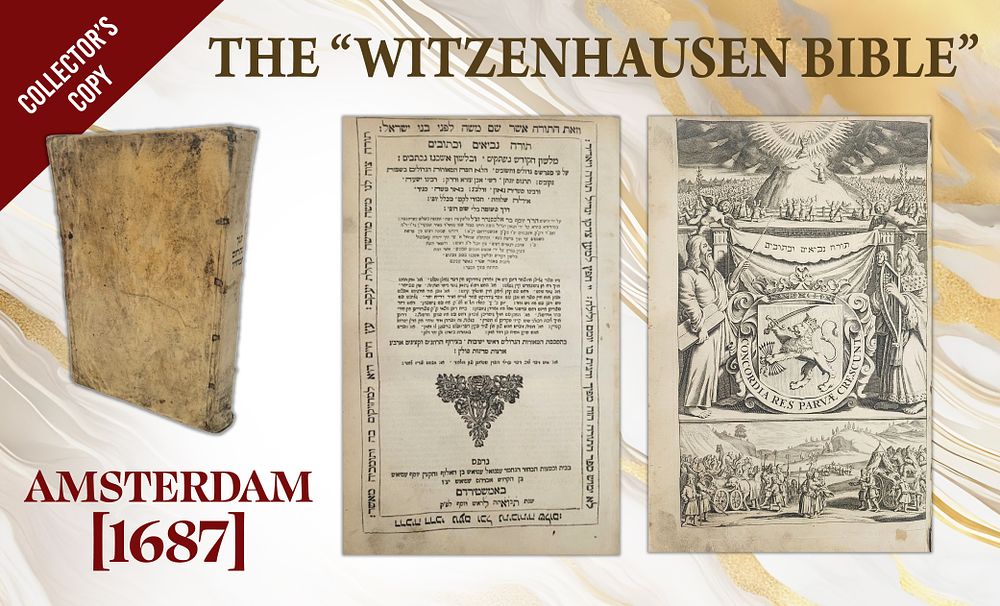
Torah, Prophets, and Writings, in the Yiddish language. Amsterdam, [1687] — the “Witzenhausen Bible.” - Torah, Prophets, and Writings, translated from the Holy Tongue and written in the Ashkenazic language. A translation of the entire Bible into Yiddish, based on: Targum Jonathan, Rashi, Ibn Ezra, Radak, Saadia Gaon, Ralbag, Be’er Moshe, Maggid, Ayalat HaShaluach, compilations of Leket, and Miklal Yofi. Amsterdam, printed by Joseph ben the holy Abraham Attias, may the Lord avenge his blood. [5447] 1687. A special work: a translation that is למעשה a Yiddish commentary on the entire Bible. The translator is Rabbi Joseph bar Alexander, known as Yuzel of Witzenhausen. The first title page is illustrated with a large and magnificent copper engraving, at whose center appears a large emblem of the Dutch Republic. On either side are depictions of Moses and King David, with additional biblical scenes above and below the emblem and figures. With enthusiastic approbations from the rabbis of the Council of the Four Lands, who effectively gave their consent to this translation of the Bible. At the beginning of the book is a lengthy introduction in Yiddish by the printer. The title of the introduction reads: “Said Joseph, son of my lord my father, the holy Abraham Attias, of blessed memory, who was burned alive for the sanctification of the Unique Name, in the city of Cordoba, in the year five thousand four hundred and twenty-seven.” In those years, another Bible translation was printed in Amsterdam by the printer Uri and Wivesh HaLevi, in the years 5436–5439 [1676–1679]. As a result, a dispute erupted between the Amsterdam printers, with each side accusing the other of encroachment upon his domain. In the present book there are two references to the bitter quarrel between the printers, which even reached the Dutch authorities: — In Yiddish verses at the center of the second title page, where it is written (in translation): “In the entire world no book like this has been printed… and if you see such a book that claims to have been printed two or three years earlier, do not believe it… do not heed words of falsehood.” — And in the section titled “The Apology of the Translator” on leaves [5–6]. For a detailed discussion of this affair, see: Habermann, Chapters in the History of Hebrew Printers, pp. 299–310. A Bible translated into Yiddish, a particularly important work known by the name “Witzenhausen Bible.” [6], 79, 150 leaves. Height: 31 cm. Condition: Very good. Attractive early vellum binding.