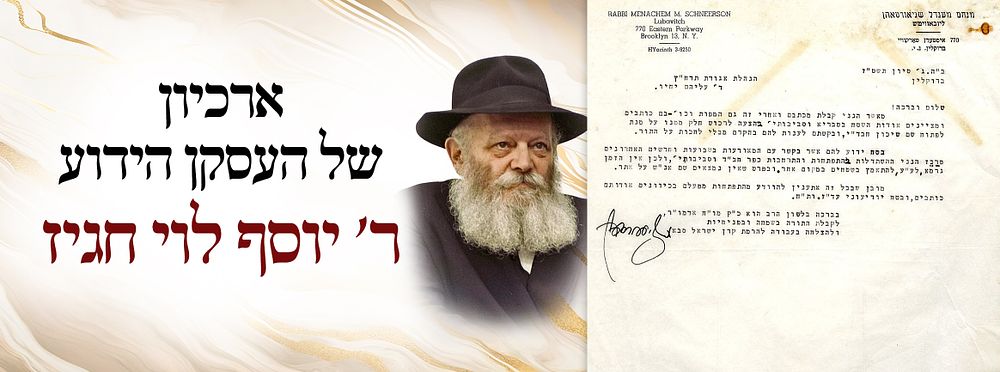
Bidspirit auction | Archive of the well-known public
Archive of the well-known public activist R. Yosef Levi Ḥagiz About 450 documents! - A vast lot comprising hundreds of historical documents documenting events in the Land of Israel during the first half of the 20th century. R. Yosef was born in Jerusalem in 5646 (1886) to his father R. Yitzhak Ḥagiz [Kamenitz], a son-in-law of the Hasidic rabbi R. Tzvi Yehuda Lederberg, who was among the Chabad Hasidim who immigrated from the city of Vitebsk and settled in Jerusalem. R. Yitzhak was a great Torah scholar and an upright, astute merchant. R. Yosef inherited from his father the paper and printing businesses and founded “Yosef Levi Ḥagiz Publishing.” The bulk of R. Yosef’s wealth and property derived from his paper and paper-products trading house, inherited from his father; the business also maintained a branch in Jaffa. A visionary and a man of many deeds, R. Yosef was a Jerusalemite in every fiber of his being and one of the foremost redeemers of the land. He had a hand in nearly every land-redemption purchase from Arab owners, upon which many neighborhoods outside Jerusalem’s Old City walls were established between 5655 (1895) and 5700 (1940). In addition to his commercial success, Providence placed a great opportunity in his hands during the First World War. During the years of war, amid the severe famine in Jerusalem, he relocated to Jaffa and lived in the Neve Tzedek neighborhood. At the time, the Ottoman authorities forbade stockpiling petroleum beyond basic needs. With keen commercial insight, R. Yosef understood that petroleum would soon be in great demand; he therefore purchased large quantities of kerosene tins and concealed them at the bottom of a well in one of his orchards in Petah Tikva—thus profiting while also supplying those in need. Even before World War I, he was highly active in the agricultural settlements. In Jaffa he was among the leaders of the “Shomrei Torah” association for establishing Talmudei Torah and yeshivot in the colonies, and he was also a member of the “Hevrat Mishmarim” in Jaffa (see Kedem Catalog 74, item 337). R. Yosef reached the height of his activity during World War I. A dreadful famine gripped the country under the crumbling Ottoman rule. People wandered the streets swollen with hunger; many died daily, and Jerusalem’s population dwindled. R. Yosef spent vast sums of his own money to purchase food—true storehouses of sustenance: sacks of flour, rice and legumes, sugar, and gallons of oil—which he distributed freely to the city’s poor, saving many from death. Immediately upon the British entry, he devoted himself to public activism. Together with R. Baruch Hirshnof of “Mekor Baruch” near the Geula neighborhood in Jerusalem, and with the “Neki’ei Yerushalayim, ” among them R. David Beharan, he founded “Agudat Tedaḥatz” (Torah, Knowledge, Lovingkindness and Charity). He served on the committee of the well-known Sha’arei Ḥesed neighborhood, purchased adjacent land, and erected a two-story commercial building. He also acquired land for the Etz Ḥayyim neighborhood on the approach to Jerusalem, transforming it into a vibrant area, and was active as well in the Beit Vagan neighborhood. The pinnacle of his endeavors was the purchase of approximately 5,000 dunams in the Western Galilee near Tiberias, with plans to establish the settlement “Eretz Naftali” at the foot of Mount Karnei Ḥittin, intended to settle thousands of observant Jews. Beyond developing the land, R. Yosef cared deeply for the welfare of its residents. A great philanthropist, each day upon opening his shop he would give the first profit to the first poor person he encountered, calling this gift “Reshit HaGez.” When he learned of the plan of Rabbi Yisrael Meir Kagan (the Chafetz Ḥayyim) to immigrate to the Land of Israel, he supported the initiative financially on condition that his name not be publicized. Ultimately the journey did not take place, and the Chafetz Ḥayyim returned the funds via an emissary. While residing in Tiberias, R. Yosef worked extensively to strengthen religious observance in the region—mitzvot dependent on the land, Sabbath observance, and more. After his passing in Adar 5734 (1974), a volume of his Torah novellae, “Hagigim Ve-Iyunim, ” was published. The archive includes the original map of the estate near Kafr Ḥittin and all documentation surrounding the acquisition: original purchase deeds; Lebanese notarial certificates approved by the British consulate in Lebanon, complete with original stamps and seals, in Arabic, Hebrew, and English; insurance documents relating to the purchases; authorization from the Military Government of the Occupied Territories permitting him and a Jewish interpreter to enter the estate (June 1949); numerous telegrams from the 1920s–30s containing important information regarding land acquisitions (Arabic and Hebrew); partnership deeds with local Arabs concerning land ownership and crop-sharing agreements;