Bidspirit auction | “My Holy Books, Essential for
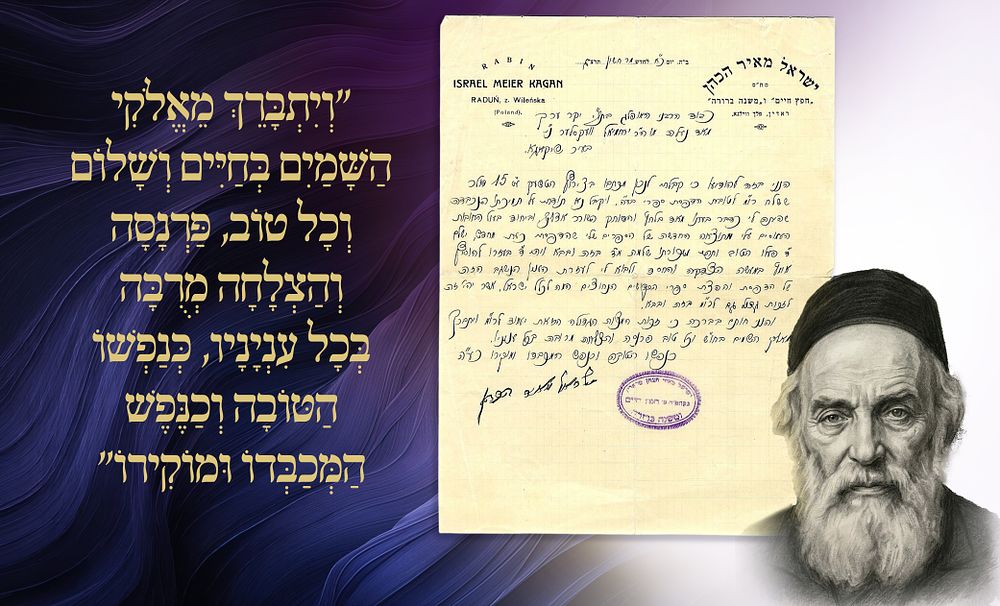
“My Holy Books, Essential for the Entirety of Israel” – A Letter from the Rabbi Yisrael Meir Kagan with Rare Expressions and Blessings for Wealth - “My Holy Books, Essential for the Entirety of Israel” – A Letter from the Rabbi Yisrael Meir Kagan with Rare Expressions and Blessings for Wealth “Sustenance and Great Success in All His Affairs” A rare and exceptionally elevated letter by the preeminent sage of the generations, our master and teacher Rabbi Yisrael Meir HaKohen of Radin. Sent in the final year of his life, on his official letterhead, written by a scribe, bearing his holy signature and seal. Radin, 21 Cheshvan 5693 (1932). The letter concerns the printing of the final edition published during the lifetime of the Chafetz Chaim—of his foundational works, foremost among them the Mishnah Berurah, one of the central halachic works in the Jewish library. It is addressed to the philanthropist Dr. Yerahmiel Wexler of Chicago, among the great supporters of Torah, who regularly supported the Chafetz Chaim and now made a substantial contribution toward a renewed printing of the Chafetz Chaim’s works and the Mishnah Berurah—the final edition printed in the author’s lifetime. Despite his extraordinary humility—indeed singular in his generation—in all matters relating to his books, the Chafetz Chaim did not conceal their importance. (It is well known that when one of the leading sages challenged a halachic ruling he had written in the Mishnah Berurah, the Chafetz Chaim replied: “At the moment I do not have a satisfactory answer to your question; however, this is how it is ruled in the Mishnah Berurah, and thus is the law!”) A similar tone appears in the present letter, in which, in an uncommon manner, the Chafetz Chaim himself praises his holy works with the rare expression: “This exalted matter of printing and disseminating my holy books, which are essential for the entirety of Israel!” Rabbi Wexler was a renowned philanthropist throughout his life, and now, having made a significant donation for a cause so exalted in the eyes of the Chafetz Chaim, the Kohen Gadol showers him with his sacred blessings—blessings that never returned empty—for wealth and abundant success: “And may he be blessed by the God of Heaven with life and peace and all goodness, sustenance and great success in all his affairs, as his good soul and as the soul of the one who honors and esteems him, Yisrael Meir HaKohen.” Rabbi Yisrael Meir HaKohen of Radin (1838–1933), reverently known as the Chafetz Chaim, was Rosh Yeshiva of Radin (the yeshiva referenced in this letter) and author of the Mishnah Berurah, Shemirat HaLashon, and dozens of additional works that became foundational pillars of the Jewish bookshelf. The entire House of Israel relies upon his rulings as upon those of the Rishonim. Already in his lifetime he was acclaimed by all Israel as “holy, holy, ” and was renowned as one possessing manifest Divine inspiration, whose words never returned void. He participated in the First World Congress of Agudath Israel in Vienna (1923) and was elected global president of the Moetzes Gedolei HaTorah. [1] Single leaf, 27 × 21 cm. Very fine condition. Light time-stains. Fold mark. Minor tear along the fold margin, without loss or damage. Regarding the recipient of the letter, Dr. Yerahmiel Wexler, the famed preacher Rabbi Shalom Mordechai HaKohen Schwadron related the following: In the 1920s, there was a Jew from the Shaarei Chesed neighborhood named Rabbi Walk, of blessed memory, who traveled from synagogue to synagogue throughout the world, inspiring souls for Zion and Jerusalem, persuading and enthusing families to leave the lands of exile and ascend to settle the holy soil. During his travels he arrived in Chicago, and following his fiery address, Dr. Yerahmiel Wexler resolved to immigrate to the Land of Israel. He brought his sons and daughters with him and ascended to the Holy Land. His holy son, Rabbi Yaakov Yechezkel, of blessed memory, he sent to study at the Slabodka Yeshiva, Knesses Yisrael, then located in the city of the Patriarchs, Hebron. As is well known, on the 18th of Av 5689 (1929), on the holy Sabbath, many of the yeshiva students and residents of the city were brutally murdered, among them Rabbi Yaakov Yechezkel. Out of discomfort, Rabbi Walk ceased delivering his sermons in the synagogue where Dr. Wexler would pray, for although Rabbi Wexler had settled in the Land of Israel, he would still appear and pray there whenever business brought him abroad. On one occasion, Rabbi Wexler encountered Rabbi Walk on the streets of New York. When asked, Rabbi Walk stammered that indeed he no longer delivered sermons in that synagogue due to his unease—after having persuaded him to immigrate and thereby losing his son, murdered by evildoers. Rabbi Wexler responded in these words: “You cannot imagine how much gratitude I feel toward you. I had a son;