Bidspirit auction | Manuscript of Exceptional Historical Importance: The
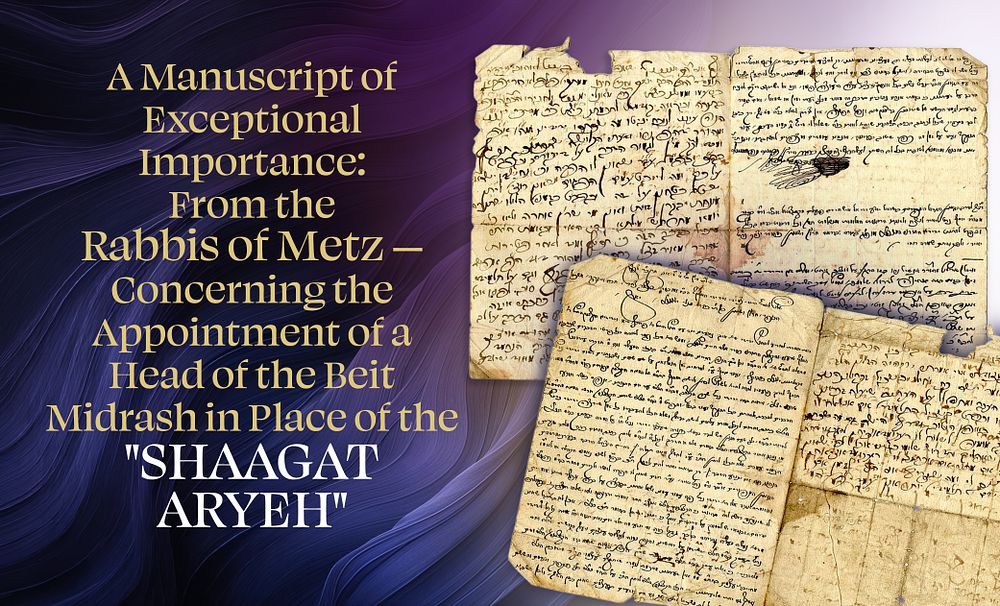
Manuscript of Exceptional Historical Importance: The Rabbis of Metz on the Appointment of a Head of the Beit Midrash Under the Shaagat Ary. Metz, 1767 - A Highly Important Historical Document Appointment of a Head of the Beit Midrash in Metz During the Tenure of the Shaagat Aryeh. Metz, 1767 A manuscript of exceptional historical value, shedding rare and previously unknown light on the contractual conditions of rabbinic and yeshiva appointments in the 18th century, as well as on the history of the Jewish community of Metz and the province of Alsace. The four-page manuscript concerns the appointment of a head of the Beit Midrash in Metz during the rabbinate of the preeminent חריף of his generation, Rabbi Aryeh Leib Ginzburg, author of Shaagat Aryeh and Turei Even. Metz, 1767. The Signatories The document was sent to the designated rabbinic candidate and was written and signed by three of the leading rabbis of Metz and its environs: Rabbi Yitzchak Itzik Netter – dayan of Metz (among the approbators of the printing of Chiddushei HaRashba, Ketubot, Metz 1765). Rabbi David HaKohen Hirtzfeld – a communal leader of the Metz congregation and among the signatories to the rabbinic conditions of the Shaagat Aryeh in the city. Rabbi Tzvi Hirsch, Av Beit Din of Copenhagen – one of the leading scholars of his generation and a confidant of Jacob Emden (the Ya’avetz). In the margin appears an additional request addressed to the recipient, formulated in Yiddish–Deutsch, on behalf of his teacher and master, Rabbi Anshei Shaflach, among the notable halachic authorities of the era. Rabbinic Figures Mentioned The letter extends blessings to several major rabbinic authorities of the time, foremost among them the rabbi of Metz, the author of Shaagat Aryeh and Turei Even, respectfully referred to as: “Our master and teacher, the renowned gaon, Av Beit Din and Rosh Metivta, may his light shine.” Also mentioned are: Rabbi Yosef Steinhardt of Fürth, author of Zikhron Yosef. His son-in-law, Rabbi Yitzchak (נר”ו). Background and Content During the tenure of the Shaagat Aryeh as rabbi of Metz, the city’s Beit Midrash flourished under the leadership of the communal officer and gaon Rabbi Meir זצ”ל. Following his passing, the community sought to appoint in his stead the young and brilliant Rabbi Manly of the community of Fürth. The community offered him: A distinguished marriage match An annual salary of five hundred Reichsthaler Rabbi Manly, however, requested that these commitments be set down in writing, signed and halachically binding. The communal leaders declined to formalize the terms in writing, citing various reasons, yet agreed instead to a solemn handshake commitment (tekia’at kaf) and vow before the assembled rabbinic authorities and community — an undertaking considered halachically irrevocable. The rabbinic correspondents express genuine hesitation: On the one hand, the leaders of Metz are God-fearing individuals whose word may be trusted; On the other — who can foresee what the future may bring? Significance A fascinating and highly important document reflecting: Halachic dilemmas Communal leadership tensions Financial negotiations Rabbinic authority structures It offers vivid insight into the inner workings of one of the foremost Jewish communities of 18th-century Europe. Accompanied by historical and bibliographic research material concerning the manuscript and its authors. Physical Description: [4] written and signed pages. Condition: Good. Age staining, fold marks, light creasing, minor tears.