Bidspirit auction | Ta’avah La’Einayim. The Copy of
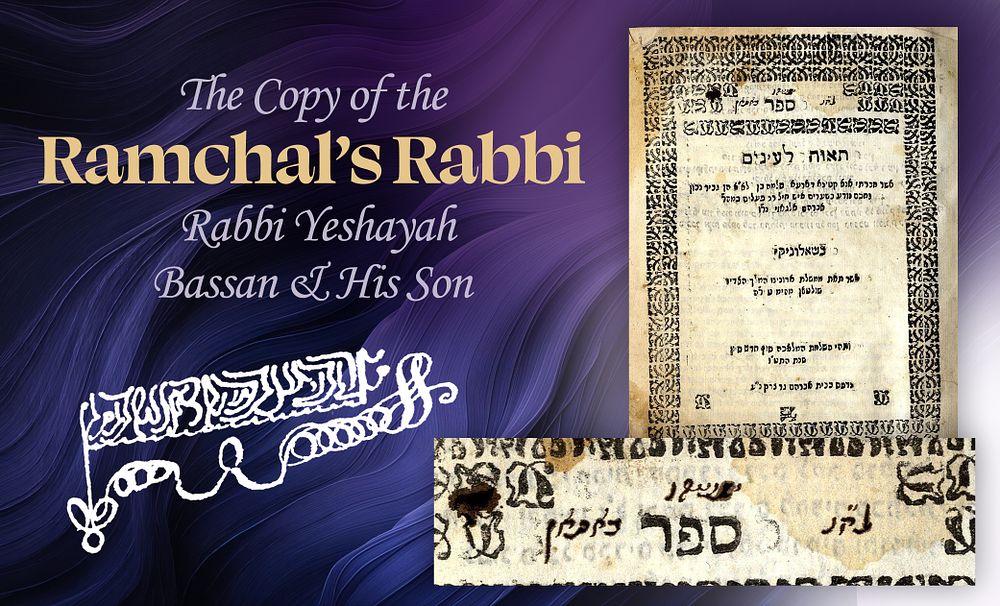
Ta’avah La’Einayim. The Copy of the Ramchal’s Teacher, Rabbi Yeshayah Bassan, and His Son - Ta’avah La’Einayim. Commentaries on the teachings of Ein Yaakov, by Rabbi Shlomo Algazi. Salonika, 1655. First edition. A rare and distinguished copy. On the title page appears the autograph signature of Rabbi Yeshayah Bassan, Av Beit Din of Reggio, author of Leḥmei Todah, one of the foremost Italian sages. He was the teacher of the Ramchal in the yeshiva of Padua and stood at his side during the controversy with Rabbi Moshe Ḥagiz and the rabbis of Venice. On the leaf preceding the title page is the ornate signature of Rabbi Yisrael Binyamin Bassan, son of Rabbi Yeshayah. Rabbi Yisrael Binyamin also served as Av Beit Din of Reggio and was a colleague of the Ramchal. In honor of his wedding, the Ramchal composed the well-known poetic drama Migdal Oz. On folio 79b appears a gloss that seems to be in the handwriting of Rabbi Yeshayah Bassan. The author, Rabbi Shlomo Algazi (the Elder) (1610–1683), was a disciple of Rabbi Meir de Boton and among the leading sages of Izmir in the 17th century. He immigrated to Eretz Israel and served as a dayan, later returning to Izmir where he served as rabbi and established a yeshiva. He stood at the forefront of the struggle against Shabbetai Tzvi, to the point of mortal danger, and was forced to flee the city. He later returned to Eretz Israel, where he passed away. He also authored Shema Shlomo, Ahavat Olam, Yavin Shemu’ah, Gufei Halachot, and other works. [4], 222, [4] leaves. 19 cm. Lacking the final two leaves. Good condition. White paper. Minor worming and staining. Contemporary vellum binding, slightly worn. Rabbi Yeshayah Bassan, son of the gaon Rabbi Yisrael Ḥizkiyah Bassan, was born circa 1673 and passed away on 2 Nisan 1739. He was among the leading rabbinic judges and righteous figures of Italy in the late 17th and early 18th centuries. He wrote responsa to communities throughout Italy (many of which were printed in his work Responsa Leḥmei Todah) and was also a poet and liturgical composer. In his youth he studied under the Ramaz, Rabbi Moshe Zacuto, one of the foremost sages and kabbalists in Italy, through whose academy the writings of Rabbi Chaim Vital on the teachings of the Arizal and his prayer customs spread throughout European Jewry. Rabbi Yeshayah married the daughter of the Ramaz’s foremost disciple, Rabbi Binyamin HaKohen Vitali. During his tenure as a rosh yeshiva in Padua, Rabbi Yeshayah Bassan became the teacher of the man later renowned as the righteous Ramchal, Rabbi Moshe Chaim Luzzatto, of blessed memory, one of the greatest masters of Mussar and Kabbalah and author of Mesillat Yesharim. Throughout the Ramchal’s lifetime, the two maintained continuous correspondence, reflecting the close bond between them. Particularly notable was the period of the Italian controversy against the Ramchal and his kabbalistic writings, when Rabbi Binyamin HaKohen, who supported him unwaveringly, and Rabbi Yeshayah Bassan were his principal defenders. After Rabbi Binyamin’s passing, Rabbi Bassan corresponded with European rabbis involved in the controversy and strongly opposed the ban against the Ramchal. It appears that he also collected and preserved the letters relating to the dispute, which remain a primary source for research on the Ramchal controversy to this day. Ultimately, Rabbi Bassan secured the Ramchal’s commitment not to write further kabbalistic works of the kind that had caused the uproar, and most of those works were suppressed. Yet in truth, the fact that the Ramchal was ultimately accepted as a righteous and pure figure, and that his many works—such as Mesillat Yesharim, Derech Hashem, and others—were embraced as influential and widely studied ethical classics throughout the Jewish world, is due in great measure to the merit of Rabbi Yeshayah Bassan.