Bidspirit auction | An Exceptionally Rare Personal Mezuzah-Amulet
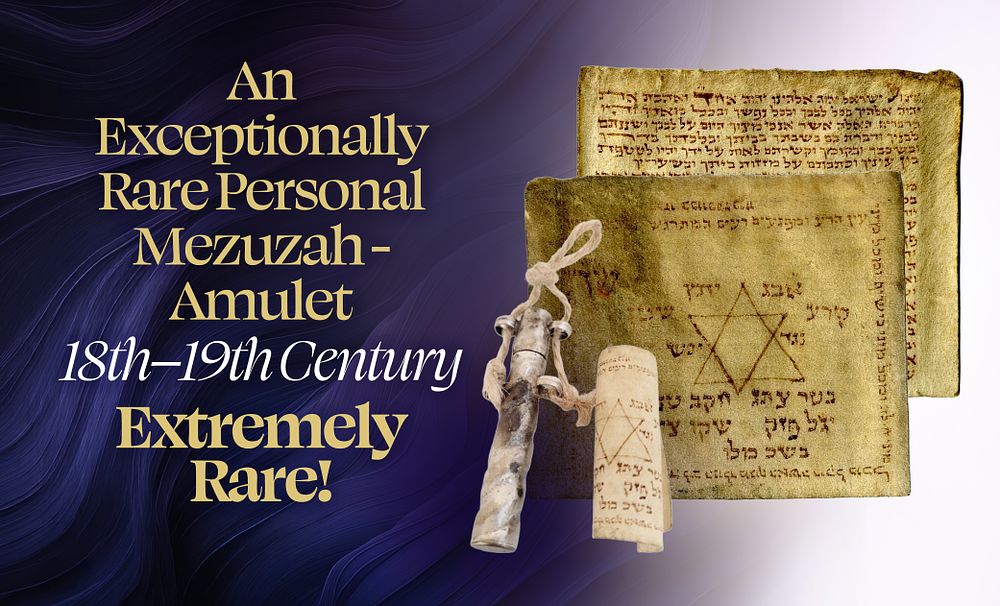
An Exceptionally Rare Personal Mezuzah-Amulet – Ashkenaz, 18th–19th Century. Extremely Rare! - An Exceptionally Rare Personal Mezuzah-Amulet – Ashkenaz, 18th–19th Century An extraordinary and very rare amulet, consisting of a rolled parchment placed בתוך a silver case, apparently unmarked. On one side of the parchment, the Mezuzah text was written in ink, in Beit Yosef script (according to the Ashkenazic tradition), in a fine and orderly hand. On the other side of the parchment appears a personal amuletic formula, at the center of which is a Star of David containing sacred names. Surrounding it is a protective text, explicitly mentioning the name of the child for whom the amulet was written: “… known as Leib, born of the woman Rikel Michal … from all kinds of illness and from all kinds of sorcery and from all kinds of the evil eye and harmful afflictions …” The text (partially erased and faded) clearly indicates that this is a personal amulet intended for a child named Leib. The name “Leib” (lion in Yiddish) היטב explains the appearance of a lion figure adorning the upper part of the case — a direct symbol of the bearer’s name and of protection and strength. The parchment is rolled and housed within a small silver case with a matching lid, and on its sides are four silver rings holding the case. It was likely also intended for threading onto a chain and worn around the neck as a personal protective amulet. On the lid of the case, in its upper section, appears a relief of a lion. Due to age and wear, the lion figure is not sharp and not fully intact, yet it remains clearly discernible. Uniqueness of the Item A combination of: A halachically valid mezuzah text on one side A personal amulet with sacred names and the mention of the mother’s name on the other A silver case decorated with a lion A clear identification of its dedication to a specific child creates an exceptionally rare object, reflecting an Ashkenazic devotional world in which the boundary between the mitzvah of mezuzah as “protection” and a personal amulet found tangible expression in a single artifact. The mention of the mother’s name (“born of the woman…”) is characteristic of Ashkenazic amulets for protection against the evil eye, sorcery, and illness, and reinforces the authenticity and personal intent of the amulet. Length of the case: approx. 8 cm Dimensions of the parchment: 6 × 5 cm Condition: Fair to good. The parchment is in good condition; the ink is faded in several places. The silver case is in very good condition. Historical-Halachic Background In Jewish tradition, the mezuzah was perceived not only as a commandment but also as a source of protection, as the Sages stated: “Guardian of the doors of Israel.” Already in early sources, the custom of writing the name Shaddai on the reverse of the mezuzah parchment is mentioned, and in Ashkenazic communities the kabbalistic formula “Kuzu B’muchsaz Kuzu” was also common as an external protective inscription. Nevertheless, the addition of angelic names, seals, and kabbalistic combinations within the body of the mezuzah itself was controversial. Maimonides sharply opposed turning the mezuzah into an amulet, whereas in certain Ashkenazic traditions from the medieval period and afterward, evidence survives of mezuzot to which external protective elements were added. The present item reflects a unique phenomenon: the use of a single parchment both as a halachic mezuzah text and as a personal amulet, in which the name of a specific child and his mother are mentioned — a characteristic Ashkenazic amulet formula for protection against illness, sorcery, and the evil eye. This combination teaches of a popular devotional perception that viewed the mezuzah itself as a source of protection, and of a fusion between the world of halachah and the world of amuletic practice. The appearance of the lion figure on the case — corresponding to the name “Leib” (lion in Yiddish) — reinforces the personal connection of the amulet to its owner and stands as a tangible testimony to the world of personal protection and faith in Ashkenazic communities in the 18th–19th centuries.