Bidspirit auction | Historic!! The Archive of Aharon
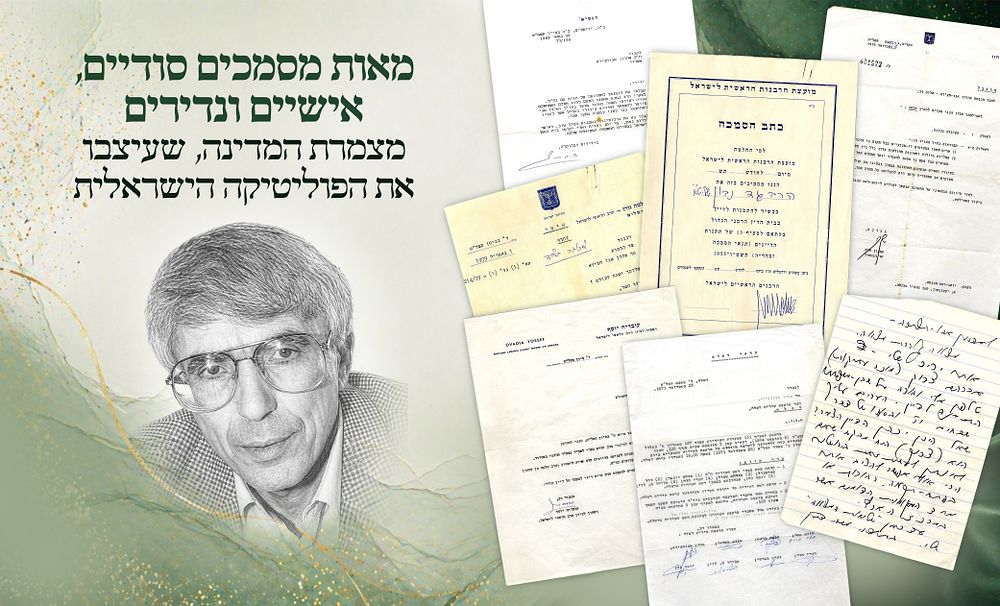
Historic!! The Archive of Aharon Abuhatzira – Hundreds of Secret, Personal, and Rare Documents from the Highest Circles of Government that Shaped Israeli Politics. - A Vast and Exceptionally Rare Archive – comprising six binders – an extraordinary and near-unrepeatable documentary record of the political, judicial, and religious history of the State of Israel. This is a collection of the highest echelon, assembled around the public activity of Aharon Abuhatzira, who stood at key centers of power during decisive periods in the history of the המדינה. This is no “dry archive, ” but rather a unique window behind the scenes of government: correspondence with the leading figures of the nation—presidents, prime ministers, ministers, members of Knesset, Supreme Court justices, and senior legal officials—alongside official state papers reflecting some of the most significant events in Israel’s history. Within the material unfolds the real machinery of decision-making: appointments, budgets, political agreements, and sensitive processes in the intertwined worlds of religion, state, and power. Especially notable are numerous informal handwritten notes and memoranda revealing the authentic dynamics between ministers, judges, and state officials. Prominent among them are many communications from the “high priest” of the judicial system, Aharon Barak—internal and highly informal notes illustrating the depth of mutual involvement and influence between the judiciary and the ruling elite of that era. Alongside these appear documents from other senior figures in the legal and security establishments, forming a rare web of hidden power relations. The archive also contains political correspondence and agreements concerning central figures in Israeli politics such as Shimon Peres, together with documents from cabinet ministers including Moshe Dayan, Chaim Herzog, Yosef Burg, Moshe Nissim, Zevulun Hammer, and Aryeh Deri. Dramatic chapters in the history of the state are reflected throughout the papers. Among the most historically significant sections is an extensive body of material from the tenure of Minister of Religious Affairs Aharon Abuhatzira. Included are protocols of rabbinical court appointments (including the simultaneous appointment of three chief dayanim through a single handwritten note), budgets for yeshivot, agreements between municipal factions, addresses of Israel’s rabbis, statistical data regarding yeshivah enrollment, and historical documentation concerning Baba Haki, including press material on his passing. Alongside these are broader state papers ranging from the Camp David Accords period and negotiations with Egypt to additional sensitive policy documents. Among the standout items is a letter signed by Rabbi Ovadia Yosef on official stationery to Minister Abuhatzira, approving the appointment of Rabbi Ezra Basri as Av Beit Din in Ashdod, together with the appointments of Rabbi Aryeh Lipschitz and Rabbi Shlomo Ben Shimon as permanent dayanim in Tel Aviv. Also present is a letter signed by Shlomo Goren approving the appointment of Gad Navon as a dayan of the Great Rabbinical Court, together with his original certificate of appointment. The archive further preserves personal and family correspondence of Minister Abuhatzira to his parents—among them Baba Haki—and to his rebbetzin wife, as well as letters sent to additional figures. Among the most unusual items is a large handwritten amulet on parchment containing sacred names, apparently given to the minister during the sensitive period of his legal struggles, in hope of aid and success in judgment. Notably, of thirty-two charges once attributed to him, only two ultimately remained: in one he was acquitted for lack of certainty, and in the other he received three months of community service, later returning to the Knesset and further ministerial office. Thus, the amulet may be said to have proved highly effective. The identity of its author is unknown, yet from the script, formulae, and style it is evident that it was composed by a kabbalist of exceptional stature. Related to this is a telegram from the wonder-working Rebbe Rabbi דוד משה מקרעטשניף blessing him that he should emerge vindicated in judgment. The historical significance of this archive is magnified many times over in the era following the judicial revolution associated with Aharon Barak, when the boundaries of judicial authority and intervention expanded dramatically. Material of this nature, had it surfaced in real time, might have formed the basis for serious criminal proceedings and perhaps even imprisonment of senior officials. The archive reveals an entire stratum of governmental reality that existed beneath the visible surface—one whose scale is now difficult even to imagine. This is a first-rank historical collection: not merely testimony, but almost an X-ray of the centers of power within the State of Israel. Official documents beside personal notes,