Bidspirit auction | A Sensational Discovery in the
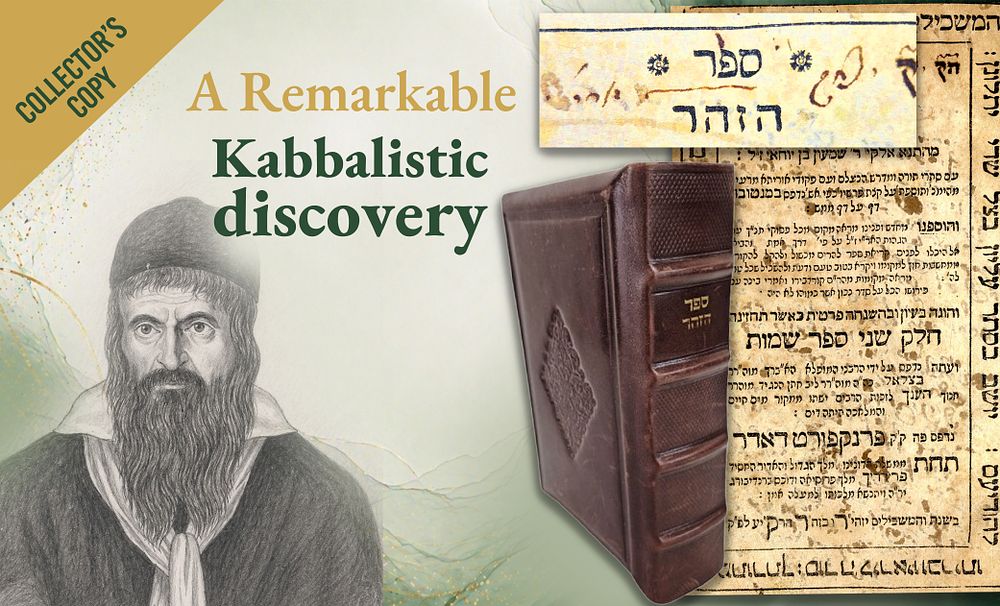
A Sensational Discovery in the World of Kabbalah: The Sacred Handwritten Manuscript of the “Baal Shem of Michelstadt” Revealed – Dozens of Extensive Annotations on the Holy Zohar! - A rare and remarkable Kabbalistic discovery – numerous annotations on the Zohar in the holy handwriting of the divine kabbalist, one of the greatest wonder-workers of his generation, Rabbi Yitzchak Aryeh Wormser (known in Yiddish as Zekel Leib), famed as the “Baal Shem of Michelstadt” for his reputed power to alter the course of nature and perform miracles in the manner of the ancients. At the beginning of the volume appears his autograph signature: “Ha-k' Yitzchak Ari.” On the front pastedown is affixed a small piece of parchment bearing the inscription, written in sacred scribal script: “Ha-k' Yitzchak Ari of Michelstadt, Holy Zohar.” In the margins of the leaves of the Zohar appear notes totaling approximately fifteen hundred words, from the pen of one of the great kabbalists. Some of the notes are trimmed. These teachings were drawn from the tradition of his masters, foremost among them the divine kabbalist Rabbi Nathan Adler, with whom he studied at that time together with his illustrious companion Rabbi Moshe Sofer, who praised their teacher with the celebrated phrase: “You have made him but little lower than God.” The manuscript before us was submitted for examination to the Machon Yerushalayim, founded by Rabbi Yosef Buxbaum, one of the foremost centers in the world for researching, deciphering, and revealing hidden manuscript treasures. Upon initial examination, the rabbis and scholars of the institute were deeply moved, for most of the writings of the Baal Shem of Michelstadt were entirely lost in the great fire that broke out in the city in 1825, after which he was even expelled by the local ruler, who accused his practical Kabbalah of having caused the blaze. As Rabbi Yosef Buxbaum wrote in his introduction (2006): the Baal Shem of Michelstadt was an immense genius and master of all branches of Torah, yet most of the teachings he committed to writing were destroyed in that fire, when his home and books were consumed. Thereafter he rewrote only a small portion of his teachings, and what remained in the hands of his descendants was scant indeed—small notebooks, rules, glosses on the Talmud, and portions of the Shulchan Aruch—while the main body of his Torah remained hidden and lost. The owners of the present manuscript graciously permitted a small portion of these glosses—fewer than ten notes out of hundreds of lines—to be published in the new Baal Shem of Michelstadt edition (2026). Thus a vast field remains for scholars and students of the hidden wisdom to analyze, decipher, and publish the unknown teachings of one of the four famed “Baalei Shem” who arose in Jewish history: Adam Baal Shem, Rabbi Israel ben Eliezer, the Baal Shem of Zamosc, and our master the Baal Shem of Michelstadt. One example of the teachings in this manuscript: in the Zohar (Part II, fol. 184a), it is explained that Rabbi Shimon bar Yochai and his disciples were walking in the wilderness when they encountered an elder who said that the Holy One led the people of Israel into the harsh desert, the domain and rule of Samael the Wicked, and specifically there the Torah was given in order to break his strength and subdue him. One might therefore think that the secrets of Torah should not be studied outside the Land of Israel, which is a place of impurity and under the dominion of the seventy nations. Yet our master concludes from this holy passage of the Zohar that it is permissible to study the secrets of Torah even in the Diaspora, for foreign lands resemble the wilderness, and through such study the forces of the Other Side may be subdued and the accuser silenced. Beyond its Torah and Kabbalistic importance, the manuscript also bears talismanic significance: manuscripts of righteous men are traditionally regarded as amulets for protection and success. All the more so this manuscript, devoted to the Zohar and containing many sacred names in the handwriting of the Baal Shem of Michelstadt—whose blessing was sought by Rabbi Moshe Sofer and by the great Polish Hasidic leader Rabbi Yitzchak Meir Alter. Examples of sacred names appearing in the manuscript include: “MaH titzaq El”י” alluding to the letters of Elohim; “Y-H-V-H Sh-D-Y, ” whose numerical value corresponds to “Name.” It should be noted that many kvitlech bearing the names of those in need of salvation were inserted among the leaves of the book, seeking deliverance through the merit of the holy author and the sacred names written therein, which are traditionally believed to empower amulets beyond the natural order. Description: Zohar, Part II. Frankfurt an der Oder, 1740. 229, [1], 1, [1] leaves. 18 cm. Condition: Good to very good. Signs of use. New leather binding. ................................................. .................................................. .