Bidspirit auction | Selichot for Women in Yiddish
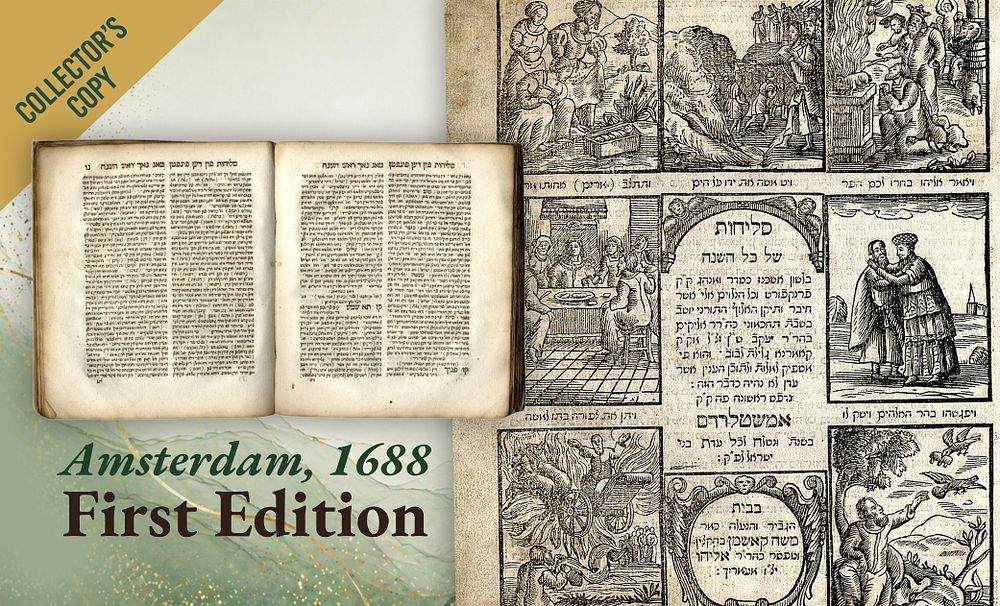
Selichot for Women in Yiddish Translation. Amsterdam, 1688. First Edition. Rare - Order of Selichot for the month of Elul and the High Holy Days, translated into Yiddish, accompanied by a “sufficient explanation of the words and of the meaning of the matter, the like of which has not yet existed, ” by Rabbi Elikim ben Rabbi Yaakov Shatz of Komarno. Before us is one of the early and important prayer books printed especially for women and the common people, who were not proficient in the Holy Tongue. As stated in the approbation of the rabbis of Amsterdam printed at the end of the book, this translation was intended to enable women and ordinary readers alike to understand the words of the Selichot and grasp the meaning of these supplications during the Days of Mercy and Repentance. This is the first edition of Rabbi Elikim’s translation. It achieved notable success, was reprinted several times, and served as the basis for many later translations. Magnificent and Unusual Title Page At the front of the volume is a splendid and striking title page composed entirely of seven delightful miniature woodcut scenes depicting episodes from the Bible. Two of these illustrations relate to female figures—Miriam, sister of Moses, and Zipporah, wife of Moses—a symbolic and moving detail in a book intended in part for women readers. Female Ownership Inscription On the front endpaper appears a handwritten female ownership inscription: “Sarah daughter of the late honorable Keteriel… wife of the late honorable Leib…” A vivid and fascinating testimony to the use of this volume by Jewish women in earlier generations. Before us is a rare prayer book of exceptional social and cultural importance, reflecting the efforts of Jewish communities to make the world of prayer and supplication accessible also to women and to the broader public in seventeenth-century Europe. [1], 79 leaves. 22 cm. Condition: Good to very good. Artistic restoration to the inner blank margin of the title page and to the blank margin of the final leaf. Early vellum binding, slightly worn. Stains.