Bidspirit auction | Archive of Exceptional Importance –
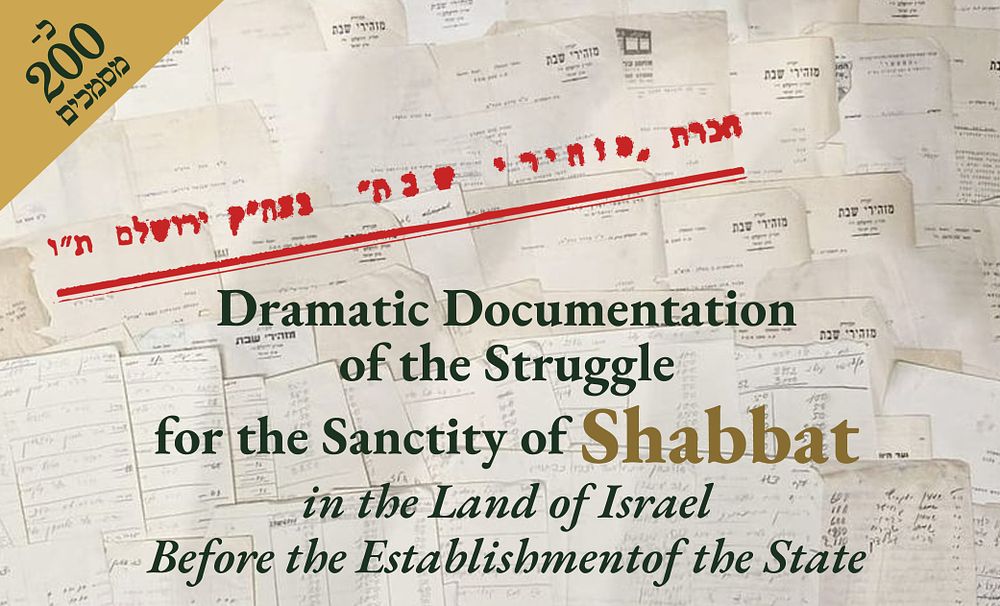
Archive of Exceptional Importance – “Mazhirei Shabbat Society” | Dramatic Documentation of the Struggle for the Sanctity of Shabbat in the Land of Israel Before the Establishment of the State - Historical Item of the Highest Order – A Comprehensive, Fascinating, and Powerful Archive comprising hundreds of original documents: letters, broadsides, and certificates, revealing a dramatic and almost unknown chapter in the struggle to preserve the Sabbath in the Land of Israel. Land of Israel, circa 1930s. A veritable treasure trove of authentic, forceful, and uncensored documentation of the activities of the society Mazhirei Shabbat (“Guardians of the Sabbath”), which stood at the forefront of the campaign to preserve the public sanctity of Shabbat in Jerusalem and throughout the country during the turbulent years preceding the establishment of the State. These papers speak—and at times cry out—with the voices of rabbis, activists, and public figures engaged daily, with determination and devotion, against mounting pressures to breach the boundaries of the Sabbath. Among the hundreds of documents emerges the full picture of a broad public struggle: Severe warning letters to shopkeepers who opened on Shabbat; passionate appeals to persons of influence—landlords, rabbis, and communal leaders; and detailed complaints concerning Sabbath desecration in Jerusalem, Tiberias, and other centers. Each letter stands as living testimony to an uncompromising campaign, written in sharp and sometimes fiery language, without fear or favoritism. The archive also includes rare and especially surprising correspondence: Thus, Meir Dizengoff, a leading secular public figure, is documented as assuring Sabbath activists that no desecration of Shabbat would occur in the Port of Tel Aviv. By contrast, certain official religious authorities in Jerusalem appear hesitant and unwilling to issue clear rulings, citing halachic reasoning described in the documents in language of evident astonishment. Among the rare highlights: • A letter from the Rabbi Yaakov of Husiatyn, written on the official stationery of his father-in-law, Rabbi Yisrael of Husiatyn. • A signed letter from the rabbis of Tiberias—Rabbi Meir Vaknin and Rabbi Yosef Levi Hagiz—concerning Sabbath desecration by buses of Egged. • A rare and nearly unimaginable letter from Rabbi Abraham Isaac Kook on official stationery of Meah Shearim Yeshiva—a noted bastion of ultra-Orthodox zealotry—together with the signature of Rabbi Yosef Gershon Horowitz. • A letter from Rabbi Binyamin Mubashovitz. • Letters addressed to Dr. Wallach of Shaare Zedek Hospital, to Rabbi Isaac Herzog, and to Angel Bakery. • An invitation to the chairman of Mazhirei Shabbat, Rabbi Dov Sokolovsky, disciple of Rabbi Yisrael Meir Kagan, from the commission of inquiry established after the killing of the Sabbath protester Rabbi Pinchas Segalov. • A striking letter to Mr. Moshe Erman stating: “It has been reported that in your house our holy Sabbath is desecrated by the playing of the phonograph and by smoking cigarettes... do not compel us to take measures against you.” Signed by Elkanah Weisenstern, chairman of the society. • A letter from the chairman of Jewish National Fund declaring that the sanctity of Shabbat is not violated in the offices of the organization. Alongside the letters are rare broadsides issued by the committee, among them a particularly striking proclamation bearing the fierce call: “Those who desecrate it shall surely be put to death, and that soul shall be cut off from among its people.” An expression of the intensity of feeling and struggle in those days. Many of the documents remain insufficiently studied and offer fertile ground for further historical discoveries. Together they form a rare mosaic of commerce, society, and religion in the Land of Israel, illustrating how from this determined struggle emerged the famed “status quo” arrangement that continues to shape Israeli public life to this day. As the sanctity of Shabbat is preserved, insofar as possible, within the public sphere of the modern State of Israel, there can be little doubt that the foundations of this reality were laid in the resolute efforts of Mazhirei Shabbat, whose full archive is presented here. A rare and perhaps unrepeated opportunity to acquire an original, powerful, and deeply significant archive—a living, breathing, and stirring witness to the historic struggle that helped shape the character of Shabbat in the State of Israel. More than [200] documents. Various sizes. Overall condition: Good to very good. The Mazhirei Shabbat Society in the Land of Israel “Mazhirei Shabbat” (“Guardians of the Sabbath”) was a general name used for associations established to encourage and strengthen Sabbath observance, inspired by the call of Rabbi Yisrael Meir Kagan, who emphasized the need for organized frameworks to supervise and actively prevent public desecration of Shabbat. During the 1930s,