Bidspirit auction | Ancient and complete Polish Torah
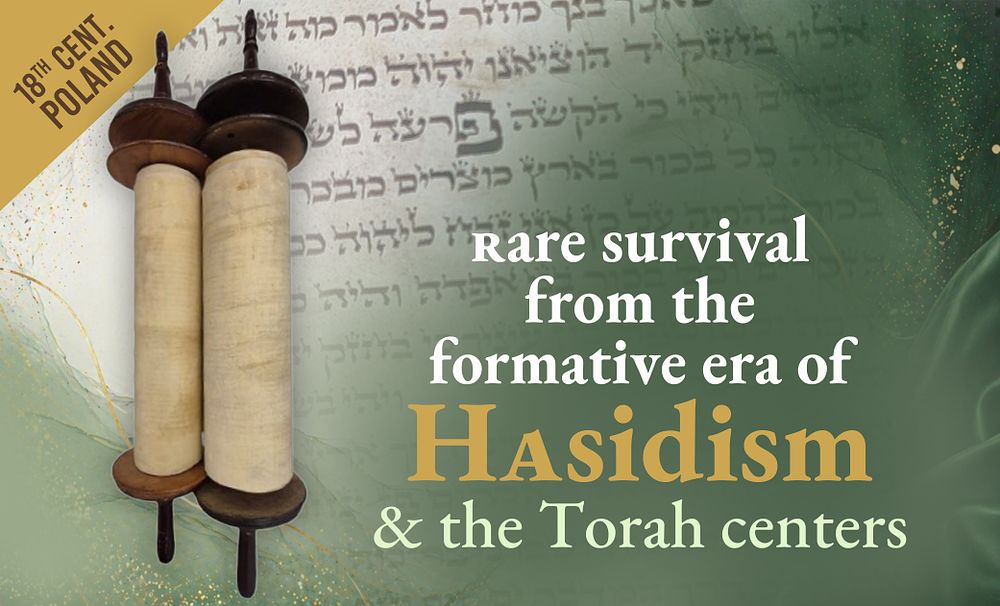
Ancient and complete Polish Torah Scroll – Pre-Hasidic, with influences of the customs of the Arizal. A rare survival from the formative era of Hasidism and the Torah centers of eighteenth-century Poland. - Presented here is an important and early Torah scroll, written in Poland circa the eighteenth century by a single scribe (with one or two membranes replaced), representing a rare link between the older Ashkenazic scribal tradition and the kabbalistic influences that began to spread through Poland and Germany before the rise and consolidation of the Hasidic movement. The scroll was written in the Beit Yosef script tradition, yet it displays clear influence from the customs of the Isaac Luria. This distinctive feature is especially evident in the writing of the Divine Names, where special forms and additional tagin appear in accordance with mystical tradition, including distinctions between the first and second letter Heh. At the same time, the preservation of traditional Ashkenazic letter forms—such as a Tzadi with a straight Yud—suggests that this scroll was likely written for circles of Perushim, kabbalists, or early study houses that preceded organized Hasidism. Another fascinating feature is the limited preservation of the tradition of unusual letters (otiyot meshunot). Thus, in the letter Peh of the word Par‘oh in the portion VeHayah Ki Yevi’acha, the scribe formed a looped Peh, following ancient scribal custom. Even after many Ashkenazic communities ceased such practices, certain early pietistic and Hasidic circles occasionally preserved a small number of these distinctive forms, as seen in old Hasidic Torah scrolls. Examination of the script reveals similarities to the styles of notable eighteenth-century scribes: • Affinity to the hand of Rabbi Rabbi Tzvi Sofer of Medzhybizh, personal scribe of the Israel ben Eliezer, particularly in the broad internal spacing of the letters and the two distinctive tagin atop the Vav of the Lamed. • Similarity to the scribal tradition of Rabbi Rabbi Moshe of Peshawarsk, one of the renowned scribes of the Hasidic world, evident in the Peh with a sharply broken back, the Kuf whose leg ends in a rounded point, and the letters Gimel and Nun joined at the right edge of the head in the old Ashkenazic manner. This Torah scroll reflects a rare transitional era—between the old Ashkenazic scribal world and the rise of Hasidism and practical Kabbalah in Eastern Europe. Height of membranes: 42 cm (some sheets were trimmed; this may not represent the original height). Condition of parchment: the membranes have undergone darkening over time, giving them a brown tone. Some sections remain clean and exceptionally well preserved. Minor repairs, shrinkage to the parchment, and fading of some letters. Sold as not kosher. With early original wooden rollers (Atzei Chaim).