Bidspirit auction | A unique halakhic document in
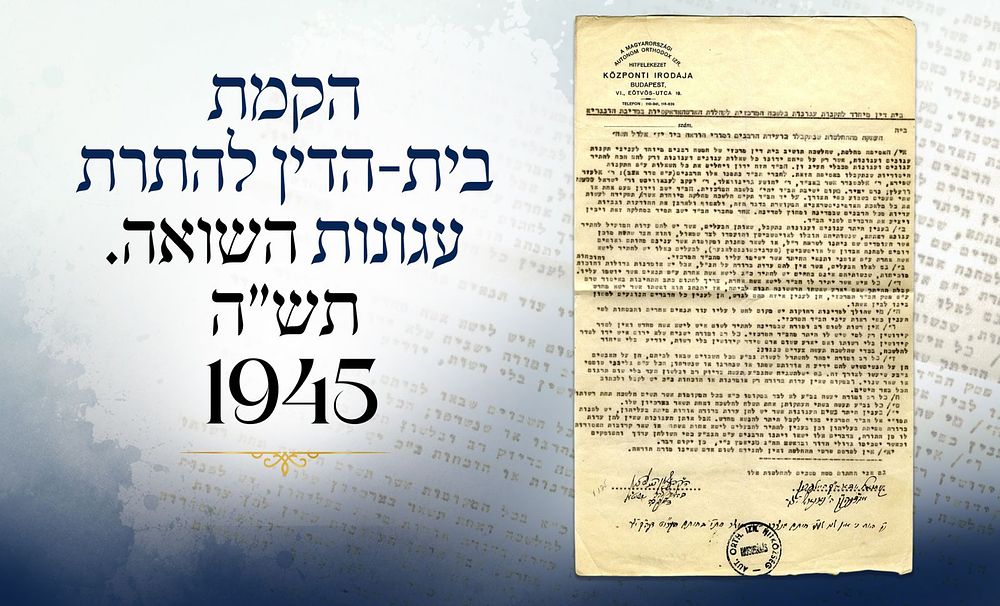
A unique halakhic document in Jewish history, of inestimable importance: the establishment of the Rabbinical Court for permitting the Holocaust agunot. [1945] - “The details of the decision must not be published, nor disclosed to any person”! Foundational document establishing the “Special Rabbinical Court for Holocaust Agunot, ” created by the leading Torah authorities and Jewish leaders of postwar Europe. The document sets forth eleven historic halakhic rulings, intended to guide decisions regarding the marital status of Holocaust survivors who had no information about the fate of their husbands or wives. Hungary, Elul [1945]. Background of the document: After the end of the Holocaust, on May 8, 1945, survivors began returning from the extermination camps—one from a city, two from a family. Men did not know the fate of their wives; women did not know the fate of their husbands. The powerful desire of the survivors—left alone and bereft—to rebuild their lives after the terrible destruction was among the most moving and empowering phenomena of the postwar period. However, this desire brought to the surface one of the most painful, complex, and unprecedented halakhic questions ever faced by the Jewish people. The rabbis who survived the Holocaust understood the immense responsibility placed upon their shoulders—the release of thousands of agunot and agunim—and gave this task the highest priority, even as they themselves were coping with the loss of their families and communities. On the 17th of Elul 5705 (August 25, 1945), approximately three months after the end of the war, leading rabbis and Jewish leaders who had survived the Holocaust—from Hungary, Romania, and Germany—convened. At this gathering, foundational principles and guidelines were established, and special rabbinical courts were created to deal exclusively with the problem of agunot. At that historic assembly, the present foundational document was drafted, in which Jewish leaders outlined the halakhic framework for resolving this extraordinarily complex issue, with the goal of releasing survivors from the bonds of aginut. At the head of the document appear the names of the rabbis appointed to sit on the panel of the court: Rabbi Elazar Shapira, Rabbi Alexander Asher Babád, Rabbi Yehoshua Greenwald, Rabbi Yaakov Segal of Lavovitch, and the renowned gaon Rabbi Yisrael Weltz, of blessed memory—among the foremost authorities on permitting agunot in his generation. Since the creation of heaven and earth, the Jewish people have known no catastrophe like the Holocaust, and accordingly, the halakhic questions that arose in its aftermath were unprecedented. While the issue of permitting agunot had been discussed throughout the generations by the greatest halakhic authorities, it had always concerned individual and specific cases. By contrast, the document before us constitutes a “wholesale” permit of agunot and agunim, Heaven forbid—a system of eleven enactments intended to permit, at once, tens of thousands of agunim who had no information regarding the fate of their wives, including women who: “were taken to Auschwitz and placed on the left side, which was the side designated for those sentenced to burning, God forbid, or sent to other camps… comparable to the extermination camp of Auschwitz (Vernichtungslager)—for husbands of such women, permission should be granted to marry another wife!” (Section b) The document also addresses the tragic possibility inherent in such a broad ruling: that a woman might return, broken in body and soul, after having survived by miraculous means innumerable forms of death, only to discover that her husband of youth—on the hope of reuniting with whom she had sustained herself throughout the years of horror—had meanwhile married another woman, believing his first wife to have perished. With which of the two women would he remain? “Every man… must sign… that if it should occur that his first wife returns to her home, then he and the wife he has newly married shall conduct themselves… regarding which of the two is to be divorced.” (Section d) Because of the sensitivity of the matter, it was determined that the rulings were to remain confidential and not be publicized except to qualified halakhic authorities: “The details of the decision must not be published, nor disclosed to any person who is not a decisor of Jewish law.” (Section 11) Signatories: Rabbi Yekutiel Yehuda Heilperin, Av Beit Din of Nánás, and his son Rabbi Ben-Zion Heilperin. Rabbi Yekutiel Yehuda Heilperin-Helfert was born in 5644 [1884] to his father Rabbi Ben-Zion, Rabbi of Nánás and author of Bnei Tzion. He studied under Rabbi Moshe Greenwald of Khust. He initially served as Rabbi of the city of Ardud, and after his father’s passing in 5679 [1919] was appointed Rabbi of Nánás. During the Holocaust he was deported to Switzerland, and afterward returned to Nánás, where he was active in permitting agunot.