Bidspirit auction | Copy of Two Giants of
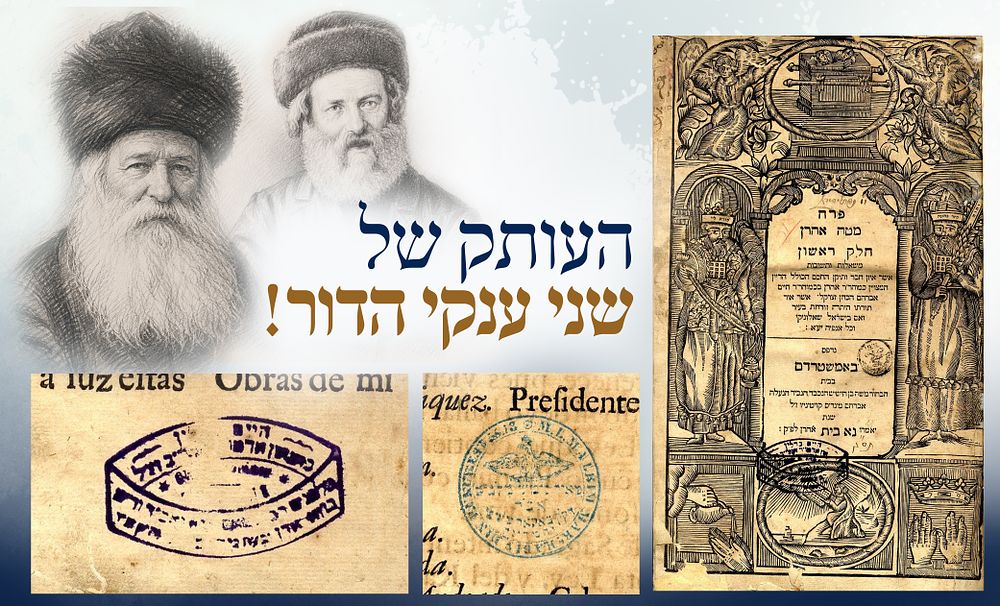
Copy of Two Giants of the Generation — the Malbim and Rabbi Chaim Berlin: Perach Mateh Aharon. First Edition. Amsterdam, 1703 - Perach Mateh Aharon, first edition, two parts bound together with separate title pages. One of the most important and sought-after responsa works of the sages of the Ottoman East. By the gaon Rabbi Aharon HaKohen Perachia, of whom the Chida records in the name of earlier authorities that he appeared as “an angel of God.” Amsterdam, 1703. An exceptionally distinguished copy that belonged successively to two towering Torah leaders: first to Maran Rabbi Meir Leibush Malbim, one of the very few Torah giants whose writings were incorporated into editions of the Mikraot Gedolot; and subsequently to Rabbi Chaim Berlin, son of the Netziv of Volozhin, head of the famed “Mother of Yeshivot” of Volozhin, and later Chief Rabbi of Jerusalem. Both of these illustrious sages left their ownership stamps in the volume. An even earlier rabbinic ownership signature also appears on the title page: “Naftali Hirsch.” Beyond its immense Torah significance—being one of the responsa works most frequently cited and discussed in halachic literature for more than three centuries—the book is renowned among bibliographers for its magnificent engraved title pages, considered among the finest achievements of Hebrew book design. As noted: “Its title page is ornamented and is among the most beautiful of all printed Hebrew title pages.” (Am HaSefer, “Library of the Rambam”) A complete and rare copy, including both celebrated title pages, the Italian-language leaves at the beginning of the volume, and the index leaves at the end. Physical Description [3], 249; [3], 168 leaves. 31.5 cm. Printed on dark, thick, high-quality paper. Ownership stamps of the Malbim and Rabbi Chaim Berlin appear on the leaf following the title page; an additional stamp of Rabbi Chaim Berlin appears in the margin of leaf 210a. Condition: Good. Signs of use. Minor tears to the margins of the title pages. Old reinforcement repair on the verso of the first title page. Massive half-leather binding. Bibliographical Note The engraved title pages of both parts rank among the most celebrated and extensively studied title pages in the history of Hebrew printing. At the top appears the Ark of the Covenant, flanked by figures of priests dressed in full priestly garments. At the bottom are hands raised in the Priestly Blessing alongside an illustration of the ritual washing of a priest’s hands. In the center appears the author holding the Tablets of the Law and facing the sea—a reference to the port city of Salonika, where he served as chief rabbi. These remarkable title pages have attracted the attention of scholars of Hebrew bibliography and Jewish art for generations. Biography Rabbi Aharon HaKohen Perachia (1627–1697) was among the leading sages of Salonika in his generation, serving as dayan, rosh yeshivah, and one of the foremost halachic authorities of the Sephardic East after the Chmielnicki massacres. He was the outstanding disciple of Rabbi Chasdai HaKohen, author of Torat Chesed, whom he frequently refers to as “my master and teacher.” The Chida records that earlier authorities described his appearance as “that of an angel of God.” His Perach Mateh Aharon is among the most important responsa works produced by the sages of the East. He also authored Bigdei Kehunah, Pirchei Kehunah, and Zikhron Devarim. Rabbi Meir Leibush Weiser — the Malbim (1809–1879), one of the greatest commentators on Tanach and among the foremost leaders of Eastern European Jewry. Known from youth as the “Illui of Volhynia, ” he served in major rabbinical positions throughout Europe and fought vigorously against the Reform movement. He was also versed in Kabbalah and studied under the renowned Rebbe Rabbi Tzvi Hirsch of Zidichov. His commentary to Tanach became a foundational work throughout the Jewish world and remains one of the cornerstones of the traditional Jewish library. Rabbi Yosef Dov Soloveitchik of Brisk (Beit HaLevi) remarked that his works were “written with Divine inspiration to arrive at the true meaning of Torah.” Rabbi Chaim Berlin (1832–1912), eldest son of the Netziv of Volozhin and one of the leading Torah figures of his generation. He served as rabbi of Volozhin, Moscow, and Jerusalem, and headed the Volozhin Yeshivah alongside his father. In 1906 he immigrated to Eretz Israel, and following the passing of Rabbi Shmuel Salant was appointed Chief Rabbi of Jerusalem and spiritual leader of its Ashkenazic community. He was among the foremost figures of Lithuanian Torah leadership at the close of the nineteenth and beginning of the twentieth century. A highly important work, both Torah-wise and bibliographically; an especially distinguished copy that belonged to two of the greatest Torah giants of the modern era — the Malbim and Rabbi Chaim Berlin.