Bidspirit auction | Manuscript of Shulchan Tahor, Part
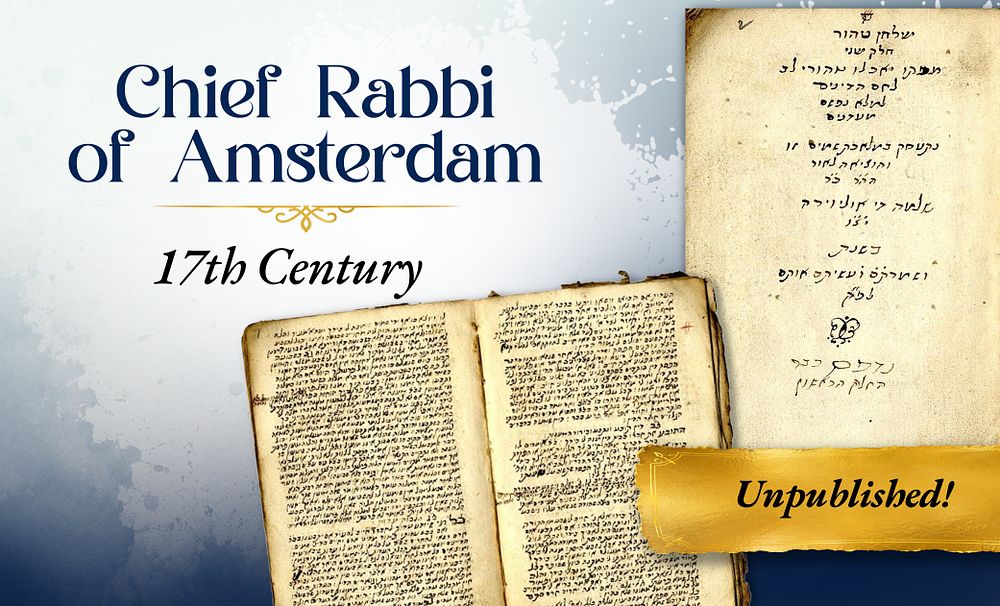
Manuscript of Shulchan Tahor, Part II, by Rabbi Shlomo de Oliveira, Chief Rabbi of Amsterdam — 17th Century; Signed Autograph; Unpublished - Complete Autograph Manuscript of Shulchan Tahor, Part II – a comprehensive halachic work on the laws of marriage and rabbinical jurisprudence, authored by the eminent sage Rabbi Shlomo de Oliveira, Rosh Yeshivat Ets Haim and Chief Rabbi of the Sephardic community of Amsterdam. [Amsterdam], year ”Ushmartem Va'asitem Otam” – 5446 [1686]. Presented here is one of the most important and rare Judaica manuscripts to survive from the scholars of seventeenth-century Amsterdam: a complete halachic work, from beginning to end, which has never been printed—more than three hundred and thirty years after its composition. The manuscript contains an ornamental title page, a signed and dated autograph introduction, indexes, a colophon, and numerous corrections and annotations in the author's own hand throughout the margins. This is the original printer’s manuscript prepared by the author himself. Tragically, shortly after completing the work, Rabbi de Oliveira passed away and did not merit to see it in print. For centuries, the manuscript was preserved in some of the world's most important collections and libraries, and is now offered for sale for the first time. The work was intended as a second volume to Shulchan Tahor by the distinguished scholar Rabbi David Pardo, one of the most important and widely used halachic compendia of earlier generations. The first volume was printed in dozens of editions throughout Europe and the Middle East, including Amsterdam, Frankfurt, Dyhernfurth, Fürth, Vienna, Salonika, Jerusalem, Warsaw, Vilna, Hungary, and the United States. In some editions the title appears as Ha-Shulchan Ha-Tahor rather than Shulchan Tahor. While it is uncommon for one author to publish a second volume to another author's work under the identical title, the autograph introduction reveals that Rabbi Shlomo regarded himself as the editor who had prepared the first volume for publication [his approbation appears at the beginning of the printed edition; see accompanying illustration]. He therefore considered it appropriate to complete the project by composing its second part, as he writes in the introduction to this manuscript: “After I corrected and prepared for the printing press the first volume of laws... my heart moved me to complete the task with a second volume of laws, including the laws of marriage and judicial procedure, thereby completing this table (shulchan).” Rabbi Shlomo clearly viewed this work as one of the crowning achievements of his scholarly career. In his introduction, he compares his undertaking to the Shulchan Aruch of Rabbi Yosef Karo, writing: “This is the table upon which all manner of delicacies are set, standing upon four legs, according to the order of the Shulchan Aruch, upon which all the eyes of Israel are fixed.” At the conclusion of the work appears an acrostic: “Shulchan Tahor Aruch Before all who know the faith; Filled is the harvester’s palm; It is a double tablet of the heart. Loving the straight path; By night it proceeds and gives light; By day it teaches morality; Draw it from the river.” Yet it was precisely this composition—regarded by its author as one of his most significant literary accomplishments—that never reached the printing press and remained hidden in manuscript form until today. Specifications [46] pages. 16 × 11 cm. Autograph manuscript, with marginal corrections and annotations. Sephardic script (semi-cursive Sephardic hand). Very good condition. Provenance Collection of Rabbi Shlomo Joachim Chaim Halberstam (Shzachah), Manuscript 114. Montefiore Library, London — Ms. 145. Described in: H. Hirschfeld, Descriptive Catalogue of the Hebrew Manuscripts of the Montefiore Library, London, 1904. Fully digitized as part of the National Library of Israel’s Ktiv manuscript project. Biography Rabbi Shlomo ben David de Oliveira (5395–5468 / 1635–1708), Chief Rabbi of Amsterdam, was born into a family of former conversos. He studied under Rabbi Menasseh ben Israel and Rabbi Saul Levi Morteira. Following the passing of Rabbi Jacob Sasportas in 1698, Rabbi de Oliveira was appointed Chief Rabbi of the Sephardic community of Amsterdam and head of the renowned Ets Haim Yeshiva. During his tenure, the custom began whereby yeshiva students composed written responsa and scholarly essays, a practice that eventually led to the publication of the periodical Peri Ets Haim in 1728. A prolific author, Rabbi de Oliveira produced numerous significant works in Talmudic methodology, biblical cantillation, and other areas of Torah scholarship, including Ayyelet Ahavim, Darkei Hashem, Darkei Noam, Zayit Ra'anan, Ta'amei HaTa'amim, Ets Haim, and many others. He also provided approbations for the works of contemporary rabbis. The Chida mentions several of his books,